
By Evan Christensen · Owner, The Barn Door Hardware Store
Published September 8, 2024 · Updated June 2026
Evan has owned and operated The Barn Door Hardware Store since 2016. Bifold vs bypass is one of the most common "which setup" questions he works through with customers — it comes down to how the doors clear the opening, how far they sit off the wall, and how much room you have in front of them. He and the team are available 7 days a week at info@thebarndoorhardwarestore.com.
Bifold and bypass barn doors solve the same problem: covering an opening when you don't have the full door width of clear wall beside it that a single sliding door needs to travel. They solve it in different ways, and the right one comes down to a few concrete differences — how the doors clear the opening, how far they sit off the wall, and whether you have room in front of the opening. This guide compares the two head to head. If you also want single track sliding in the picture, start with our full sliding vs bypass vs bifold guide.
How bifold barn doors work
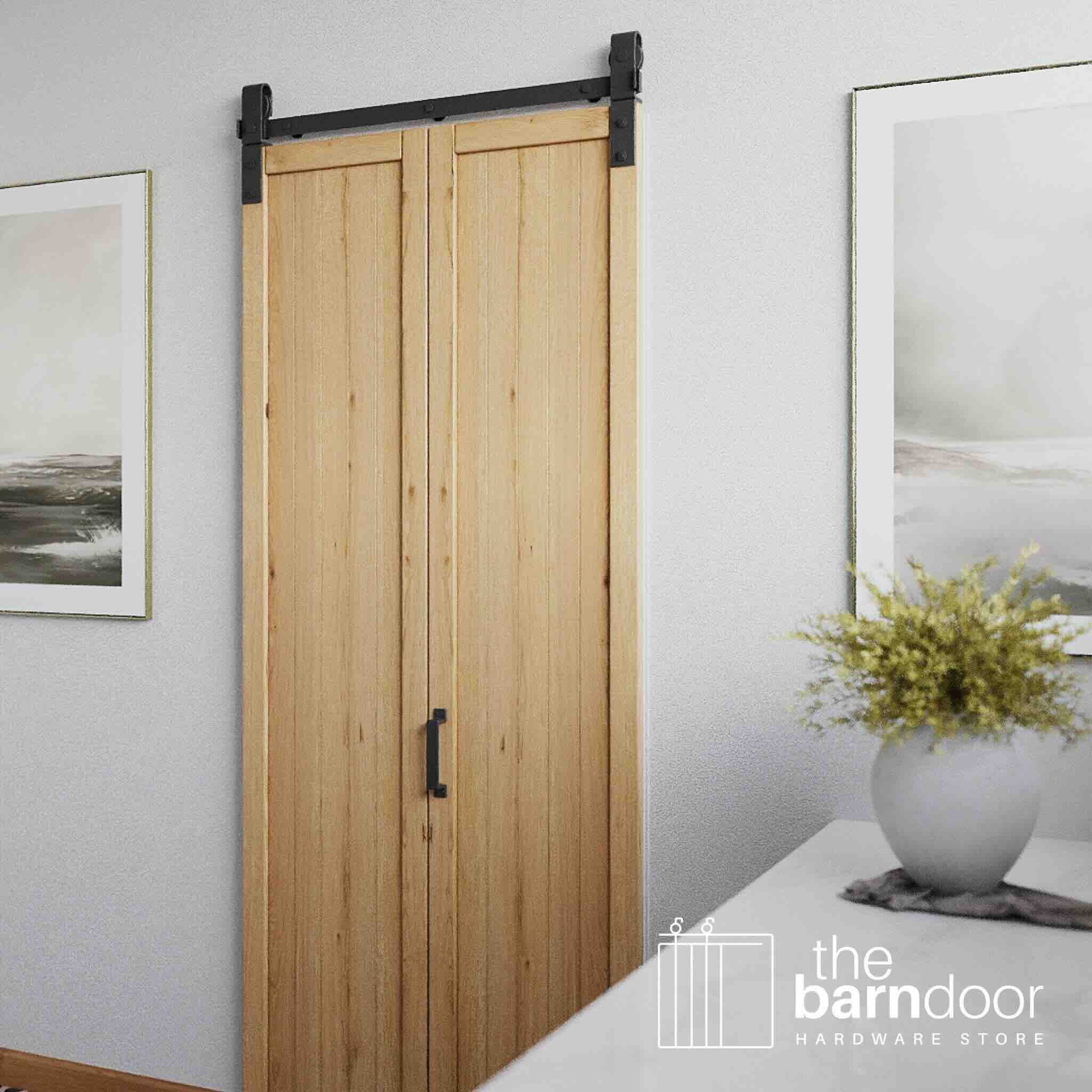
Bifold barn door hardware folds panels accordion-style along a wall-mounted track. One end of the assembly slides along the track while the other pivots from a fixed bracket, so the panels concertina together and stack compactly beside the opening rather than sliding fully past it. That compact fold is why bifold works where there isn't enough clear wall for a standard sliding door to travel.
It comes in two configurations. One-way folds all panels to a single side — the right call when clearance only exists on one side of the opening. Biparting folds panels to both sides from the center, which gives a symmetrical look and clears the opening on both sides.
Two things define the bifold experience. First, the panels project out from the wall as they fold, so you need enough clearance in front of the opening for them to swing without hitting furniture or a wall return. Second, bifold sits close to the wall — about 1/2 in off it, barely more than a single sliding door's 3/8 in, and far tighter than a bypass setup. That tight standoff means a smaller perimeter light gap and better privacy, which makes bifold a strong choice for closets, laundry rooms, and pantries.
How bypass barn doors work
Bypass configurations use two to four doors that slide past each other and stack in front of the opening instead of beside it. That's the advantage over a single sliding door: a bypass can cover a wide opening without needing clear wall on either side for the panels to park. There are two kinds.
Single bypass runs the doors on one shared track, where they telescope — only two doors pass each other at a time. With the correct track length (3x the door width for a 2-door setup), the telescoping doors slide fully aside and clear the whole opening, even with limited wall on one side — and because they share one linked track, single bypass constrains sway better than a double bypass on two independent tracks, which makes it well suited to holding a wide opening clear. The one tradeoff is a closed-position trait, not an opening one: the doors overlap each other in the center when shut (6 in with standard rollers, 9 in with spoke wheel rollers), so they close with a slight offset rather than sitting flush. That overlap closes the center gap for coverage and privacy; it doesn't reduce how far the doors open. One usability upside — the doors are linked through the telescoping action, so pushing one eventually engages the next, and you only operate one door to open the whole setup.
Double bypass runs the doors on two parallel tracks, so they stack completely in front of each other and the full opening clears at once. Both sides of a pass-through stay accessible at the same time, which makes double bypass the usual pick for hallways, room dividers, and any opening that needs to work from both sides. The track is also the only one of the two bypass styles offered with soft close.
The thing to know on privacy: a bypass door rides on an outer track that holds it more than 2 in off the wall — a noticeably bigger perimeter gap than bifold's 1/2 in.
Bifold vs bypass at a glance
| Bifold | Single bypass | Double bypass | |
|---|---|---|---|
| Wall space needed beside opening | Minimal — folds compactly | Minimal — telescopes | Minimal — stacks in front |
| Clears the full opening | Yes (one or both sides by config) | Yes — with correct track length | Yes — full stacking |
| Pass-through access | One or both sides by config | One side at a time | Both sides at once |
| Center overlap when closed | None | 6 in or 9 in | None |
| Wall standoff (privacy) | 1/2 in — tight | More than 2 in | More than 2 in |
| Soft close available | No | No | Yes |
| Panels project into the room | Yes — fold outward | No | No |
How to choose between them
Start with the opening and the room in front of it, not the look.
Choose bifold when clear wall is limited on both sides, you want the door sitting close to the wall for privacy, and you have room in front of the opening for the panels to fold out. Choose single bypass when you're covering a wide opening with limited wall on one side and a permanent center overlap is acceptable — that is, you don't need the entire opening clear at once. Choose double bypass when you need the full opening clear and pass-through from both sides, like a hallway or room divider, and you want soft close.
Two outside cases worth flagging. If you actually have the full door width of clear wall on one side, a single sliding door is simpler than either of these — see the full configuration guide. And if there's no header wall to mount into, ceiling mount rules bifold out — it isn't compatible with bifold, so a bypass setup (or a single sliding door) is the way to go there.
Sizing basics for each
Once you've settled on a setup, the sizing differs. Here's the starting point — confirm the exact figure for your kit against its instruction manual before ordering.
Bifold. Track length equals the total door panel width, not the opening width. For a 2-panel one-way bifold that fully clears the opening, total panel width should be at least the opening + 6 in (5 in on the pivot side, 1 in on the non-pivot side). For a symmetrical biparting setup, total panel width should be at least the opening + 10 in (5 in per side). The full formulas are in our bifold barn door measuring guide.
Bypass. For a 2-door single bypass, each door should be (opening + 10 in) ÷ 2 for standard rollers. For a 2-door double bypass, each door should be (opening + 6 in) ÷ 2. In both cases, track length should be 3x the door width to fully clear the opening. For 3- and 4-door configurations, see our bypass barn door hardware, or email us for the exact track length.
Keeping either setup running smoothly
Both bifold and bypass hardware runs on sealed bearings that run dry. Do not lubricate the track or rollers — no silicone spray, WD-40, or grease. Lubricant attracts debris, builds up in the channel, and increases rolling resistance over time.
A door that's sticking or getting noisy is almost always track debris or a door that's hanging out of level, not a lubrication problem. Wipe the track channel out with a dry cloth (a damp cloth followed by a dry wipe handles stubborn grime), check that the door hangs level, and retighten the mounting hardware periodically. If a roller is genuinely worn, replace it rather than trying to lubricate it. To seal a closet door against light or dust, use a pile or brush weatherstrip on the edges — not a rubber compression seal, which drags on a moving door and wears unevenly.
Common questions
Which is more private, bifold or bypass? Bifold. It sits about 1/2 in off the wall — close to a single sliding door's 3/8 in — so the perimeter light gap is small. A bypass door rides an outer track that holds it more than 2 in off the wall, a noticeably bigger gap. For a closet, laundry, or pantry where you care about light and privacy, bifold is the tighter setup.
Can a bypass setup fully clear the opening? Both can, with the track sized correctly (3x the door width for a 2-door setup). On a single bypass, the 6 in / 9 in center overlap is how far the doors overlap each other when closed — not an obstruction left in the opening — so the telescoping doors still slide fully aside. A double bypass clears the opening too and, on its two parallel tracks, closes flush with no center overlap and opens both sides of a pass-through at once.
Is soft close available on both? Only on double bypass. Bifold and single bypass are not offered with soft close.
Do bifold panels need clearance in front of the opening? Yes. The panels project into the room as they fold, so you need room in front of the opening for them to swing — furniture, an appliance, or a wall return in the panel's arc is the most commonly overlooked issue. Bypass doors don't have this, since they stay parallel to the wall as they slide.
Still deciding?
Email us at info@thebarndoorhardwarestore.com with your opening width and a description of the wall beside it — how much clearance you have on each side, and how much room there is in front of the opening. We can usually confirm bifold or bypass in one reply. Available 7 days a week.
Browse our bifold barn door hardware, single bypass barn door hardware, and double bypass barn door hardware. Outfitting a closet specifically? See our closet door slider hardware guide.
