
By Evan Christensen · Owner, The Barn Door Hardware Store
Published February 16, 2024 · Updated April 2026
Evan has owned and operated The Barn Door Hardware Store since 2016. Helping customers decide whether a barn door is actually the right choice for their space is one of the most common conversations his team has — and being honest about the limitations is part of that. He and the team are available 7 days a week at info@thebarndoorhardwarestore.com.
Barn doors are the right solution in specific situations — and the wrong one in others. We sell barn door hardware for a living, so we obviously think they're worth buying when the fit is right. But the fit isn't always right, and the most useful thing we can do is help you figure that out before you order, not after.
This guide covers the real pros and cons — the ones that should actually inform your decision — with specific guidance on the situations where each matters most.

The pros of barn doors
Space saving — specifically swing clearance
The original reason barn doors exist: a hinged door requires a clear arc of floor space to swing open. In a tight bathroom, narrow hallway, or pantry where furniture or walls are close to the opening, that swing clearance either doesn't exist or forces compromises on furniture layout. A barn door slides parallel to the wall and requires no swing clearance at all — just wall space beside the opening for the door to travel into.
This is the single most useful thing a barn door does better than a hinged door. If swing clearance is your problem, a barn door solves it cleanly.
Aesthetics — a visible design element, not just a door
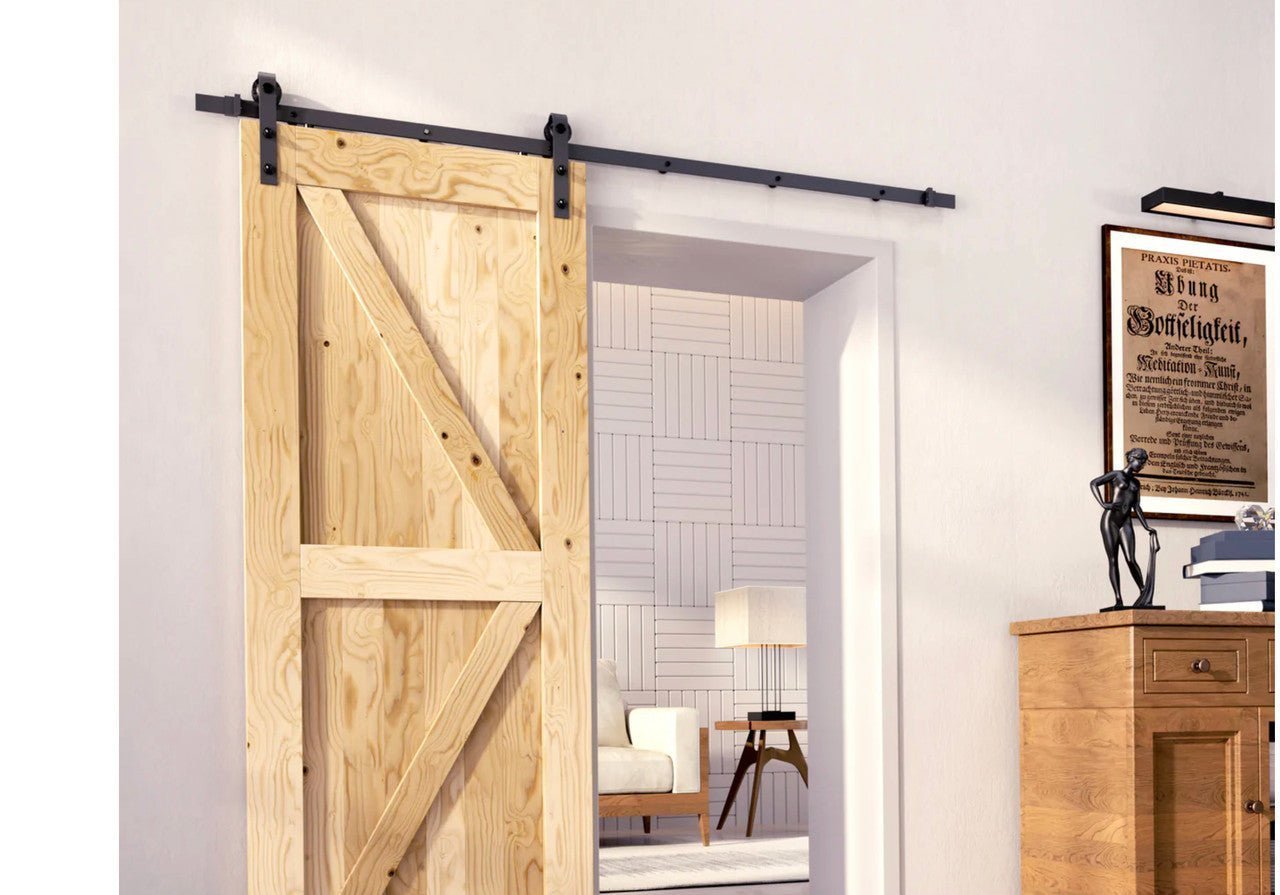
A barn door is visible hardware — the track, the hangers, and the door panel are all part of the look. Done well, this is an advantage: the hardware becomes a design element rather than something to hide. We carry hardware in a wide range of styles and finishes, from minimal straight-strap designs in raw stainless to decorative wagon wheel hangers in all 17 Goldberg Brothers finish colors. The door itself is usually sourced locally and can be almost any panel material. Browse our hardware collections for the full range.
Configuration flexibility for wide openings
For openings too wide for a single door — room dividers, wide closets, open-plan transitions — barn door configurations scale well. Bypass and bifold configurations handle openings from 4 ft to well over 12 ft. A hinged solution for the same width would require multiple doors and more wall space for swing clearance.
The cons of barn doors
Wall space is required
The most common installation problem: a barn door needs clear wall space beside the opening equal to the full door width. A 36 in opening needs a 40 in door, which needs 40 in of unobstructed wall to slide fully open. Light switches, outlets, windows, corners, and built-ins all block this travel path. Before ordering, walk the full path the door will need to travel and confirm there's nothing in the way.
If wall space is limited on both sides, bypass hardware or bifold hardware are alternatives that require less lateral clearance.
Privacy is limited — but addressable
A barn door doesn't fill a door frame — it slides in front of an opening, which means there are gaps at the edges and the door sits 3/8 in off the wall, creating an air path around the perimeter. For pantries, hallways, and living spaces, this doesn't matter. For bathrooms and bedrooms, it needs to be managed.
The practical solutions: size the door with 3 in of overlap per side (not the standard 2 in) to reduce edge gaps, add a latch to keep the door from sliding open, and use jamb-up pile weatherstrip at the edges to reduce light bleed. None of these fully replicate the seal of a hinged door in a frame, but together they're adequate for normal residential bathroom and bedroom privacy.
We carry five latch types for barn doors — from simple flip latches to the Goldberg Brothers paddle mechanism. Browse our locks and latches collection for the full range. For more on privacy specifically, see our barn door privacy guide.
Sound transmission is higher than a hinged door
The edge gaps and wall offset that limit privacy also limit sound isolation. Pile weatherstrip at the edges helps meaningfully. The wall offset gap — 3/8 in running the full perimeter — cannot be sealed. For most bedrooms and bathrooms this is a manageable tradeoff. For spaces where sound isolation is a hard requirement (a home recording space, a bedroom on a noisy shared wall), a properly sealed hinged door will always outperform a barn door. This is worth being honest about before committing.
For the full breakdown of what works and what doesn't, see our barn door soundproofing guide.
Not suitable for exterior weather sealing
Barn doors are not designed to seal against weather — they're external-mount sliding panels with intentional gaps around the perimeter. For exterior applications, stainless steel hardware is the only option we carry that's rated for outdoor and coastal environments. But hardware durability is a separate question from weather sealing: even with stainless hardware, a barn door will not seal against rain, wind, or significant temperature differentials the way a properly fitted exterior hinged door would. If weather sealing matters for your application, a barn door is the wrong door type regardless of hardware.
How to decide
A barn door is the right choice when:
- You have swing clearance problems that a sliding door solves
- You have adequate wall space beside the opening for the door to travel
- The visible hardware is an asset to the design rather than something to hide
- Privacy requirements are manageable with a latch and weatherstrip
A barn door is the wrong choice when:
- There's no clear wall space beside the opening and bypass or bifold don't solve it
- Sound isolation is a hard requirement
- Weather sealing is needed (exterior, exposed installations)
- The opening genuinely needs the seal of a hinged door in a frame
If you're on the fence, the most useful thing to do is measure your wall space first. If the math works — enough clear wall for the door to travel — most other concerns are manageable. If the wall space isn't there, no amount of hardware selection will fix it.
Not sure if a barn door works for your opening?
Email us at info@thebarndoorhardwarestore.com with your opening dimensions, available wall space on each side, and what you're trying to achieve. We'll tell you whether a barn door is the right solution — and if not, what is. Available 7 days a week.
