
Bifold barn door hardware folds panels accordion-style along a wall-mounted track — the right solution when wall clearance beside the opening is limited and a standard sliding door can't slide fully out of the way. Available in Goldberg Brothers and Quick Ship, in one-way and biparting configurations, with sizing rules that differ significantly from standard sliding hardware. Read our bifold measuring guide before selecting a track length. Not sure between 2-door and 4-door? Use our hardware finder.

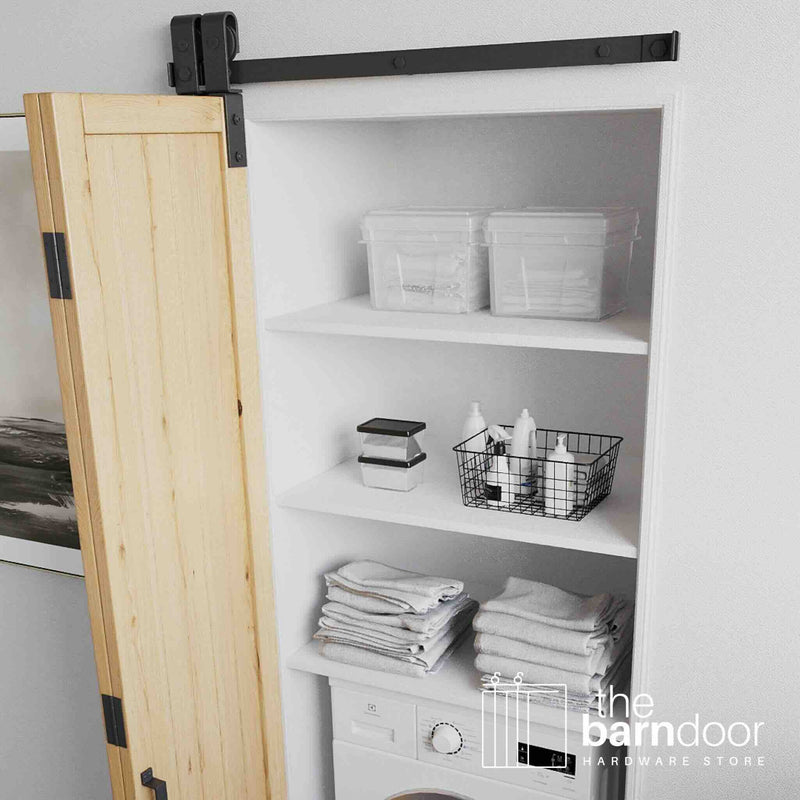

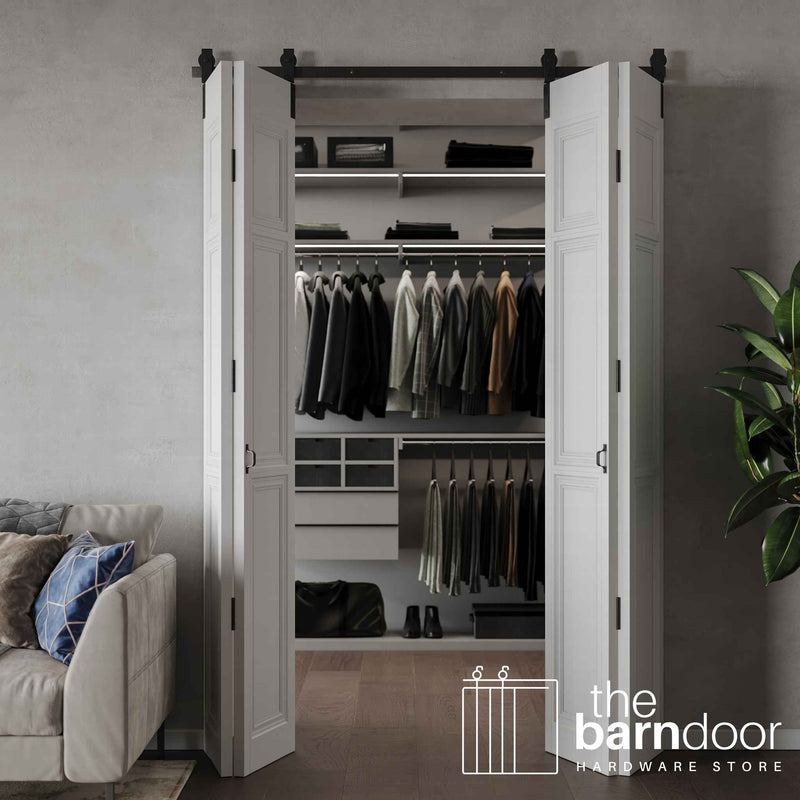


Bifold barn door hardware is the right choice when wall clearance beside the opening is limited — closets, pantries, laundry rooms, and wide openings where a single sliding panel won't fully clear. Instead of sliding to one side, bifold doors fold and stack on a pivot system — the panels accordion toward the side of the opening rather than traveling along the wall. If you have the wall space for a standard slider, standard sliding hardware is simpler. If you don't, bifold solves it.
Goldberg Brothers bifold kits include handles — the only kit type in our lineup where handles come standard. Quick Ship bifold kits do not include handles. Kits are available in Goldberg Brothers and Quick Ship, across standard and heavy duty tiers. Sizing is the most important decision before ordering — the track length and overlap calculations are different from sliding hardware and are covered in detail below.
One-way vs. biparting — which configuration do you need?
Before selecting a kit, decide where you want the doors to stack when open. That decision determines which configuration is right for your opening.
| Configuration | How it works | Best for |
|---|---|---|
| Biparting | Doors fold from the center — half the panels stack to each side | Openings where wall clearance exists on both sides; naturally symmetrical look when open and closed |
| One-way | All doors fold and stack to one side | Openings where clearance only exists on one side; allows full panel coverage from a single pivot point |
The symmetry question for one-way setups
If you're using a one-way configuration, decide before ordering whether you want the installation to look symmetrical over the opening when the doors are closed. A symmetrical one-way setup uses equal panel widths on both sides of the opening even though all panels stack to one side — this requires more total door width and a longer track than an asymmetrical setup, but it looks intentional rather than offset. If symmetry matters to your project, plan for it before you size your doors and track.
| Configuration | Doors | Max opening | Browse |
|---|---|---|---|
| 2-door bifold | 2 | 93 in | 2-door bifold |
| 4-door biparting | 4 | 188 in | 4-door biparting |
| 4-door one-way | 4 | 189 in | 4-door one-way |
| 6-door one-way | 6 | 285 in | 6-door one-way |
| 8-door biparting | 8 | 380 in | 8-door biparting |
| 12-door biparting | 12 | 572 in | 12-door biparting |
Max opening shown is the heavy duty maximum. See each collection for standard-duty coverage, sizing formulas, and pricing. For doors heavier than standard duty or thicker than 1-3/8 in, see our heavy duty bifold collection.
For a complete guide to the 2-door bifold — how it works, sizing, and how it differs from the 4-door biparting — see our 2-door bifold guide. For a comparison of bifold alongside biparting and bypass configurations, see our double barn door guide.
Sizing — the most important step before ordering
Bifold track length is based on total door width — not the rough opening. Measure your door panels, not the hole in the wall. All systems are external mount.
2-door bifold sizing
| Goal | Total track coverage needed | Overlap breakdown |
|---|---|---|
| Minimum coverage (doors close over opening) | Opening width + 3 in | 2 in on pivot side, 1 in on non-pivot side |
| Fully clear opening — asymmetrical | Opening width + 6 in | 5 in on pivot side, 1 in on non-pivot side |
| Fully clear opening — symmetrical (recommended) | Opening width + 10 in | 5 in on each side |
4-door biparting sizing
| Goal | Total track coverage needed | Overlap breakdown |
|---|---|---|
| Minimum coverage | Opening width + 4 in | 2 in on each pivot side |
| Fully clear opening | Opening width + 10 in | 5 in on each pivot side |
The full pre-order measurement checklist (door width, height, wall clearance, ceiling clearance) applies to bifold hardware as well — see our barn door measuring guide.
Weight capacity and door thickness
| Brand / tier | Capacity | Door thickness |
|---|---|---|
| Goldberg Brothers — standard duty | 62½ lbs per panel | 1-1/4 in to 1-3/8 in |
| Goldberg Brothers — heavy duty | 200 lbs per panel | 1-3/8 in to 2-1/4 in |
| Quick Ship | 90 lbs per panel / 220 lbs total system | 1 in to 1-3/8 in (J-strap) · 1 in to 2 in (J top mount) |
If you're not sure how much your door panels weigh, a solid pine panel at typical interior door dimensions runs 50–80 lbs depending on thickness. A solid hardwood or thick engineered panel can run significantly heavier. When in doubt, weigh the panel or email us at info@thebarndoorhardwarestore.com the dimensions and material — we'll give you a reasonable estimate before you order.
Brands and finish options
Both Goldberg Brothers and our Quick Ship line are available in this collection. The same honest difference applies here as across our other hardware: Goldberg Brothers hardware is made to order with tighter engineering tolerances, per-piece inspection, and better long-term durability. The Quick Ship line ships in 2–3 business days and costs less — the right call for budget-driven projects with lighter panels.
Goldberg Brothers bifold kits are available in all 17 finishes — the full range including economy, standard, upgrade, and designer colors. Quick Ship is available in matte black and brushed nickel only.
Wheel options on heavy duty bifold
Heavy duty bifold kits come with steel wheels by default, color-matched to your hardware finish. Delrin wheels are available as an upgrade — they run significantly quieter than steel, which matters on a bedroom closet or any install where noise is a consideration. Two tradeoffs: Delrin wheels are only available in black regardless of finish, and they're only suitable for panels under 100 lbs. If your panels exceed 100 lbs, stick with steel.
What's in the kit
Goldberg Brothers bifold kits include the track, pivot hardware, rollers, mounting hardware, and handles. Quick Ship kits include all hardware components except handles — handles are a separate purchase if you go with Quick Ship. See our handles collection for options.
A solid header above the opening is required for track mounting — the same requirement as all wall-mounted barn door hardware. Unlike standard sliding configurations, ceiling mount is not a compatible option for bifold hardware. No soft close option is available for any bifold configuration.
Note: Goldberg Brothers bifold kits include a wall-mounted bottom pivot on the pivot side. Quick Ship kits include a floor-mounted pivot. If your cabinet or installation has no floor surface beneath the door to mount a pivot into, choose the Goldberg Brothers kit.
Questions before ordering?
Email us at info@thebarndoorhardwarestore.com with your opening width, wall clearance on each side, and whether you need a one-way or biparting configuration — we'll confirm the right kit, sizing, and whether Goldberg Brothers or the Quick Ship line is the better fit for your project. Available 7 days a week.
