
Single bypass hardware runs two to four doors on one shared track — and because the doors telescope sequentially, the system can fully clear an opening even with limited wall space on one side. Quick Ship line only, rated to 220 lbs total system weight, in matte black and brushed nickel. The sizing and overlap rules are specific to this configuration — the guide below covers them in full. Not sure which bypass configuration fits your opening? Use our hardware finder.

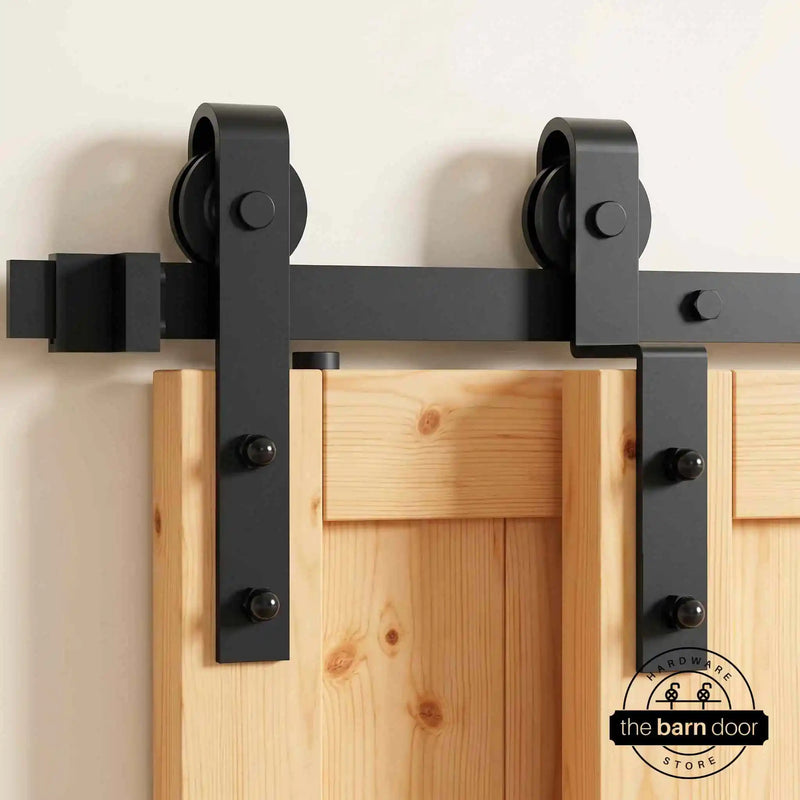


Single bypass hardware puts two or more doors on one shared track, with each door hanging at a different depth so they can pass each other without colliding. This collection is Quick Ship only — there is no Goldberg Brothers option at this configuration. For heavy doors over 220 lbs total system weight, bypass isn't the right configuration regardless of brand.
The defining feature of single bypass is telescoping functionality. Because both doors run on the same track, when one door's travel is exhausted — it reaches the end of its range — it engages the other door and carries it along. This creates a smooth, sequential opening motion across the full span rather than requiring each door to be moved independently. This makes single bypass the best choice for wide openings where telescoping functionality is the goal, not just door coverage.
How two doors share one track
The key is the hanger design. One door hangs on a standard hanger close to the track. The second door uses a bent "stair-step" hanger that offsets it forward — positioning it at a different depth from the track so both doors can travel the full length without making contact with each other.
The result is two doors that look like a standard sliding setup from the front but operate on a single track. Because both doors run on the same track, when one door reaches the end of its travel it engages the other and carries it along — that's the telescoping effect. The doors don't move in constant unison; one travels first until its range is exhausted, then the second door gets pulled into motion.
This is particularly useful for wide built-in openings — entertainment centers, room dividers, wide closets, and pantries — where you want one smooth motion to open or close the entire span rather than moving each door independently.
Track length — pass-through vs. clear opening
Single bypass track length depends on one decision you need to make before ordering: do you want the doors to partially clear the opening, or fully clear it?
Pass-through configuration
In a pass-through setup, you slide one door to one side to access roughly half the opening — the other door stays in place. The track only needs to be slightly longer than the opening width. This works for wide openings where partial access is all you need and wall space is limited.
Clear opening configuration
If you want both doors to fully retract and leave the entire opening unobstructed, the track length calculation depends on how many doors you're using:
| Number of doors | Track length formula | Example (36 in doors) |
|---|---|---|
| 2 doors | 3× door width | 3 × 36 in = 108 in track |
| 3 doors | 5× door width | 5 × 36 in = 180 in track |
| 4 doors | 6× door width | 6 × 36 in = 216 in track |
For the full single vs. double bypass comparison, see our single vs. double bypass guide. For all bypass sizing formulas in one place, see our bypass measuring guide.
Door overlap when closed
Because both doors share one track at different depths, they overlap at the center when closed — they can't meet flush edge-to-edge the way doors on separate tracks can. The amount of overlap depends on the hanger style:
- J-strap and straight strap hangers: approximately 6 in overlap at center
- Spoke wheel hangers: approximately 9 in overlap at center — the larger wheel diameter requires more offset between doors
For most applications the overlap is a minor visual consideration, not a functional one. Neither single bypass nor double bypass can achieve a center seal or flush closure — that's a shared limitation of all bypass configurations. The advantage of double bypass over single bypass is that there's no mandatory overlap and doors can move independently, which means you can use slightly narrower doors and a slightly shorter track. The tradeoff is bulkier hardware. See our double bypass hardware page for a full comparison. What single bypass gives you in return: it needs less clearance above the opening than a two-track system, the doors sit closer to the wall with less hardware bulk, and there's only one track to mount. For a wide opening where telescoping motion and a cleaner wall profile matter more than independent door movement, single bypass is usually the better call.
Weight capacity
All single bypass kits in this collection are rated to 220 lbs total system weight — that's the combined weight of all doors on the track, not per door. A two-door setup with 100 lb doors is at the upper range of what this system is designed to handle comfortably.
Single bypass is not available for systems over 220 lbs combined. Double bypass configurations can accommodate heavier systems — email us your door specs and we'll point you in the right direction.
