
By Evan Christensen · Owner, The Barn Door Hardware Store
Published January 26, 2024 · Updated May 2026
Evan has owned and operated The Barn Door Hardware Store since 2016. The single vs. double bypass question is one of the most common configuration decisions customers face — and the right answer depends entirely on how the opening is used, not on the size of the room. He and the team are available 7 days a week at info@thebarndoorhardwarestore.com.
Single bypass and double bypass barn doors both solve the same problem: covering a wide opening with multiple sliding panels when there isn't enough wall clearance on one side for all the panels to stack. Both are the go-to fix for wide closet openings, room dividers, and pass-throughs between living areas — anywhere a single sliding door has no adjacent wall to park against. The difference between them comes down to how they achieve that — and what the functional tradeoffs are.
Neither is universally better. The right choice depends on how the opening is used, not how large the room is. This guide covers exactly how each configuration works, where each excels, and the specific reasons to choose one over the other. If you're still weighing bypass against other double-door setups like biparting, start with our double sliding door configurations guide, then use this page to settle single vs. double bypass.
How single bypass works
Single bypass — also called single-track bypass — uses two to four doors on one shared track. The doors slide independently along the same rail, telescoping past each other as they open. Because they share one track, pushing or pulling one door eventually engages the other through the telescoping mechanism — you can open or close the full setup by moving one door.
The telescoping action is the key advantage: the doors don't need to stack fully beside the opening. Each pair of panels bypasses the next, which means single bypass can achieve a fully clear opening even with limited wall space on either side.
The tradeoff: single bypass doors maintain a center overlap when closed — typically 6 in for standard rollers, 9 in for spoke wheel rollers. The doors never sit flush against each other in the closed position. This overlap is permanent and cannot be adjusted away. For openings where a flush close matters aesthetically or for draft reduction, this is worth knowing upfront.
Browse our single bypass hardware collection.
How double bypass works
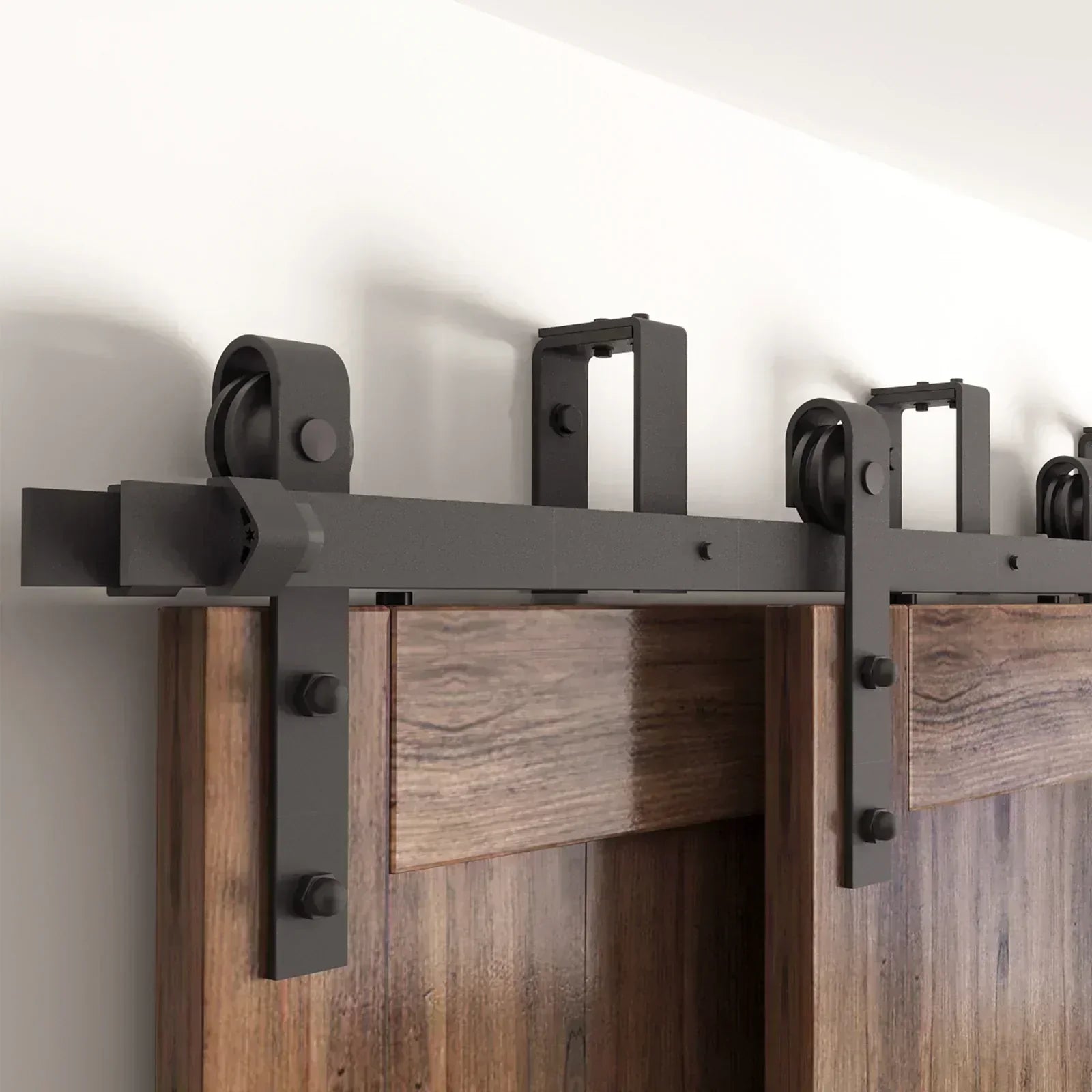
Double bypass — sometimes called double-track or dual-track bypass — uses two parallel tracks mounted one in front of the other above the opening. The front track rides on brackets that hold it off the wall, ahead of the inner track; each door panel runs on its own track and slides independently. Because the tracks are separate, the doors can fully stack behind each other. Unlike single bypass, there's no permanent center overlap — though we recommend planning for about 2 in of overlap per side (3 in for bedrooms and bathrooms where more privacy coverage matters). Doors can technically sit flush, but a small overlap ensures better wall coverage at the edges when closed.
For pass-through applications — where you push both doors to one side for access — double bypass is the stronger choice. The doors are narrower than single bypass doors covering the same opening width, and they fully stack behind each other with no overlap, giving more clear opening when pushed to the side. Each door does need to be operated independently — there's no telescoping link between them by default, though telescoping is available as an add-on with Goldberg Brothers double bypass kits.
Double bypass also supports soft close, which single bypass does not. For bedroom, bathroom, or noise-sensitive installations, soft close is worth adding. Browse our double bypass hardware collection.
Full stacking vs. telescoping — two separate capabilities
These two terms get confused often, and they're not the same thing.
Full stacking means the doors can travel completely past each other and sit entirely behind one another, leaving the full opening clear. Double bypass supports full stacking on all kits — because each door is on its own track, the rollers never collide. Single bypass cannot achieve full stacking: the shared track means the rollers physically collide before the doors can stack completely.
Telescoping means one door engages and carries the other once its own travel is exhausted, creating a single coordinated opening motion. On single bypass, this happens automatically by design. On double bypass, doors move independently by default — telescoping is only available as an add-on with Goldberg Brothers double bypass kits.
So if you want full stacking but don't need telescoping, any double bypass kit works. If you want both full stacking and telescoping in the same system, the Goldberg Brothers double bypass kit with the telescoping add-on is the only configuration that delivers both.
Weight capacity by hardware line
| Hardware line | Weight capacity |
|---|---|
| Quick Ship | 220 lbs total system weight |
| Goldberg Brothers | Up to 250 lbs per door |
For heavier doors, Goldberg Brothers is the right choice given the higher per-door rating.
Side-by-side comparison
| Single bypass | Double bypass | |
|---|---|---|
| Number of tracks | 1 shared track | 2 parallel tracks |
| Door panels | 2–4 doors | 2–4 doors |
| Center overlap when closed | Yes — 6 in or 9 in | No permanent overlap — plan for 2 in per side (3 in for privacy) |
| Fully clear opening | Yes — via telescoping | Yes — via full stacking |
| One door opens both | Yes — telescoping links them | No by default — available as a Goldberg Brothers telescoping add-on |
| Pass-through stacking | Doors overlap when stacked — less clear opening | Doors fully stack — more clear opening when pushed aside |
| Wall depth required | Single track depth | Two parallel track depths |
| Soft close available | No | Yes |
| Privacy | Same as double — front door rides well off the wall | Same as single — front door rides well off the wall |
Which to choose
Choose single bypass when:
- You want a fully clear opening and the telescoping mechanism suits your wall clearance
- The convenience of operating both doors with one push or pull matters — single bypass links the doors through the telescoping mechanism
- A center overlap when closed is acceptable for your application
- You don't need soft close
- Wall depth is limited and a single track profile works better than two parallel tracks
Choose double bypass when:
- The opening is used as a pass-through and you need the doors to stack as compactly as possible when pushed to the side
- You want no center overlap when the doors are closed — a flush close matters aesthetically or practically
- Soft close is important for noise control at the end of travel
- You're comfortable operating each door independently, or want to add Goldberg Brothers telescoping for coordinated movement
Sizing basics
Single bypass — 2 doors
- Door width (non-spoke rollers): (opening + 10 in) ÷ 2
- Door width (spoke wheel rollers): (opening + 13 in) ÷ 2
- Track length for fully clear opening: 3× door width
Double bypass — 2 doors
- Door width: (opening + 6 in) ÷ 2
- Track length for fully clear opening: 3× door width
For 3 and 4-door configurations and pass-through track sizing, see our full barn door sizing guide.
Floor guides and installation
All bypass kits include the necessary floor guides — floor-mounted T guides, the same style used with standard sliding hardware. If your flooring rules out floor screws, a pass-through setup can be tricky, since there's often no wall surface in the right position for a wall-mounted guide instead. Email us before ordering if finished flooring is a concern and we'll advise on the best approach for your setup.
Bypass hardware mounts to the wall above the opening, the same as any other barn door hardware. A solid header above the opening is required — the combined weight of two doors on a bypass system needs secure framing to support it. If there's no solid header available, ceiling mount hardware is the alternative.
Installation is a manageable DIY project — two tracks instead of one means a bit more setup time than a single sliding door, but the process follows the same principles.
Not sure which bypass configuration fits your opening?
Email us at info@thebarndoorhardwarestore.com with your opening width, the wall space available on each side, and how the opening is used — we'll confirm the right configuration before anything ships. Available 7 days a week.
