
Flush pulls are the right choice for the wall-facing side of a barn door — a projecting handle on that side will catch on the door frame as the door slides and limit your opening. Flush pulls have minimal projection so the door travels its full length unobstructed. Two brands are available: Goldberg Brothers recessed pulls (requires a routed mortise) and Quick Ship face-mounted pulls (no routing required) in matte black, brushed nickel, and stainless steel. For guidance on when to use a flush pull vs. a bar handle, and how to set up two-sided operation on a barn door, see our barn door handles guide. For a full comparison of flush pulls vs. bar handles, see our barn style doors guide.
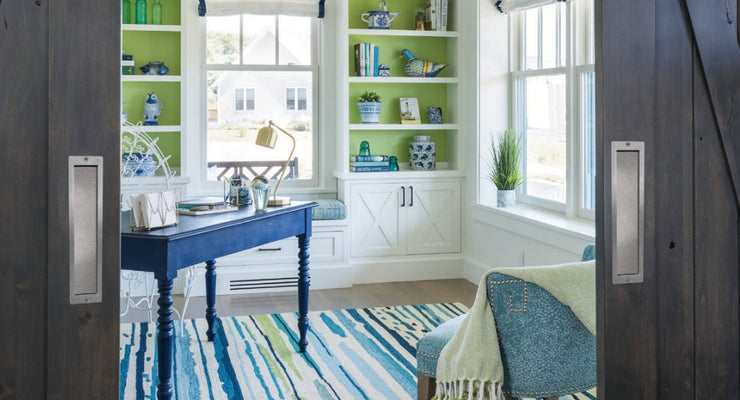




Here's a problem that comes up regularly: a barn door with a projecting handle on the wall side. As the door slides open, that handle hits the door frame or wall trim and stops the door short — you lose part of your opening. On a door meant to fully clear an opening, that's a real functional problem, not just an aesthetic one.
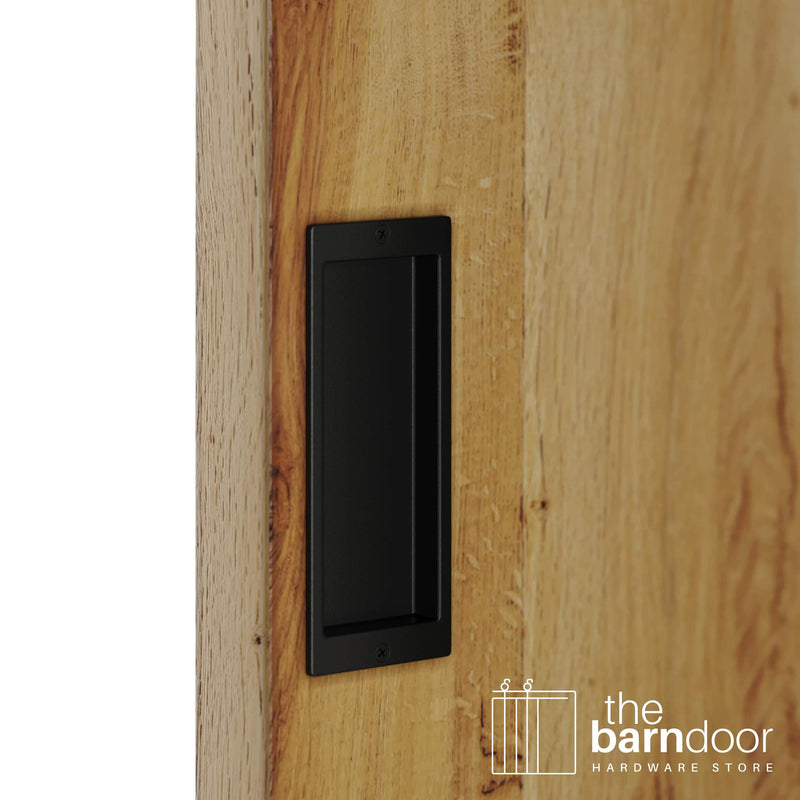
A flush pull sits recessed into or flat against the door surface with minimal projection. The door can travel its full length without the pull catching on anything, and you still have a functional grip for opening and closing the door from both sides. If your sliding door needs a handle on the side that faces the wall when open, a flush pull is almost always the right solution.
Two brands are available here — Goldberg Brothers and our Quick Ship line. The key difference between them is installation: Goldberg Brothers pulls require a routed mortise pocket in the door; Quick Ship pulls are face-mounted and require no routing. Goldberg Brothers pulls are available in 6 in and 12 in lengths. The Quick Ship line is a single size: 8-5/8 in long × 2-3/8 in wide, most similar to the square corner style.
Goldberg Brothers vs. Quick Ship
| Goldberg Brothers | Quick Ship | |
|---|---|---|
| Installation | Requires a routed mortise pocket in the door | Face-mounted — no routing required |
| Lengths | 6 in, 12 in | 8-5/8 in × 2-3/8 in (one size) |
| Finishes | All 17 Goldberg Brothers finishes | Matte black, brushed nickel |
| Outdoor rated | Stainless steel option available | No |
| Routing template | Available separately | Not needed |
Styles and sizes
All flush pulls are rectangular. The variations are in corner radius:
| Style | Profile |
|---|---|
| Square corner | Sharp rectangular corners — clean and minimal |
| Partial radius | Softened rectangular corners — slightly warmer look |
| Full radius | Top and bottom are semi-circles — the most rounded profile |
| Full radius with wings | Full radius profile with decorative side extensions — most ornate option |
Available in two lengths: 6 in and 12 in. The 12 in pull gives more grip surface and reads as more prominent hardware — worth choosing on larger doors or when the pull is a visible design element on both sides.
Installation — what to know before you order
Goldberg Brothers — mortise required
Goldberg Brothers flush pulls sit recessed into the door surface. Before installation, you'll need to rout a pocket into the door face. Mortise dimensions:
| Pull length | Mortise size required |
|---|---|
| 6 in pull | 5 in long × 2 in wide × 1/2 in deep |
| 12 in pull | 11 in long × 2 in wide × 1/2 in deep |
The 1/2 in depth means there are no door thickness restrictions — the mortise doesn't go anywhere near through the door. Routing is the customer's responsibility. A routing template is available for purchase and makes the mortise cut straightforward with a standard router.
For handle height guidance that applies to flush pulls as well as bar handles, see our barn door handle height guide.
Quick Ship — face-mounted, no routing
Quick Ship flush pulls mount flat against the door surface — no mortise, no routing required. They sit proud of the door face rather than recessed into it. Available in matte black, brushed nickel, and stainless steel. Simpler to install, though the recessed pocket on Goldberg Brothers pulls allows significantly more finger engagement — the pull is notably easier to grip and use day-to-day.
Questions about which flush pull works for your door or whether routing is feasible for your installation? Email us at info@thebarndoorhardwarestore.com — we'll confirm the right pull before you order. Available 7 days a week.
