
By Evan Christensen · Owner, The Barn Door Hardware Store
Published April 18, 2026 · Updated May 2026
Evan has owned and operated The Barn Door Hardware Store since 2016. "Barn style doors" covers a wide range of configurations, hanger designs, and finish choices — more than most guides acknowledge. He and the team are available 7 days a week at info@thebarndoorhardwarestore.com.
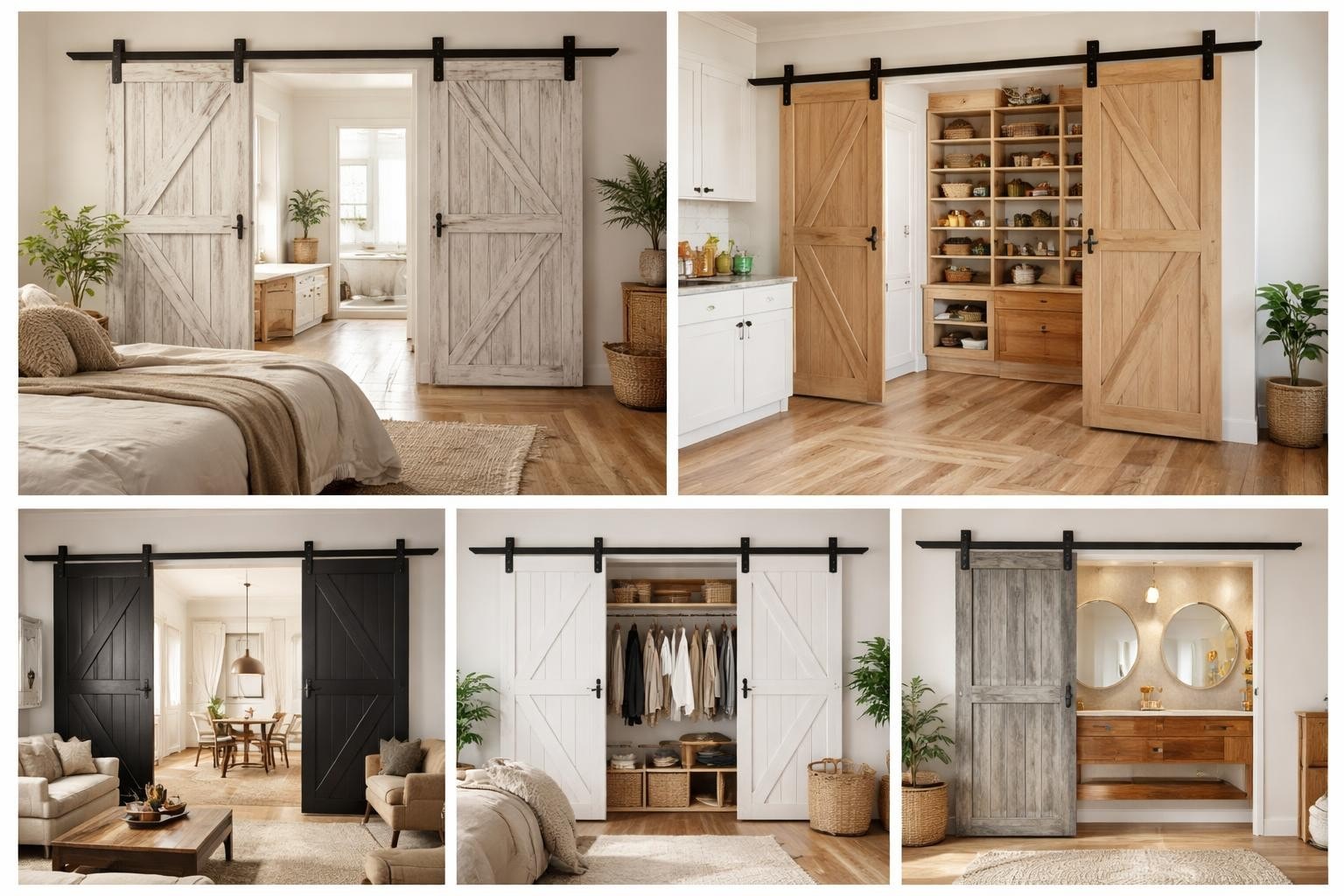
"Barn style doors" describes the sliding hardware mechanism, not a single look. The hanger design, finish, configuration, and door panel each contribute independently to what the door actually looks like and how it operates. Getting all four right for your space is what separates a barn door that reads as intentional from one that feels like an afterthought.
This guide covers the hardware side — hanger styles, configurations, finishes, and the installation requirements that determine what's feasible in your opening. For the door panel itself, we almost always recommend sourcing locally rather than buying a kit that ships the door; the freight cost on a shipped panel is the biggest markup in most barn door projects.
Hanger styles — the primary aesthetic choice
The hanger is the piece that attaches to the door and rolls along the track. It's the most visible hardware element and the primary aesthetic variable. Here's how the main styles read in a space:
J-strap
A curved arm that wraps over the roller housing — the most common hanger style. Modern-industrial in character, works across a wide range of interior aesthetics. Available in standard duty (up to 200 lbs) and heavy duty (up to 400 lbs). Standard duty comes in 4 finishes; heavy duty unlocks all 17 Goldberg Brothers finish colors. Browse: standard / heavy duty.
Straight strap
A flat vertical bar with a clean, minimal profile. Slightly warmer than the J-strap due to the radiused corners. For spaces where you want the hardware to be present but not dominant. Standard duty up to 125 lbs. Browse: straight strap.
Top mount
Attaches to the top edge of the door rather than the face — no visible straps on the door surface at all. The most minimal look available. Standard duty handles up to 75 lbs (both J top mount and straight top mount). Heavy duty top mounts handle up to 100 lbs. Browse: standard / heavy duty top mounts.
Horseshoe
A multi-wheel assembly in a horseshoe frame — 250 lbs in standard duty, up to 600 lbs in heavy duty. More substantial and decorative than a single-wheel strap. Right for heavier doors where the hardware needs to carry real weight. Browse: standard / heavy duty horseshoe.
Wagon wheel
Decorative spoke wheel roller — the most visually distinctive hanger in the lineup. 400 lbs, all 17 Goldberg Brothers finishes. For spaces where the hardware is intended to be a design feature. Browse: wagon wheel.
Hidden roller
Full roller assembly attaches to the back of the door — nothing visible on the door face. For a floating panel aesthetic with no hardware showing from the front. Requires 4-3/8" of clearance above the rough opening. Browse: hidden roller hardware.

The Diamond Black kit and Diamond Brushed Nickel kit are good examples of this — the cutout detail reads as decorative but the hardware itself is still structurally straightforward.
Configurations — determined by wall clearance
The configuration you need is almost always determined by your wall space, not aesthetics. Here's how to think through it:
| Configuration | What it requires | Best for |
|---|---|---|
| Single sliding | Clear wall beside opening = full door width | Standard openings with adequate side clearance |
| Biparting (single track) | Clear wall on each side = one door width | Wide openings; symmetrical look from both sides |
| Single bypass | Shared track; telescoping gives full clear opening | Wide openings; one push opens both doors |
| Double bypass | Two parallel tracks; doors fully stack | Pass-through openings; more compact door stacking |
| Bifold | Panels fold beside opening | Limited side clearance; closets and pantries |
| Ceiling mount | Track mounts to ceiling | No solid wall surface above the opening |
For a detailed breakdown of how each configuration works, see our configuration guide.
Finish options
Goldberg Brothers hardware is available in 17 finish colors. Availability depends on the hardware lineup:
- Standard duty: Matte black, black, arch bronze, silver metallic
- Heavy duty, bifold, and handles: All 17 finishes — including Jacob's gold, raw steel, rustic brown, regal red, flint gray texture, copper vein, and more
- Stainless steel: Raw stainless, matte black texture, black — outdoor rated
- Quick Ship: Matte black and brushed nickel
If you have a specific finish in mind that's only in the heavy duty lineup, stepping up to heavy duty for the finish alone — even on a lighter door — is a legitimate reason to do so. Finish availability is one of the most underappreciated reasons customers choose heavy duty hardware on standard-weight doors.
Goldberg Brothers also offers decorative accent trim sets that attach to J-strap, flat top strap, and wagon wheel hangers — 7 theme collections, 35+ designs, all 17 finishes. The trim swaps independently of the roller so you can change the decorative look without replacing the hardware.
What to confirm before ordering
Ceiling clearance above the door
The track mounts above the opening and requires clearance between the top of the door and the ceiling. For Goldberg Brothers hardware:
| Hanger style | Clearance needed above the door |
|---|---|
| Straight strap, straight top mount, horseshoe | 4" |
| J-strap, J top mount | 4-1/2" |
| Hidden roller | 4-3/8" above the rough opening — note: this is measured from the top of the rough opening (not the top of the door) because the roller assembly mounts differently |
Standard and heavy duty hardware clearance is measured from the top of the door. Hidden roller clearance is measured from the top of the rough opening. If you're comparing options, account for this difference when measuring your space.
If your opening is close to the ceiling, measure this before choosing a hanger style. Straight strap and horseshoe styles require the least clearance at 4".
Wall clearance beside the opening
The door needs clear wall space equal to the full door width on the slide side. A 40" door needs 40" of unobstructed wall. Check the full path for switches, outlets, trim, windows, and corners before ordering — not after. If wall clearance isn't available, bypass or bifold configurations solve it.
Door weight
Hardware capacity must meet or exceed door weight. Choose hardware rated at or above your door's estimated weight — no safety factor multiplier needed, the ratings are working limits. See our barn door weight guide for estimates by door type.
Existing trim around the opening
If you have casing or trim around the opening, a trim clearance kit (longer bolts and spacers) is needed to bridge the trim and let the track sit flush. This is a separate purchase — not included in any kit. Covers trim up to 1-1/4". For trim deeper than that, email us before ordering.
Maintenance
Quality barn door hardware requires very little maintenance. Goldberg Brothers hardware uses sealed bearings designed to run dry — no lubrication required, ever. Do not apply WD-40, dry lubricant spray, oil, or any other lubricant to the track or rollers. Lubricant attracts dust, builds up over time, and creates more rolling resistance — not less.
The only routine maintenance task: wipe the track with a dry cloth periodically to remove dust. For anything more stubborn, a damp cloth followed by a dry wipe. That's genuinely most of what quality hardware needs. See our hardware maintenance guide for the full breakdown.
Privacy and sound — honest expectations
Barn style doors have a 3/8" wall offset gap that runs the full perimeter of the door face. That gap allows some light and sound through regardless of what weatherstrip is applied. For bedrooms and bathrooms, the practical solutions are: size the door with 3" of overlap per side (not the standard 2"), add pile or brush pile weatherstrip at the edges — the only type compatible with sliding doors — and install a latch to keep the door from drifting open.
Do not use rubber or foam compression weatherstrip on a sliding door. These types are designed for hinged doors that close against a stationary frame. On a sliding door they create drag, eventually preventing the door from closing fully, and wear out quickly.
For more on privacy and sound reduction, see our barn door privacy guide and soundproofing guide.
Not sure which hanger style or configuration fits your space?
Email us at info@thebarndoorhardwarestore.com with your opening dimensions, ceiling clearance above the door, door weight estimate, and finish preference — we'll confirm the right hardware before anything ships. Browse our full hardware collection or use our hardware finder to get started. Available 7 days a week.
If you want the door and hardware together, the Patterned Barn Door Kit includes both — a black panel with matching hardware, ready to install.
