
By Evan Christensen · Owner, The Barn Door Hardware Store
Published August 11, 2024 · Updated July 2026
Evan has owned and operated The Barn Door Hardware Store since 2016. Low maintenance requirements are one of the underappreciated advantages of quality barn door hardware — and a meaningful factor when choosing between kit options. He and the team are available 7 days a week at info@thebarndoorhardwarestore.com.
The honest answer to "how much maintenance does barn door hardware need?" is: very little, if you started with quality hardware. Modern sealed bearings don't require lubrication. Powder coat finishes are extremely durable and don't need treatment. The track needs to be wiped down occasionally. That's genuinely most of it.
This is worth knowing before you buy — low maintenance requirements are one of the real advantages of quality barn door hardware over budget alternatives, and a meaningful factor when deciding between kit options. A kit that saves money upfront but requires more ongoing attention has a different total cost than one that runs reliably for years without intervention.
What actually needs maintenance
1. Track cleaning — the main one
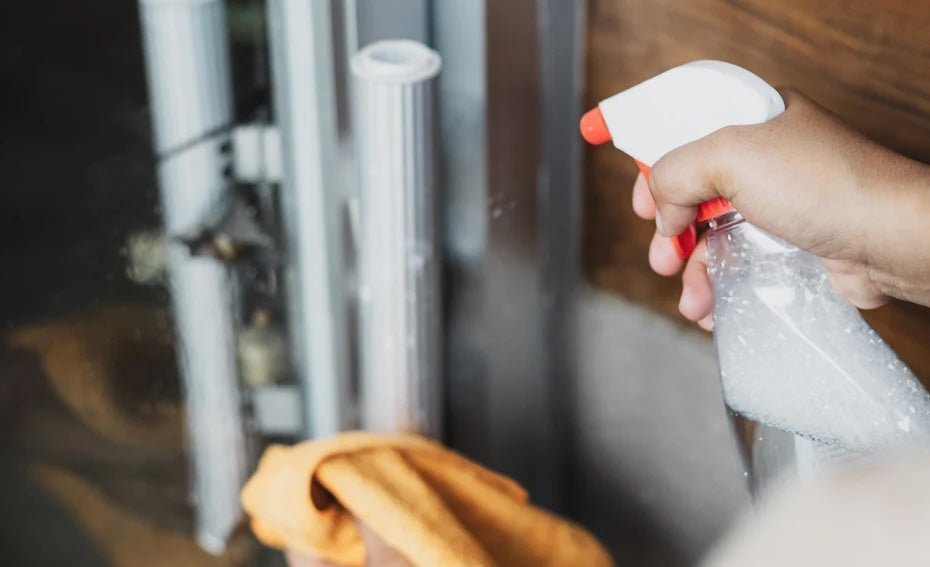
Dust accumulates on the track over time. A periodic wipe-down with a dry cloth keeps the track in good condition. For debris that's settled into the track channel, a soft brush or a vacuum with a brush attachment clears it without scratching the finish. Dust is the primary contaminant — nothing at track height typically gets wet or greasy in a normal interior installation.
If something more stubborn gets on the track — paint overspray, adhesive residue, construction dust — start with a damp cloth and water. If water alone doesn't remove it, add a small amount of mild soap, wipe clean, then wipe again with a dry cloth to remove any residue. The goal is to avoid anything that could crack or compromise the powder coat.
Do not use silicone spray, WD-40, oil-based cleaners, or any lubricant on the track. Oil attracts dust and creates a sticky residue that's harder to deal with than the original problem. The track should be kept clean and dry.
Should you lubricate the rollers or track? No. Goldberg Brothers hardware rides on factory-sealed bearings that run dry for the life of the hardware. Silicone spray, WD-40, grease, and olive oil — all of them widely recommended elsewhere — attract dust and increase rolling resistance over time. If a door is sluggish, the cause is almost always track debris or a level/anti-jump issue, not a lack of lubrication. Wipe the track clean and dry, check the door is level, and leave the bearings alone.
2. Hardware checks — after high-use periods
With frequent operation — especially on a door that's hitting the track stop hard — lag bolts and mounting screws can gradually back out. Check the mounting hardware periodically and retighten anything that's worked loose.
The more durable fix is soft close hardware, which decelerates the door before it reaches the stop and eliminates the impact that causes hardware to back out over time. Soft close can be retrofitted after installation on most standard and heavy duty configurations. Browse our single track and heavy duty hardware for soft close options.
3. Annual visual inspection
Once a year, check the full system — rollers, track, mounting hardware, floor guide, and track stops. You're looking for anything visibly worn, cracked, bent, or loose. Most of the time there's nothing to address. The value is catching small issues before they become larger ones.
What doesn't need maintenance
- Roller bearings. Modern Goldberg Brothers hardware uses sealed bearings that don't require lubrication and are designed to run dry for the life of the hardware. Applying lubricant to sealed bearings doesn't help and can attract contaminants. Leave them alone.
- Powder coat finish. Powder coat is an extremely durable finish that doesn't require waxing, sealing, or treatment of any kind for interior use. It won't fade, chip, or corrode under normal interior conditions — including inside coastal homes where ambient humidity is elevated. It's not rated for perpetual outdoor exposure or running water, but for any standard interior installation there's nothing to do.
- Track alignment. A properly installed track on a solid header board or blocking should not require realignment over time. If your door is drifting, that's a specific issue with a specific fix — not a routine maintenance item. See our door drifting guide.
When hardware actually needs to be replaced
The most common replacement scenario is a flat-spotted roller. A flat spot develops when a roller sits stationary under load for extended periods, or when the door weight exceeds the roller's rated capacity. The symptom is a consistent bump or catch at the same point in the door's travel — smooth everywhere else but catches in that one spot every time.
A flat-spotted roller needs to be replaced — it won't self-correct. When replacing, consider whether the original roller was appropriately rated for the door weight. If the door has always been at or near the hardware's limit, upgrading to steel wheels or to heavy duty hardware with a higher capacity rating will prevent the same issue from recurring.
| Wheel type | Flat spot resistance | Noise level |
|---|---|---|
| Nylon (Quick Ship) | Most prone | Moderate |
| Delrin (Goldberg Brothers standard duty) | Prone under heavy load | Quietest |
| Steel (Goldberg Brothers heavy duty default) | Most resistant | Louder than Delrin |
If your rollers have flat spotted, email us at info@thebarndoorhardwarestore.com with your door weight and current hardware — we'll confirm whether a roller replacement or a full hardware upgrade is the right solution.
Something not working the way it should?
If your door has a specific problem — sticking, drifting, noise, jumping the track — our barn door troubleshooting guide covers the real cause and fix for each. Or email us at info@thebarndoorhardwarestore.com with a description — what the door is doing, when it started, and what hardware you're using. Most barn door problems have a specific cause and a specific fix. Available 7 days a week.
