
By Evan Christensen · Owner, The Barn Door Hardware Store
Published April 17, 2026 · Updated May 2026
Evan has owned and operated The Barn Door Hardware Store since 2016. Shed and workshop installations make up a meaningful portion of stainless hardware orders — the hardware questions are straightforward once you understand what outdoor exposure actually requires. He and the team are available 7 days a week at info@thebarndoorhardwarestore.com.
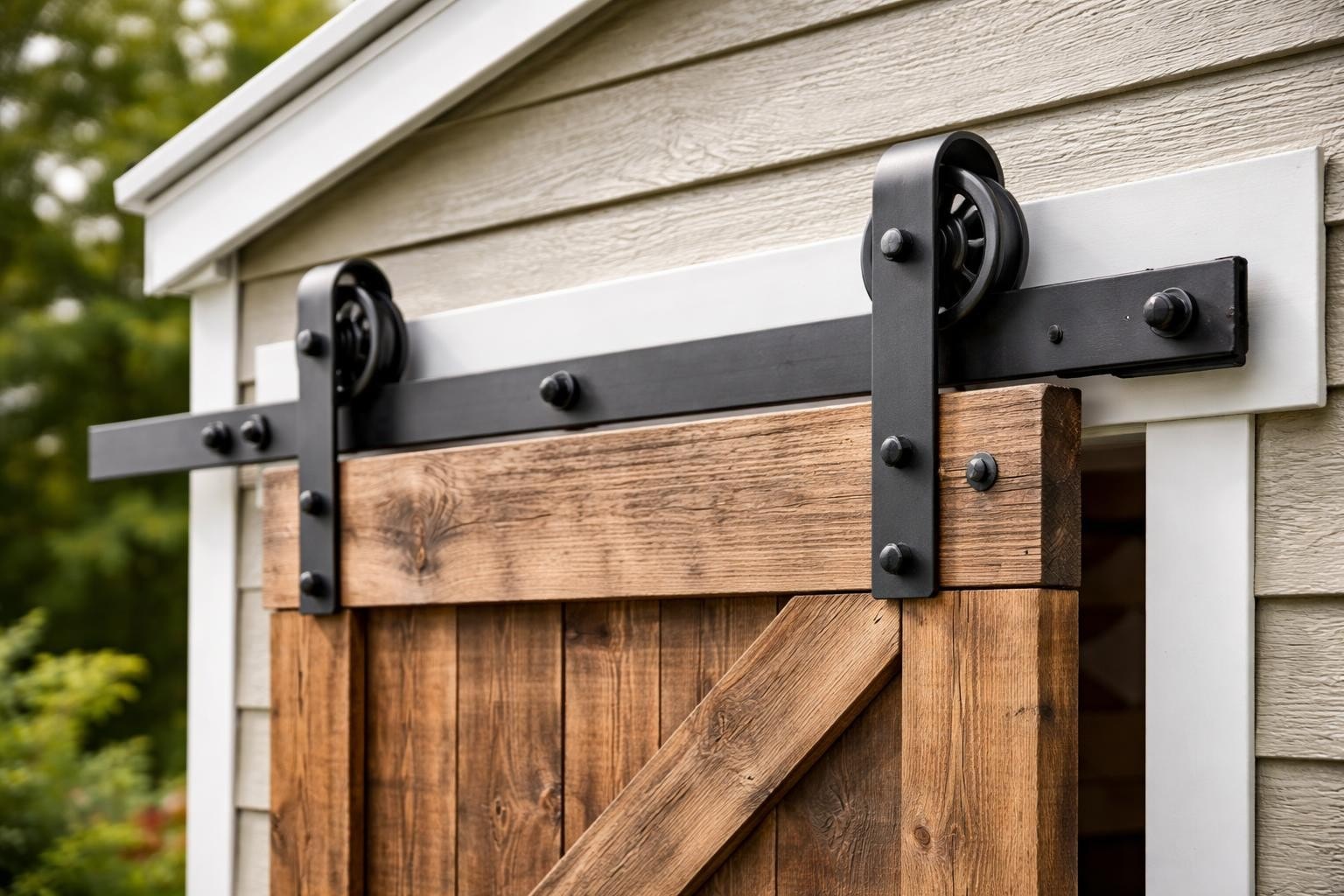
Sliding barn door hardware works on sheds, workshops, and barns — the mechanism is the same as interior installations. The difference is the environment. Standard powder-coated steel hardware is designed for interior use. Outdoors, sustained moisture, temperature swings, and direct weather exposure will eventually cause powder coat to chip and the underlying steel to corrode.
For shed and outdoor installations, stainless steel hardware is the right starting point — not an upgrade. This guide covers how to size a sliding shed door track, what hardware is rated for outdoor use, and what to confirm before ordering.
Why sliding hardware for a shed
The practical case for sliding doors on a shed is the same as for interior applications: no swing clearance. A hinged shed door requires a clear arc of ground space in front of the opening — space that's often occupied by equipment, vehicles, or a walkway. A sliding door travels parallel to the shed wall, requiring only clear wall space beside the opening for the door to slide into.
For wide shed openings — a garage bay, a barn entrance, a large workshop — bypass configurations let two or more panels slide past each other, covering the full opening without needing the full door width of clear wall on one side. Junction plates allow track sections to be joined end-to-end for any run length. For custom track lengths beyond what's listed, email us at info@thebarndoorhardwarestore.com.

Hardware for outdoor use — stainless steel only
Standard barn door hardware is powder-coated steel. Powder coat is a durable surface coating that performs well in interior environments — including bathrooms and coastal interiors. It is not designed for sustained outdoor exposure, direct rain, or repeated wet-dry cycles. Over time, powder coat chips and the underlying steel corrodes.
Stainless steel hardware is a corrosion-resistant alloy throughout — not a surface coating over standard steel. The corrosion resistance runs through the material, not just the surface. This is why stainless holds up in outdoor, coastal, and high-humidity environments where powder coat eventually fails. It is the only hardware we carry rated for outdoor use.
We carry Goldberg Brothers stainless steel barn door hardware in three finishes: raw stainless, matte black, and black. All three are outdoor rated. Browse our stainless steel hardware collection for the full lineup of flat-track strap and top mount styles.
If your shed is covered — a garage bay with overhead protection, a barn with roof overhang — standard powder-coated hardware may hold up reasonably well. For direct outdoor exposure, stainless is the right choice regardless of coverage.
Sizing the track
Track length
Track length must be at least 2x the door width — not 2x the opening width. For a 48" opening, the door is 52" (opening + 4"), so the track needs to be at least 104". Sizing to the opening rather than the door is the most common ordering mistake — it leaves the track too short for the door to fully clear the opening.
Door width
Size the door panel at least 2" wider than the opening on each side — opening + 4" minimum — so it overlaps the wall and covers the opening fully when closed. For a 48" wide shed opening, that's a 52" door minimum.
Door height
Opening height plus 1". The extra inch provides top coverage. Goldberg Brothers hardware is designed for the door to sit 3/8" off the floor; for shed and outdoor installations, allow additional clearance so the door slides freely over uneven ground, gravel, or a raised threshold.
Wall clearance beside the opening
The door needs clear wall space equal to the full door width on the slide side. Walk the full travel path and check for anything in the way — corners, trim, vents, windows — before ordering. If wall space is limited on both sides, a bypass configuration covers the opening with less lateral clearance required.
For the full sizing breakdown, see our barn door dimensions guide.
Door weight and hardware capacity
Hardware capacity must meet or exceed your door's weight. No safety factor multiplier is needed — the capacity ratings on our hardware are working limits, not theoretical maximums. Estimate your door weight by material:
| Door type | Estimated weight (per standard panel) | Hardware to consider |
|---|---|---|
| Lightweight wood or plywood panel | 40–70 lbs | Any face or top mounted stainless steel product |
| Solid wood panel | 80–150 lbs | Any face mounted stainless steel product |
| Heavy solid wood or insulated panel | 150–300 lbs | Any face mounted stainless steel product |
| Metal-clad or very heavy panel | 300+ lbs | Email us before ordering |
Our stainless steel face mount hardware handles up to 400 lbs per door. Top mount stainless handles up to 100 lbs per door. Browse our stainless steel collection for current capacity specs by style.
Installation considerations for shed applications
Header mounting
The track must mount into solid structure — not into siding or thin sheathing alone. For most shed walls, this means a 1×6 hardwood board spanning the full track length, secured through the siding into the structural framing behind it. For sheds with exposed structural headers, the track can often mount directly into the header. Confirm the mounting surface is solid before drilling.
Clearance above the door
All Goldberg Brothers stainless steel hardware requires 5-1/2" of clearance above the door — measured from the top of your door panel to the ceiling or roof framing. Measure this before ordering and before committing to stainless hardware.
Floor guide
A floor guide is required — without it, the door hangs from the top only and swings away from the shed wall in wind or when pushed. For shed applications where drilling into a concrete floor or gravel base isn't practical, a wall-mounted floor guide is the alternative. Browse our floor guides collection.
Latching for wind
Outdoor doors are more susceptible to wind-driven drift than interior doors. A latch keeps the door reliably closed and prevents it from slamming or sliding open in wind. We carry stainless steel flip latches and cabin hooks rated for outdoor and coastal environments. Browse our locks and latches collection.
Sealing gaps against weather
A sliding door rides 3/8" off the wall and won't seal like a hinged exterior door — there is always a perimeter gap. To cut drafts, wind-driven dust, and pests, run pile or brush weatherstrip around the opening and add a brush sweep along the bottom edge. Use pile or brush, not rubber or silicone compression seals — compression seals drag on a moving door, add rolling resistance, and wear unevenly. If a basic brush sweep isn't tight enough, step up to denser pile rather than switching to rubber. Weatherstripping reduces air and debris infiltration, but it won't make a sliding door airtight.
For a full step-by-step installation walkthrough, see our barn door installation guide.
Maintenance
Goldberg Brothers stainless hardware uses sealed bearings designed to run dry. No lubrication is required — and applying lubricant attracts debris, builds up over time, and makes rolling harder rather than easier. Do not apply silicone spray, WD-40, or any other lubricant to the track or rollers.
For outdoor installations, the main maintenance task is keeping the track clear of debris — leaves, dirt, and grit accumulate faster outside than in interior applications. Wipe the track with a dry cloth regularly. For anything more stubborn, a damp cloth followed by a dry wipe. Periodically check mounting hardware for anything that's worked loose, particularly after wind events or hard use.
Stainless steel does not require touch-up painting or surface treatment — the corrosion resistance is through the alloy, not the surface. The hardware should look and operate the same in year five as it did at installation.
Questions about your shed installation before ordering?
Email us at info@thebarndoorhardwarestore.com with your opening width, door material and estimated weight, wall structure, and whether the installation is covered or directly exposed — we'll confirm the right hardware and track length before anything ships. Available 7 days a week.
