
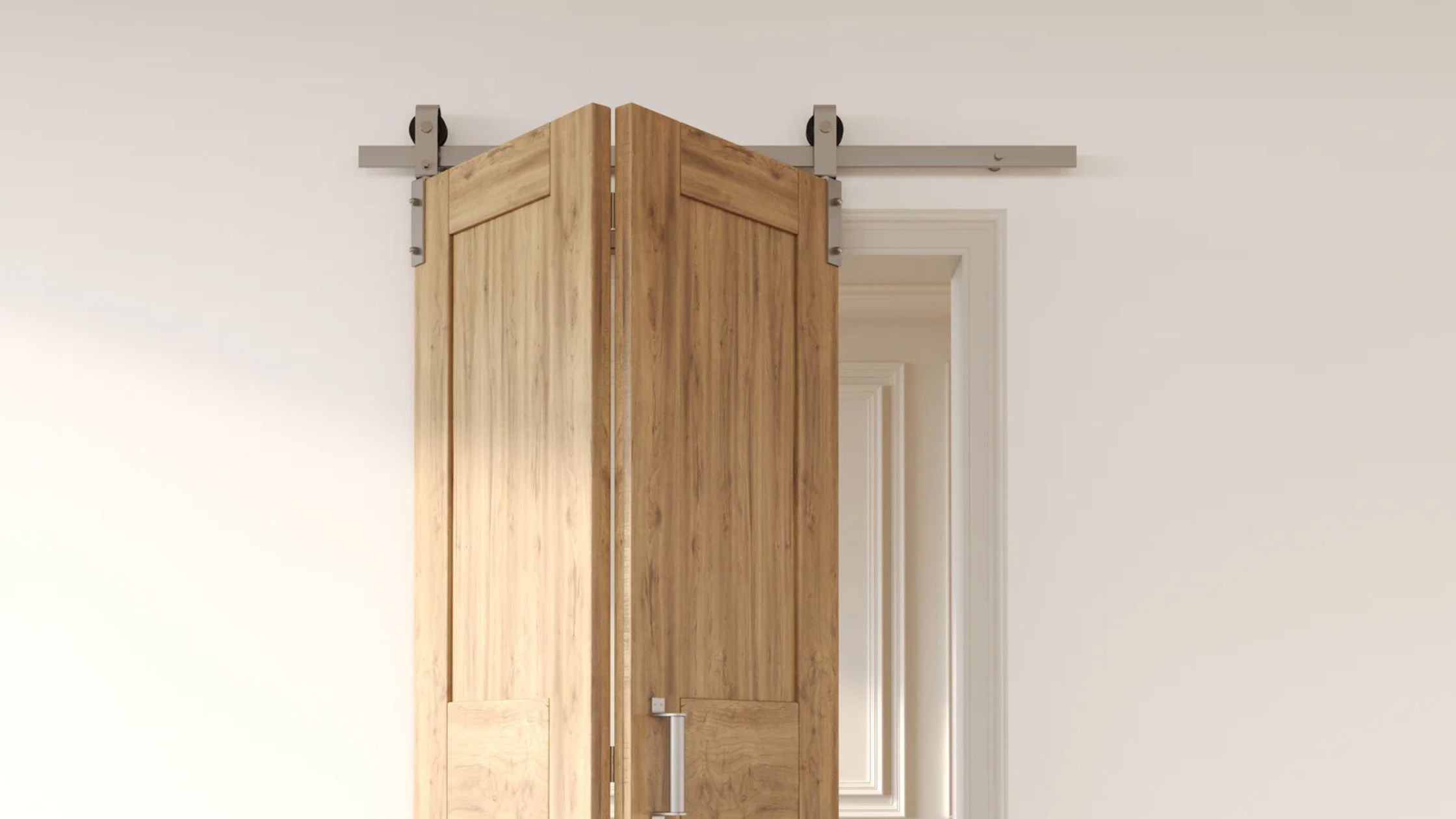
My neighbor Sarah called me last week, frustrated. She'd measured her bathroom entry at least five times, and no matter how she calculated it, a standard barn door would block her light switch. "What if I told you there's a door that slides and folds?" I asked. Her skepticism turned to excitement when I showed her a single bifold barn door in action. If you're working with tight spaces, narrow hallways, or rooms where every inch counts, this hybrid solution might be exactly what you need.
What Makes a Single Bifold Barn Door Different
You know the classic barn door that glides along a track? Now imagine cutting that door down the middle and adding a hinge. That's essentially what a single bifold barn door does. When you slide it open, the door folds in half, requiring only about 50% of the clearance space compared to a traditional sliding barn door.
Here's why that matters. A standard 36-inch barn door needs at least 36 inches of wall space to slide completely open. But a single bifold barn door? It only needs about 18 inches because the door panels fold together as they slide. For small bathrooms, closets, or laundry rooms, that difference is huge.
The mechanism combines two movement types:
- Sliding action along a mounted track (just like traditional barn doors)
- Folding motion at the center hinge (similar to closet bifold doors)
- Synchronized movement that keeps both panels aligned as they open and close
Think of it as getting the aesthetic appeal of a barn door without sacrificing half your room to the door swing. I've installed these in master bathrooms where the homeowner wanted barn door style but couldn't lose the wall space for towel bars or storage.

Choosing the Right Hardware System
Not all hardware kits are created equal, and with bifold systems, the stakes are even higher. You're dealing with moving parts that need to work in perfect harmony, which means quality matters more than ever.
Track and Mounting Options
The track is your foundation. I always recommend starting here because everything else depends on getting this right. You'll find two primary mounting styles:
Top-mount systems attach the track directly to the wall above the door opening. This top-mount bifold kit is a solid example of this approach. These work great when you have strong wall studs and want a cleaner look without ceiling involvement.
Front-mount systems extend the track out from the wall surface. The front-mount option gives you more clearance behind the door, which helps if your doorway has decorative trim or if you're mounting over drywall. This style also makes maintenance easier since all components are accessible from the front.
| Mounting Type | Best For | Clearance Needed | Installation Difficulty |
|---|---|---|---|
| Top Mount | Clean aesthetics, strong studs | Minimal (1-2 inches) | Moderate |
| Front Mount | Trim clearance, accessibility | More (2-4 inches) | Easier |
| Ceiling Mount | Unusual openings, added support | Variable | Advanced |
For most DIY installations, I lean toward front-mount systems. They're more forgiving during installation, and you can adjust them more easily if something's slightly off.
Weight Capacity and Door Size
Here's something most people don't think about until it's too late: bifold hardware experiences different stress than standard sliding systems. Because the door folds, the pivot point takes on concentrated weight. You need hardware rated for at least 150% of your door's actual weight.
A standard single bifold barn door typically weighs:
- Hollow-core wood: 40-60 pounds
- Solid wood: 80-120 pounds
- Glass or metal: 100-150 pounds
Match your hardware accordingly. I've seen too many installations where someone bought hardware rated for exactly their door weight, then wondered why rollers started wobbling after six months. Give yourself that safety margin.
Installation Considerations That Matter
You've picked your hardware, you've got your door ready, now what? Installation is where theory meets reality, and I've learned some hard lessons over the years that'll save you headaches.
Finding and Reinforcing Studs
This isn't optional. A single bifold barn door puts dynamic load on your mounting points every single time it opens or closes. Drywall anchors won't cut it, no matter what the packaging claims.
Use a good stud finder and mark every stud across your door opening. Most 36-inch openings will give you two solid mounting points. If your studs don't line up with your track brackets, you have two options:
- Install a header board (my preferred method) – Mount a solid 1x6 or 2x4 board across the studs, then attach your track to that board
- Use blocking – Cut pieces of 2x4 and install them horizontally between studs at your mounting height
The header board approach gives you flexibility to position track brackets anywhere along the board, which makes adjustment much easier during installation.
Door Panel Alignment and Clearance
Getting both panels to align perfectly requires patience. Start by hanging the door in the closed position and checking these clearances:
- Floor clearance: 1/2 to 3/4 inch (enough to clear carpet or rugs)
- Wall clearance: 1 to 2 inches (prevents scraping during operation)
- Panel-to-panel: Even gap at the center when closed
I use a level on each panel independently before securing anything permanently. One trick I've picked up: hang the door, open and close it twenty times, then check alignment again. The settling period reveals issues you won't catch on the first test.

Design Styles and Material Choices
Let's talk aesthetics, because function without style is just engineering. The beauty of a single bifold barn door is that it works with virtually any design direction you're heading.
Material Options That Hold Up
Solid wood remains the gold standard for durability and appearance. I'm partial to pine or fir for painted finishes, and oak or maple for stained doors. They handle humidity changes better than composite materials, which matters in bathrooms and laundry rooms where moisture is constant.
Engineered wood (MDF or particleboard core with veneer) gives you stability at a lower price point. These work brilliantly for two-panel wood bifold barn doors where you want consistent color without the wood grain variation. Just make sure you seal all edges properly before installation.
Glass panels are trending in 2026, especially frosted or textured glass for bathrooms. They maintain privacy while letting light through, solving the "dark hallway" problem that solid doors create. Just remember: glass is heavy, so upgrade your hardware accordingly.
Finish and Hardware Coordination
Your door finish should complement your hardware finish, but they don't need to match exactly. Here's what I've found works:
- Matte black hardware pairs with everything from white painted doors to natural wood stains
- Brushed nickel or stainless works best with gray-toned paints or light woods
- Oil-rubbed bronze creates warmth against darker wood stains or deep paint colors
Speaking of hardware finishes, think about your door handles and pulls early in the process. A single bifold barn door typically needs a handle on each panel for balanced operation, and those handles become focal points in your design.
Practical Applications Room by Room
Where does a single bifold barn door make the most sense? I've installed these in practically every room type, but certain applications really shine.
Bathrooms and Powder Rooms
This is where the single bifold barn door proves its worth. Small bathrooms rarely have space for the door swing zone of a traditional door, and a standard barn door often blocks towel hooks, toilet paper holders, or light switches when open.
A single bifold barn door solves these problems elegantly. The compact footprint when open leaves wall space accessible, and you can add a privacy lock for security without compromising the aesthetic.
Closets and Storage Spaces
Walk-in closets and pantries benefit hugely from bifold barn door systems. Unlike traditional bifold doors that hang from a top track and use bottom pivots, a single bifold barn door slides completely out of the opening. This gives you full access to the doorway without fighting the door.
I recently helped a client convert her reach-in closet to a single bifold barn door system. Previously, she had standard hinged doors that required several feet of clearance to swing open, making that whole floor area unusable. Now? She can pull her laundry basket right up to the opening while the door sits neatly to one side.
Laundry Rooms and Utility Spaces
Here's an application most people don't think about: hiding washer-dryer combos or utility areas. A single bifold barn door lets you close off these spaces when guests visit, then slide them completely open when you're doing laundry and need to move around freely.
The folding action means the door doesn't extend into adjacent hallways or walkways, which is crucial in those tight transitional spaces where laundry rooms often end up in home layouts.

Troubleshooting Common Issues
Even with perfect installation, you might run into quirks as your single bifold barn door settles into regular use. Here's what I see most often and how to fix it.
Panels Not Aligning Properly
If your door panels don't meet evenly when closed, check these things in this order:
-
Roller adjustment – Most quality hardware includes adjustable roller brackets. Loosen the mounting bolts slightly and shift the roller position up or down to level the panel.
-
Track level – Use a long level (4 feet minimum) to verify your track is perfectly level. Even a quarter-inch drop over six feet causes alignment issues
Sticky or Resistant Movement
Smooth operation depends on several factors working together. When doors start dragging or resisting movement:
Clean the track regularly. Dust and debris accumulate in the track channel, creating friction. I use a dry microfiber cloth monthly and a damp cloth quarterly.
Lubricate rollers. A light spray of silicone lubricant (never oil-based) on roller wheels keeps everything gliding smoothly. Do this every three months in high-use areas.
Check for door warping. Solid wood doors can warp slightly in humid environments. If you notice the door isn't sitting flat anymore, you might need to adjust mounting points or add spacers to compensate.
Hardware Noise and Rattling
Nobody wants a noisy door. If you're hearing clicks, rattles, or grinding sounds:
- Tighten all bolts – Movement gradually loosens hardware. Check every mounting bolt quarterly.
- Inspect roller wheels – Worn wheels develop flat spots that cause rhythmic thumping.
- Add rubber bumpers – Small adhesive rubber bumpers where panels meet the door frame eliminate rattling on closure.
Comparing Single vs. Double Bifold Systems
Should you go with a single bifold barn door or step up to a double bifold system? The answer depends entirely on your opening width and how you use the space.
Single bifold barn doors work perfectly for openings up to 36 inches wide. Beyond that, the door panels become unwieldy and heavy. They're ideal when:
- Your opening is standard door width (30-36 inches)
- You have wall space to one side for the door to slide
- You want simpler hardware with fewer moving parts
- Budget is a consideration (less hardware means lower cost)
Double bifold systems use two separate bifold doors that meet in the middle, suitable for openings 48 inches and wider. Consider these for:
- Large closet openings or room dividers
- Situations where you want symmetrical operation
- Spaces where wall clearance is severely limited on both sides
For most residential applications, the single bifold barn door hits the sweet spot of functionality, aesthetics, and cost-effectiveness.
Making Your Single Bifold Barn Door Pop
You've got the function sorted out, now let's talk about making your door a design feature rather than just a functional element.
Paint and Stain Techniques
A single coat of paint doesn't do justice to a quality door. Here's my finishing process:
- Prime properly – Use a quality primer that blocks tannin bleed (especially important on pine)
- Sand between coats – Light sanding with 220-grit after each coat creates a furniture-quality finish
- Consider two-tone – Paint the main panels one color and the rails/stiles another for visual interest
- Seal the edges – Even painted doors need edge sealing to prevent moisture infiltration
For stained doors, pre-stain conditioner is your best friend on softwoods. It prevents blotching and ensures even color absorption. I've seen beautiful single bifold barn doors ruined by skipping this simple step.
Hardware as Jewelry
Think of your hardware as jewelry for the door. Don't just grab whatever's cheapest. The hardware you choose sets the entire tone.
Pull handles are particularly important on bifold doors because users need to grip both panels during operation. I prefer handles that run vertically along the door edge, giving multiple grab points at different heights.
For minimalist designs, flush pulls create clean lines without protrusions. These work especially well on glass panel doors or in tight spaces where a protruding handle might catch on clothing or bags.
The DIY Conversion Option
Here's something interesting: you can actually convert an existing bifold door into a single bifold barn door system. I've done this conversion several times, and while it requires some carpentry skills, it's totally achievable for confident DIYers.
The basic process involves removing the bottom pivot hardware from a standard bifold door, reinforcing the top edge to handle track mounting, and installing barn door hardware. This video demonstration walks through the conversion process step-by-step if you're curious about the technique.
The advantage? You can reuse a perfectly good door instead of buying new. The downside? Standard bifold doors are often lightweight hollow-core construction, which may not hold up as well to the lateral forces of barn door operation. If you go this route, reinforce the top rail significantly before mounting hardware.
Trending Styles for 2026
Design trends shift constantly, but certain styles have staying power. Based on what I'm seeing in installations this year, here's what's resonating with homeowners.
Modern Farmhouse Meets Industrial
The blend of rustic and industrial continues strong. Think reclaimed wood doors with matte black hardware, or clean-lined shaker-style panels paired with exposed track systems. Current bifold barn door styles lean heavily into this aesthetic because it works with both contemporary and traditional home designs.
Glass and Mixed Materials
Frosted glass, particularly with geometric patterns, is huge right now. I'm seeing more requests for single bifold barn doors that combine wood frames with glass panel inserts. These bring light into spaces while maintaining the door's functional privacy.
Metal-framed doors with glass panels create an industrial loft vibe that works surprisingly well in modern bathrooms and home offices.
Simplified Profiles
Overly ornate doors are out. Clean lines, minimal paneling, and smooth surfaces dominate 2026 installations. This simplification actually makes doors easier to maintain and clean, which matters in high-traffic areas like bathrooms and laundry rooms.
Maintenance Schedule Worth Following
A single bifold barn door requires minimal maintenance if you stay ahead of issues. Here's the schedule I recommend to clients:
Monthly tasks:
- Wipe down track with dry cloth to remove dust
- Check that all mounting bolts remain tight
- Test door operation and note any changes in smoothness
Quarterly tasks:
- Apply silicone lubricant to roller wheels
- Inspect hinge at fold point for wear or looseness
- Clean door surface thoroughly
Annual tasks:
- Remove door and inspect all hardware closely
- Check for warping or structural changes in door panels
- Touch up paint or finish as needed
- Verify track remains securely mounted and level
This takes maybe fifteen minutes per maintenance session, and it extends your door's functional life by years. I've seen well-maintained single bifold barn doors operating smoothly after a decade of daily use.
Cost Considerations and Value
Let's talk money, because that's always part of the equation. A complete single bifold barn door system typically costs more than a standard hinged door but less than custom pocket doors.
Budget breakdown for a typical installation:
| Component | Budget Range | Mid-Range | Premium |
|---|---|---|---|
| Hardware Kit | $150-$250 | $250-$400 | $400-$600 |
| Door (unfinished) | $100-$200 | $200-$350 | $350-$600 |
| Finishing Materials | $30-$50 | $50-$80 | $80-$120 |
| Installation (DIY) | $0 | $0 | $0 |
| Installation (Pro) | N/A | $200-$400 | $400-$700 |
For DIY installations, you're looking at $280-$500 for a complete system with a quality door and hardware. Professional installation adds $200-$700 depending on your location and installation complexity.
Is it worth it? Absolutely, when you factor in the space savings and aesthetic impact. I've had clients tell me their single bifold barn door became a conversation piece, with guests specifically commenting on the clever design solution.
Privacy and Sound Considerations
One question I get constantly: "Will this door be as private as a regular door?" The honest answer is no, standard single bifold barn doors aren't as soundproof as traditional hinged doors with weatherstripping.
But you can improve both privacy and sound dampening significantly:
Weatherstripping – Apply self-adhesive weatherstripping along all door edges where panels meet the frame. This creates a tighter seal and reduces sound transmission.
Panel overlap – Configure panels so they overlap slightly at center closure rather than meeting flush. This eliminates the gap where sound and light pass through.
Solid core doors – Heavy, solid-core construction naturally dampens sound better than hollow-core alternatives.
For rooms where privacy and soundproofing are critical concerns, consider these modifications essential rather than optional. I've installed single bifold barn doors on master bathrooms where homeowners were initially concerned about privacy, and with proper weatherstripping and solid doors, they report complete satisfaction.
Track Configuration Options
Beyond basic top-mount and front-mount systems, you have configuration choices that affect both appearance and function.
Exposed track shows the full hardware system, celebrating the industrial aesthetic. This is what most people envision when they think "barn door." The track, rollers, and mounting brackets become design features.
Hidden roller systems conceal the roller mechanism inside a track channel, showing only the track itself. These create cleaner lines and work well in contemporary settings where you want the door to be the focus rather than the hardware.
Box rail systems enclose the entire track and roller assembly in a rectangular housing. These protect hardware from dust and damage while creating a distinct architectural element above the doorway.
I generally recommend exposed track for farmhouse or industrial styles, and hidden systems for modern or minimalist designs. Your choice should align with your overall home aesthetic and the statement you want the door to make.
Finding the Right Door Size
Sizing a single bifold barn door requires different calculations than traditional barn doors. You're not just measuring the opening width; you need to account for the folding mechanism and panel proportions.
Here's the formula I use:
Door width = Opening width + 4 to 6 inches (overlap on each side) Door height = Opening height + 2 to 4 inches (from floor to top of opening, accounting for floor clearance)
So for a standard 32-inch door opening that's 80 inches tall:
- Door width: 36-38 inches (allows 2-3 inch overlap per side)
- Door height: 82-83 inches (accounts for 1-inch floor clearance, 1-2 inch top overlap)
Each folding panel will be approximately half the total door width, meaning your example door creates two 18-19 inch panels when open. This compact footprint is exactly why single bifold barn doors work so well in tight spaces.
A single bifold barn door offers the perfect balance between space efficiency and design impact, especially in tight spaces where traditional doors just don't work. Whether you're renovating a small bathroom, updating a closet, or hiding utility areas, the folding-sliding combination delivers functionality without sacrificing style. Ready to transform your space with quality hardware that's built to last? The Barn Door Hardware Store has everything you need, from complete hardware kits to expert installation support, all backed by their limited lifetime warranty and free shipping across the continental US.

