
By Evan Christensen · Owner, The Barn Door Hardware Store
Published April 16, 2026 · Updated May 2026
Evan has owned and operated The Barn Door Hardware Store since 2016. Sliding door track questions almost always come down to two things: the wrong track length and the wrong configuration for the available wall space. Getting both right before ordering is what this guide is for. He and the team are available 7 days a week at info@thebarndoorhardwarestore.com.
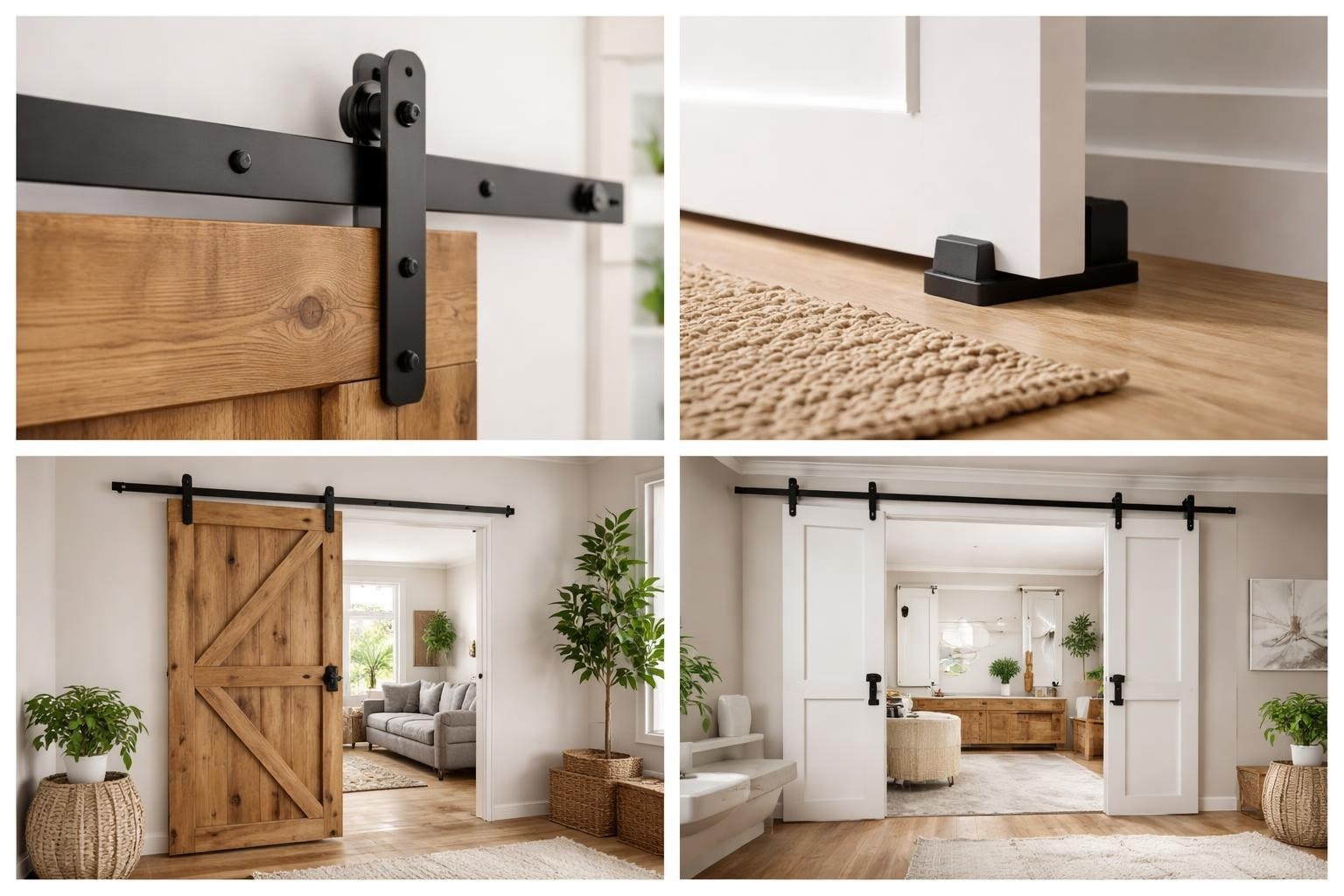
Sliding door track hardware is the foundation of any barn door installation — the track carries the full weight of the door and determines how the door moves for the life of the installation. Get the track length, configuration, and capacity right, and everything else follows. Get any one of them wrong, and the door won't operate properly regardless of how well the rest of the installation is done.
This guide covers the decisions that determine track selection: configuration, sizing, capacity, and what to confirm before ordering.
Configuration — the first decision
Track configuration is almost always determined by how much clear wall space exists beside the opening, not by the size of the opening itself. Here's how to think through it:
| Configuration | How it works | Wall clearance needed | Best for |
|---|---|---|---|
| Single track | One or two doors slide on one track | Full door width on slide side | Standard openings with adequate wall beside |
| Single bypass | 2–4 doors share one track, telescoping past each other | Minimal for pass-through. For a fully clear opening: door width + 6" overlap (9" for spoke wheel rollers) | Wide openings, one push opens both doors |
| Double bypass | Doors run on two parallel tracks, fully stacking behind each other | Minimal for pass-through. For a fully clear opening: full door width on the stack side | Wide openings needing pass-through access |
| Bifold | Panels fold accordion-style along the track | Minimal — panels fold compactly | Limited wall clearance on both sides |
| Ceiling mount | Track mounts to ceiling instead of wall | No wall surface needed above the opening | No solid wall header above the opening |
If you're unsure which configuration suits your opening, see our configuration guide for a full breakdown with worked examples.
Track length — the most common ordering mistake
The formula below applies to a single track setup with one door. For bypass, bifold, and multi-door configurations, track length calculations differ — see our full sizing guide for those formulas.
Track length must be at least 2× the door width — not 2× the opening width, and not the opening width plus a few inches. Here's why: the door needs to travel its full width to clear the opening, and the track needs to accommodate both the open and closed positions of the door simultaneously.
The most common mistake: sizing the track to 2× the opening instead of 2× the door. A 36" opening with a 40" door needs an 80" track minimum — not 72". A 72" track (2× opening) leaves 8" of the opening still covered when the door is fully slid. Always size to the door, not the opening.
Door width formula first: opening width + 4" minimum (2" overlap per side). For bedroom and bathroom openings, use opening + 6" (3" per side) for better privacy coverage. Then double that door width for track length.
Worked example: 36" opening → 40" door (standard) → 80" track minimum. For a bedroom: 36" opening → 42" door → 84" track minimum.
For bypass configurations, track length calculations differ by number of panels and configuration type. See our full sizing guide for bypass and bifold formulas.
Track capacity and door weight
Choose hardware rated at or above your door's estimated weight. No safety factor multiplier is needed — the capacity ratings on our hardware are working limits, not theoretical maximums. Estimate door weight by material:
| Door type | Estimated weight | Hardware to consider |
|---|---|---|
| Hollow core | 25–35 lbs | Any standard duty kit |
| Solid core | 50–80 lbs | Standard duty — J-strap or straight strap |
| Solid pine / poplar | 80–120 lbs | Standard duty J-strap (200 lbs) or horseshoe (250 lbs) |
| Solid hardwood | 100–150 lbs | Standard duty horseshoe or heavy duty lineup |
| Reclaimed / old-growth | 120–200+ lbs | Heavy duty lineup |
| Metal-framed door | 150–300+ lbs | Email us before ordering |
Not sure how heavy your door is? See our barn door weight guide for more detailed estimates. Use our hardware finder to match door weight to the right kit.
Track material — standard vs. stainless
Most sliding door track is powder-coated steel — the right choice for interior applications including bathrooms, kitchens, and high-humidity rooms. Powder coat holds up well in normal interior environments and is available in a wide range of finishes.
Stainless steel is a different material category — a corrosion-resistant alloy throughout, not a surface coating over standard steel. It's the right choice for outdoor applications, coastal environments, and any installation where sustained direct moisture exposure is expected. Browse our stainless steel hardware collection.

For finish options across our hardware lineup:
- Standard duty Goldberg Brothers: Matte black, black, arch bronze, silver metallic
- Heavy duty Goldberg Brothers: All 17 finish colors
- Stainless: Raw stainless, matte black texture, black
- House value line: Matte black and brushed nickel
Wall clearance and mounting
Clearance beside the opening
The door needs clear wall space equal to the full door width on the slide side. Walk the full travel path before ordering and check for light switches, outlets, windows, trim, and corners. If clearance isn't available on one side, bypass or bifold configurations can solve it with less lateral wall space required.
Clearance above the door
For Goldberg Brothers standard and heavy duty hardware, clearance is measured from the top of the door. Hidden roller hardware uses a different reference point — clearance is measured from the top of the rough opening.
| Hanger style | Clearance above the door (except hidden roller — see below) |
|---|---|
| Straight strap, straight top mount, horseshoe (standard duty) | 4" |
| J-strap, J top mount (standard duty) | 4-1/2" |
| J-strap, flat top strap, J top mount, flat top top mount, horseshoe (heavy duty) | 5-1/2" |
| Wagon wheel, horseshoe wagon wheel (heavy duty) | 9" |
| All stainless steel styles | 5-1/2" |
| Hidden roller | 4-3/8" above the rough opening (not above the door) |
For standard and heavy duty hardware, measure from the top of your door to the ceiling before selecting a hanger style. Straight strap requires the least at 4". For hidden roller, measure from the top of the rough opening instead.
Header board
In most installations, the track mounts to a 1×6 hardwood board (oak, maple, or poplar — not pine) spanning the full track length, secured into the wall studs behind it. Drywall alone will not support the load. If blocking was installed inside the wall during construction, the track can mount directly into it. See our header board guide for more detail.
Existing trim around the opening
If casing or trim surrounds the opening, a trim clearance kit is needed — longer bolts and spacers that bridge the trim up to 1-1/4". This is a separate purchase not included in any kit. For trim deeper than 1-1/4", email us before ordering.
Maintenance
Quality sliding door hardware requires very little maintenance. Goldberg Brothers hardware uses sealed bearings that run dry — no lubrication is needed or recommended. Do not apply silicone spray, WD-40, or any lubricant to the track or rollers. Lubricant attracts debris, builds up over time, and makes rolling harder rather than easier.
The main maintenance task is keeping the track clear of dust and debris — wipe with a dry cloth periodically. For anything more stubborn, a damp cloth followed by a dry wipe. Check mounting hardware occasionally for anything that's worked loose from daily use. See our hardware maintenance guide for the full breakdown.
Where to start
Before ordering any sliding door track hardware, confirm three things:
- Configuration: How much clear wall is beside the opening? That determines single track, bypass, bifold, or ceiling mount.
- Door weight: What material is the door? That determines capacity tier.
- Track length: Door width × 2. Size to the door, not the opening.
Browse our full hardware collection or use our hardware finder to match your door to the right kit. For a full step-by-step installation walkthrough, see our installation guide.
Not sure which track configuration or length is right for your opening?
Email us at info@thebarndoorhardwarestore.com with your opening width, available wall clearance on each side, door material and estimated weight, and ceiling clearance above the opening. We'll confirm the right configuration and track length before anything ships. Available 7 days a week.
