
By Evan Christensen · Owner, The Barn Door Hardware Store
Published January 13, 2026 · Updated April 2026
Evan has owned and operated The Barn Door Hardware Store since 2016. Sizing questions are among the most common he helps customers work through — wrong track lengths and miscalculated door widths account for the majority of installation headaches he sees. He and the team are available 7 days a week at info@thebarndoorhardwarestore.com.
Barn door sizing works the opposite of what most people expect. With a hinged door, you need one that fits inside the frame. With a barn door, you need one that's larger than the opening — sometimes significantly larger — and a track that's longer than you might think. Get the sizing wrong and you'll end up with visible gaps along the edges, privacy problems in bathrooms, or a door that can't slide fully open because the track is too short. These are the most common reasons for returns and installation do-overs, and every one of them is avoidable with the right measurements upfront.
This guide covers sizing for every common barn door configuration: single track barn door hardware, double biparting doors, bypass systems, and bifold setups. Use the chart for standard openings, the formulas for anything unusual, and the configuration table if you're still deciding which type fits your space.
Looking for standard door sizes and room-by-room dimensions instead of your exact opening? See our standard barn door dimensions guide.
Sizing a specific opening? We have step-by-step guides for a 32 in opening and a 36 in opening.
Barn door size chart: opening width to door and track size
This chart applies to single sliding doors. For bypass, bifold, and biparting configurations, see the sections below.
| Opening width | Min. door width | Privacy door width | Min. track length | Recommended track |
|---|---|---|---|---|
| 24 in | 28 in | 30 in | 56 in (4.7 ft) | 60 in (5 ft) |
| 28 in | 32 in | 34 in | 64 in (5.3 ft) | 72 in (6 ft) |
| 30 in | 34 in | 36 in | 68 in (5.7 ft) | 72 in (6 ft) |
| 32 in | 36 in | 38 in | 72 in (6 ft) | 80 in (6.6 ft) |
| 36 in | 40 in | 42 in | 80 in (6.6 ft) | 96 in (8 ft) |
| 40 in | 44 in | 46 in | 88 in (7.3 ft) | 102 in (8.5 ft) |
| 42 in | 46 in | 48 in | 92 in (7.7 ft) | 108 in (9 ft) |
| 48 in | 52 in | 54 in | 104 in (8.7 ft) | 120 in (10 ft) |
| 60 in | 64 in | 66 in | 128 in (10.7 ft) | 144 in (12 ft) |
The minimum functional overlap is 1/2 in per side — enough to cover the opening edge. We recommend 2 in per side as a practical standard that accounts for walls that aren't perfectly square and looks intentional. For bathrooms and bedrooms where privacy gaps are noticeable, 3 in per side is the better choice. Track length minimum is always 2× the door width.

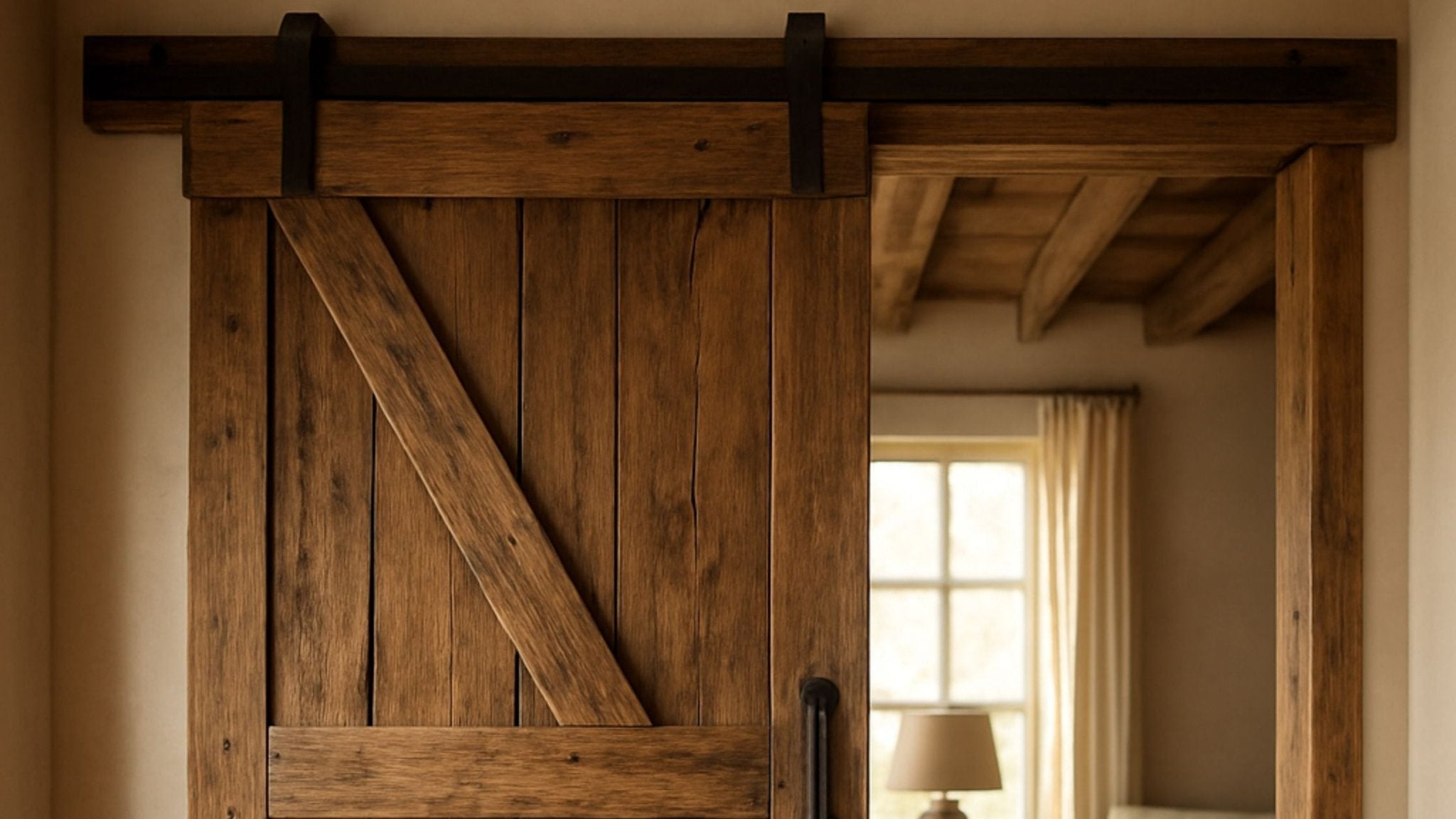
Classic J-Strap barn door hardware kit
How to calculate barn door size — single sliding door
Door width
Standard rooms: Opening width + 4 in = minimum door width
Bathrooms and bedrooms: Opening width + 6 in = privacy door width
A 36 in opening needs at minimum a 40 in door. For a bathroom, go to 42 in. The extra width ensures no light or sight line bleeds around the door edge when it's closed.
Door height
Formula: Opening height + 1 in = door height
An 80 in opening calls for an 81 in door. The extra inch adds coverage at the top of the opening. At the bottom, the door hangs about 3/8 in off the floor — that gap comes from where the track is mounted, not from the door height, and it lets the door slide without dragging. Add more clearance for uneven or outdoor floors (gravel, raised thresholds). Never size a barn door to exactly match the opening height.
Track length
Formula: Door width × 2 = minimum track length
A 40 in door needs at minimum an 80 in track. This allows the door to slide completely clear of the opening. Size the track as close to 2× the door width as your standard lengths allow. When a door slides significantly past the opening edge it looks unintentional — the door should clear the opening cleanly without traveling unnecessarily far beyond it.
For every configuration's track math worked out in one place, see our sliding door track length formulas.
How to measure your opening correctly
Walls and floors aren't perfectly square, especially in older homes. Before calculating anything, take three measurements: width at the top, middle, and bottom; height at the left side, center, and right side. Use the largest number for each dimension — if your opening is 32 in at the top and 32.5 in at the bottom, ordering based on the smaller number means your door won't cover the full opening at its widest point.

Bypass barn door sizing
Bypass configurations use multiple doors that slide past each other. Before calculating door and track sizes, decide whether you want a pass-through setup (doors slide open but always partially cover the opening) or a fully clear opening (doors stack completely out of the way). The goal affects track length significantly.
Single bypass door width formulas
Single bypass doors share one track and must overlap in the center when closed. The overlap amount depends on roller style.
| Doors | Roller type | Door width formula |
|---|---|---|
| 2 doors | Standard (non-spoke) | (Opening width + 10 in) ÷ 2 |
| 2 doors | Spoke wheel | (Opening width + 13 in) ÷ 2 |
| 3 doors | Standard (non-spoke) | (Opening width + 10 in) ÷ 3 |
| 3 doors | Spoke wheel | (Opening width + 13 in) ÷ 3 |
| 4 doors | Standard (non-spoke) | (Opening width + 16 in) ÷ 4 |
| 4 doors | Spoke wheel | (Opening width + 22 in) ÷ 4 |
The added inches account for the center overlap between doors plus 2 in of coverage beyond the opening on each side. For 3-door single bypass, door 3 behaves like a biparting door — no overlap with the bypass pair, which is why the divisor increases to 3 but the added inches stay the same. For 4-door single bypass, the setup is essentially two 2-door single bypass systems meeting in the middle — doors 2 and 3 have no overlap between them.
Single bypass track length
Pass-through setup: Track = opening width + planned door overlap on each side (minimum 4 in total — 2 in per side recommended)
Fully clear opening:
- 2 doors: door width × 3
- 3 doors: door width × 5
- 4 doors: door width × 6
Double bypass door width formulas
Double bypass runs doors on parallel tracks. The doors meet in the middle with a 2 in overlap and extend 2 in beyond each side of the opening.
| Doors | Door width formula |
|---|---|
| 2 doors | (Opening width + 6 in) ÷ 2 |
| 3 doors | (Opening width + 8 in) ÷ 3 |
| 4 doors (biparting center) | (Opening width + 8 in) ÷ 4 |
| 4 doors (overlapping center) | (Opening width + 10 in) ÷ 4 |
For 4-door double bypass: if you want the two center doors to meet flush in the middle like biparting doors, use the +8 in formula. If you want the center doors to overlap (same as the outer doors), use the +10 in formula.
Double bypass track length
Pass-through setup: Track = opening width + planned door overlap on each side (minimum 4 in total — 2 in per side recommended)
Fully clear opening:
- 2 doors: door width × 3
- 3 doors: door width × 5
- 4 doors: door width × 6
Note: standard inventoried bypass products use the same track length for both tracks. If your fully clear opening calculation produces a track longer than your wall space allows, Goldberg Brothers can produce shorter tracks so you're not paying for or mounting unused track — email us at info@thebarndoorhardwarestore.com for a custom quote.
Browse our double bypass hardware and single bypass hardware collections.
Ceiling clearance for bypass configurations
Bypass hardware has different clearance requirements than standard single-track sliding hardware, since two doors or two tracks are involved. Measure from the top of your door to the ceiling before selecting a hanger style.
| Configuration | Hanger style | Clearance needed |
|---|---|---|
| Single bypass | Straight strap | 5 in |
| J-strap | 6 in | |
| Spoke wheel | 8 in | |
| Double bypass | All styles except spoke wheel | 8 in |
| Spoke wheel | 9-1/2 in |
Floor guides for bypass configurations
Single bypass kits include one floor-mounted guide for each flat hanger style, and one U-channel guide for each bent or bypass hanger style. The U-channel guide attaches to the inner door and constrains both doors over greater distances without creating a tripping hazard on the floor.
Double bypass kits include a floor-mounted guide. Note that double bypass floor guides are typically positioned in the center of the opening where no wall is available — a wall-mounted floor guide is not a practical alternative for double bypass installations, unlike single sliding doors. Browse our floor guides collection.

Bifold barn door sizing
Bifold hardware folds panels accordion-style rather than sliding straight across. Sizing works differently from standard sliding hardware — the key measurement is the total door panel width, not the rough opening.
One-way bifold (panels fold to one side)
Minimum coverage and track length depends on whether you want a fully clear opening and whether you want symmetrical coverage:
| Setup | Total door panel width | Track length |
|---|---|---|
| Minimum coverage | Opening + 3 in (2 in pivot side, 1 in non-pivot side) | Total door panel width |
| Fully clear, asymmetrical | Opening + 6 in (5 in pivot side, 1 in non-pivot side) | Total door panel width |
| Fully clear, symmetrical (recommended) | Opening + 10 in (5 in each side) | Total door panel width |
Biparting bifold (panels fold to both sides)
| Setup | Total door panel width | Track length |
|---|---|---|
| Minimum coverage | Opening + 4 in (2 in each pivot side) | Total door panel width |
| Fully clear opening | Opening + 10 in (5 in each pivot side) | Total door panel width |
Track length for bifold equals total door panel width — not opening width, and not door width × 2. The folded panels stack compactly against the wall, so the track only needs to span the total width of the door panels.
For a full breakdown of bifold symmetry considerations, one-way vs. biparting decisions, and how to handle in-frame bifold conversions, see our bifold measuring guide. Browse our bifold hardware collection.

Should you measure to the trim or to the opening?
This is one of the most common sources of sizing errors — the answer depends on what's around your opening.
| Situation | Measure from | Add to door width |
|---|---|---|
| Opening has door casing / trim | Outside edge of trim on one side to outside edge on the other | +2 in total (1 in overlap each side) |
| Opening is sheetrock only, no trim | Raw opening edge to edge | +4 in total (2 in overlap each side) |
| Opening has baseboard but no door casing | Raw opening width; note baseboard depth for spacer calculation | +4 in total; add adjustable spacers to account for baseboard depth |
Common barn door sizing mistakes
| Mistake | What goes wrong | The fix |
|---|---|---|
| Sizing the door to match the opening | Gaps run down both edges, and light and sound bleed through — most noticeable in bathrooms and bedrooms | Add 4 in to the opening width (2 in overlap per side); use 6 in for bath and bedroom privacy |
| Ordering a track the length of the opening | The door can't slide far enough to clear the opening | Track length is 2× the door width — size it to the door, not the opening |
| Measuring the opening at only one point | An out-of-square opening leaves the door short at its widest point | Measure width at top, middle, and bottom (and height at both sides); order to the largest number |
| Measuring to the opening when casing or trim is present | The door lands on the trim, so it won't sit flat or fully cover the frame | Measure to the outside edge of the trim, or plan spacers for the trim depth |
| Forgetting the wall space beside the opening | Not enough room to mount the track, or the door hits a switch, corner, or return wall | Confirm clear wall equal to the door width on the slide side before ordering |
| Using single-door math for a bypass or bifold | Wrong door width and track length for the configuration | Use the bypass or bifold formulas in the sections above |
