
By Evan Christensen · Owner, The Barn Door Hardware Store
Published February 12, 2025 · Updated June 2026
Evan has owned and operated The Barn Door Hardware Store since 2016. Choosing between sliding, bypass, and bifold configurations is the first question he helps most customers answer — and it's almost always determined by the wall space available beside the opening, not by style preference. He and the team are available 7 days a week at info@thebarndoorhardwarestore.com.
The most common question we field from customers early in a barn door project is some version of "which type should I get?" The answer is almost always driven by the physical constraints of the opening — specifically, how much wall space is available beside it — rather than by aesthetic preference. Get that right first and the style decision is straightforward. Get it wrong and you end up with hardware that technically installs but doesn't work the way you expected.
This guide covers the three main barn door configurations — single track sliding, bypass, and bifold — with the specific situations each one is right for and the key constraints of each.
Single track sliding — the most common configuration
A single track sliding door runs on one track mounted above the opening and slides to one side — or both sides in a biparting setup with two doors. It's the most common barn door configuration and the simplest to install.
The key requirement: the full door width of clear wall space beside the opening on the slide side. A 36 in opening needs a 40 in door, which needs 40 in of unobstructed wall to slide fully open. If a light switch, outlet, window, or corner is in the door's path, the door can't fully clear the opening.
- Best for: Openings with adequate wall space on at least one side
- Doesn't work when: Wall space is limited or obstructed on both sides
- Alternative when wall space is limited: Bifold barn door hardware
- Alternative when no wall surface exists above the opening: Ceiling mount hardware
Single track sliding also provides better privacy than bypass configurations. With one door sitting 3/8 in off the wall, the gap between the door face and the wall surface is minimal. Bypass setups require at least one door to ride on an outer track, holding it significantly further from the wall — increasing the air gap around the door perimeter.
Browse our single track sliding hardware.
Bypass — for wide openings with limited side wall space
Bypass configurations use multiple doors that slide past each other on parallel or shared tracks, stacking in front of each other rather than beside the opening. The right solution when you need to cover a wide opening but don't have enough wall space on either side for the panels to stack completely clear.
Single bypass
Two to four doors on one shared track. Only two doors bypass each other at a time — the doors telescope sequentially, which lets the system fully clear the opening with the correct track length (3x the door width for a 2-door setup), even with limited wall space on one side. Because the doors ride one linked, shared track, a single bypass also constrains sway more effectively than a double bypass on two independent parallel tracks, which makes it well suited to holding a wide opening fully clear. The one thing to know is a closed-position trait, not an opening one: the doors overlap each other in the center when shut — 6 in with standard rollers, 9 in with spoke wheel rollers — so they close with a slight offset rather than sitting flush. That overlap closes the center gap for coverage and privacy; it doesn't reduce how far the doors slide open. There's also a usability benefit: because the doors are linked through the telescoping action, pushing or pulling one door eventually engages the other — you only operate one door to open or close the full setup.
- Best for: Wide openings where a fully clear opening and tight sway control are the priority
- Note: Doors overlap in the center when closed (6 in or 9 in), so they sit with a slight offset rather than flush — a closed-position trait, not a limit on how far they open
Double bypass
Two to four doors on two parallel tracks. Doors stack completely in front of each other — the full opening can be cleared simultaneously. Both sides of a pass-through remain accessible at the same time, making double bypass the preferred choice for hallways, room dividers, and any opening that needs to function from both sides.
- Best for: Wide openings where full clearance and pass-through access are needed
- Advantage over single bypass: Doors sit flush with no center overlap when closed, and both sides of a pass-through open at once
Browse our double bypass barn door hardware and single bypass barn door hardware.
Bifold — when wall clearance beside the opening is limited
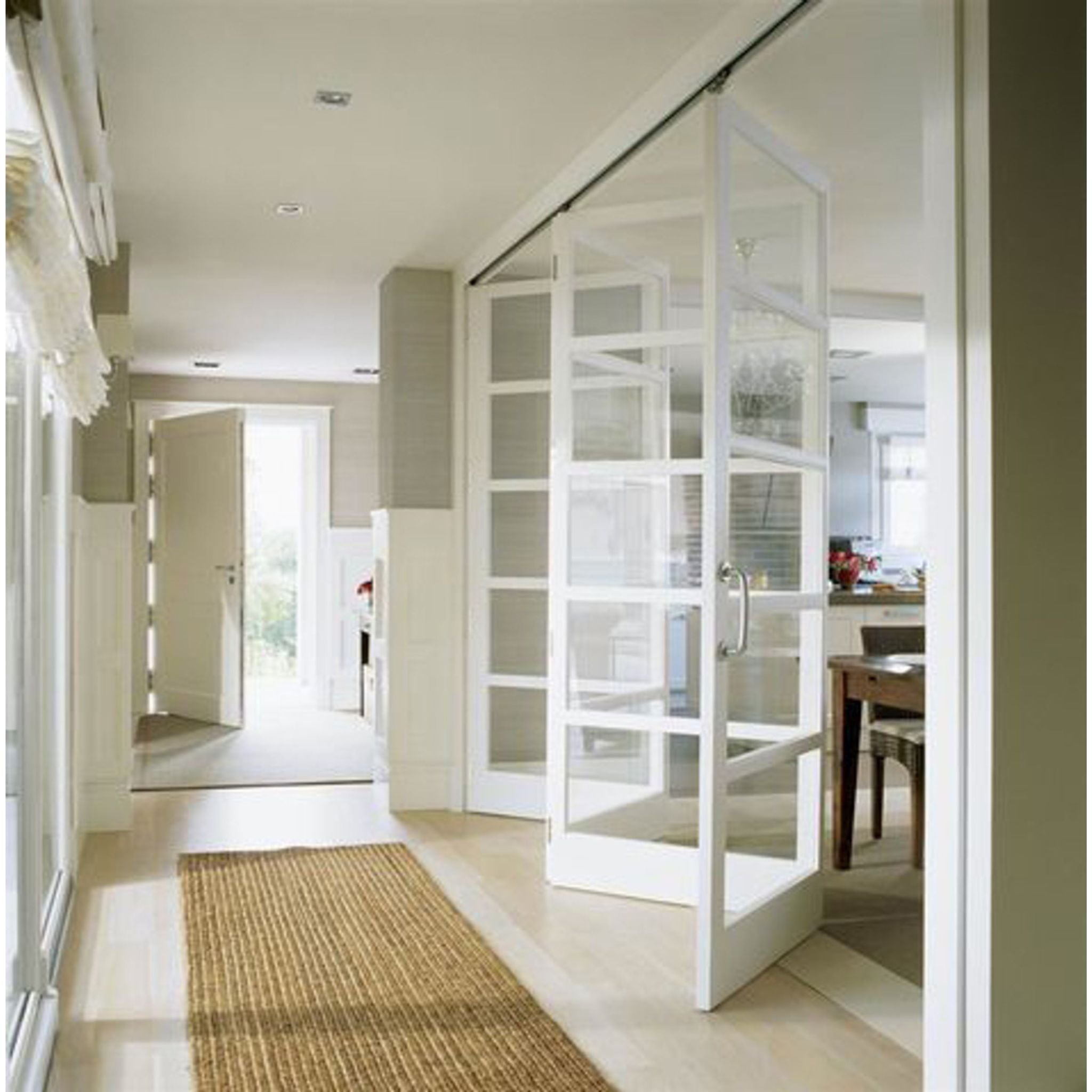
Bifold barn door hardware folds panels accordion-style along a wall-mounted track. The folded panels stack compactly beside the opening rather than sliding fully past it, which means bifold works in spaces where there isn't enough clear wall for a standard sliding door to travel.
Bifold comes in two configurations:
- One-way: All panels fold to one side. Works when clearance only exists on one side of the opening. Requires careful planning around symmetry — see our bifold barn door measuring guide for the formulas.
- Biparting: Panels fold to both sides from the center. The most common configuration for wide openings — gives a symmetrical look and fully clears the opening on both sides.
One tradeoff worth knowing: bifold panels project out from the wall as they fold open. The space saved beside the opening comes at the cost of the panels swinging out into the room during operation. In tight spaces this is usually acceptable, but it's worth confirming you have enough clearance in front of the opening for the panels to fold without obstruction.
On privacy, though, bifold is one of the tighter configurations. The panels sit about 1/2 in off the wall — barely more than a single sliding door's 3/8 in, and far closer than the more-than-2 in standoff a bypass outer door needs. You get the compact footprint and a tight perimeter light gap.
If you have existing in-frame bifold doors and want to replace them with barn door bifold hardware, this cannot be done with the same door panels without significant modification. In-frame and barn door bifold systems have different door sizing and mounting requirements. See our door conversion guide for more detail.
Browse our bifold barn door hardware collection.
Quick comparison
| Single track sliding | Single bypass | Double bypass | Bifold | |
|---|---|---|---|---|
| Wall clearance needed | Full door width beside opening | Minimal — telescoping action | Minimal — doors stack in front | Minimal — panels fold compactly |
| Full clear opening | Yes | Yes — with correct track length | Yes | Yes |
| Pass-through access | One side at a time | One side at a time | Both sides simultaneously | One or both sides depending on config |
| Center overlap when closed | No | Yes — 6 in or 9 in | No | No |
| Soft close available | Yes | No | Yes | No |
| Ceiling mount option | Yes | Yes | Yes | No |
| Wall standoff (privacy) | 3/8 in — tightest | More than 2 in | More than 2 in | 1/2 in |
How to decide which configuration is right for your opening
Start with wall space, not aesthetics:
- If you have full door width of clear wall on at least one side: Single track sliding is the simplest and most common choice. Go here first.
- If wall space is limited on both sides but you need a wide opening covered: Bypass — single if telescoping clearance solves it, double if you need full stacking and pass-through access.
- If wall space beside the opening is genuinely limited and bypass depth isn't an option: Bifold. The panels fold compactly and require less lateral wall space than any sliding configuration.
- If there's no wall surface above the opening to mount into: Ceiling mount for single sliding doors. Note that ceiling mount is not compatible with bifold.
If none of these configurations fit your space, a traditional hinged door may genuinely be the right answer. Barn doors are a better solution than hinged doors in specific situations — particularly where swing clearance is limited — but they're not universally superior. The best door is the one that works for your opening.
Sizing basics for each configuration
Once you've settled on a configuration, the sizing differs for each. Here's the starting point — confirm the exact figure for your kit against its instruction manual before ordering.
Single track sliding
Door width is the opening + 4 in (2 in of overlap per side); for bedrooms and bathrooms, step up to the opening + 6 in (3 in per side) for better privacy. Track length is 2x the door width. Size the track to the door, not the opening.
Bifold
Track length for bifold equals the total door panel width — not the opening width. For a 2-panel one-way bifold that fully clears the opening, total door panel width should be at least the opening + 6 in (5 in on the pivot side, 1 in on the non-pivot side). For a symmetrical biparting setup with equal overlap on both sides, total door panel width should be at least the opening + 10 in (5 in per side). For the full formulas, see our bifold barn door measuring guide.
Bypass
For a 2-door single bypass, each door should be (opening + 10 in) ÷ 2 for standard rollers. For a 2-door double bypass, each door should be (opening + 6 in) ÷ 2. In both cases, track length should be 3x the door width to fully clear the opening. For 3- and 4-door configurations, see our full sizing guide.
Common questions
What's the difference between bypass and bifold barn doors?
Bypass doors slide past each other on parallel or shared tracks and stack in front of the opening. Bifold panels are hinged together and fold accordion-style, stacking compactly beside the opening. Both solve the same problem — not enough clear wall for a single sliding door to travel — but bypass trades that wall space for stacking depth in front of the opening, while bifold trades it for panels that swing out into the room as they fold.
Do bypass barn doors fully open?
Yes — both single and double bypass fully clear the opening when the track is sized correctly (3x the door width for a 2-door setup). On a single bypass, the 6 in / 9 in center overlap is how far the doors overlap each other when closed, not an obstruction that stays in the opening — with the right track length the telescoping doors slide fully aside. The real difference is at the closed position and in pass-through: a double bypass runs on two parallel tracks, so its doors close flush and both sides of a pass-through open at once, while a single bypass closes with a slight center offset but constrains sway better on its one shared track.
Which barn door type is best for a closet?
It depends on the wall beside the opening and whether you need to reach the whole closet at once. Reach-in closets with limited side wall usually come down to bypass vs bifold — see our closet door slider hardware guide for the trade-offs.
Can you convert existing bifold doors to barn door bifold hardware?
Not with the same panels. In-frame and barn-door bifold systems use different door sizing and mounting, so existing in-frame panels need significant modification or replacement. See our door conversion guide for detail.
Does every barn door need wall space beside the opening?
Only single track sliding does — it needs the full door width of clear wall on the slide side. Bypass and bifold are the alternatives when that side wall space is limited or obstructed on both sides.
Going deeper on a single configuration
Once you've narrowed down the configuration, these guides cover the details specific to each:
- Bifold vs bypass barn doors — the two head to head on space, privacy, and clearing the opening, once single track sliding is ruled out.
- Closet door slider hardware — bypass vs bifold specifically for reach-in and walk-in closets.
- Double barn door guide — biparting, bypass, and bifold for two-door openings.
- Bifold barn door measuring guide — the one-way and biparting sizing formulas.
Not sure which configuration fits your opening?
Email us at info@thebarndoorhardwarestore.com with your opening width and a description of the wall space beside it — how much is available on each side, and whether there are any obstructions. We can usually confirm the right configuration in one reply. Available 7 days a week.
