
By Evan Christensen · Owner, The Barn Door Hardware Store
Published April 26, 2026 · Updated July 2026
Evan has owned and operated The Barn Door Hardware Store since 2016. "Double barn door" is one of the most common terms customers use to describe several very different configurations — and choosing the wrong one before ordering is one of the most avoidable mistakes we see. He and the team are available 7 days a week at info@thebarndoorhardwarestore.com.
When customers say they want "double barn doors," they usually mean one of three completely different things: two doors meeting in the center on a single track (biparting), two doors sliding past each other on parallel tracks (bypass), or two panels that fold compactly beside the opening (bifold). Each configuration works differently, requires different hardware, and has different wall clearance requirements. Get the right one matched to your opening before ordering. This guide covers all three.
Deciding between a single door and a double-door setup in the first place? Start with our sliding vs bypass vs bifold guide, then come back here once you know a two-door configuration is what you need.
Configuration 1: Biparting (two doors, one track, meet in the center)
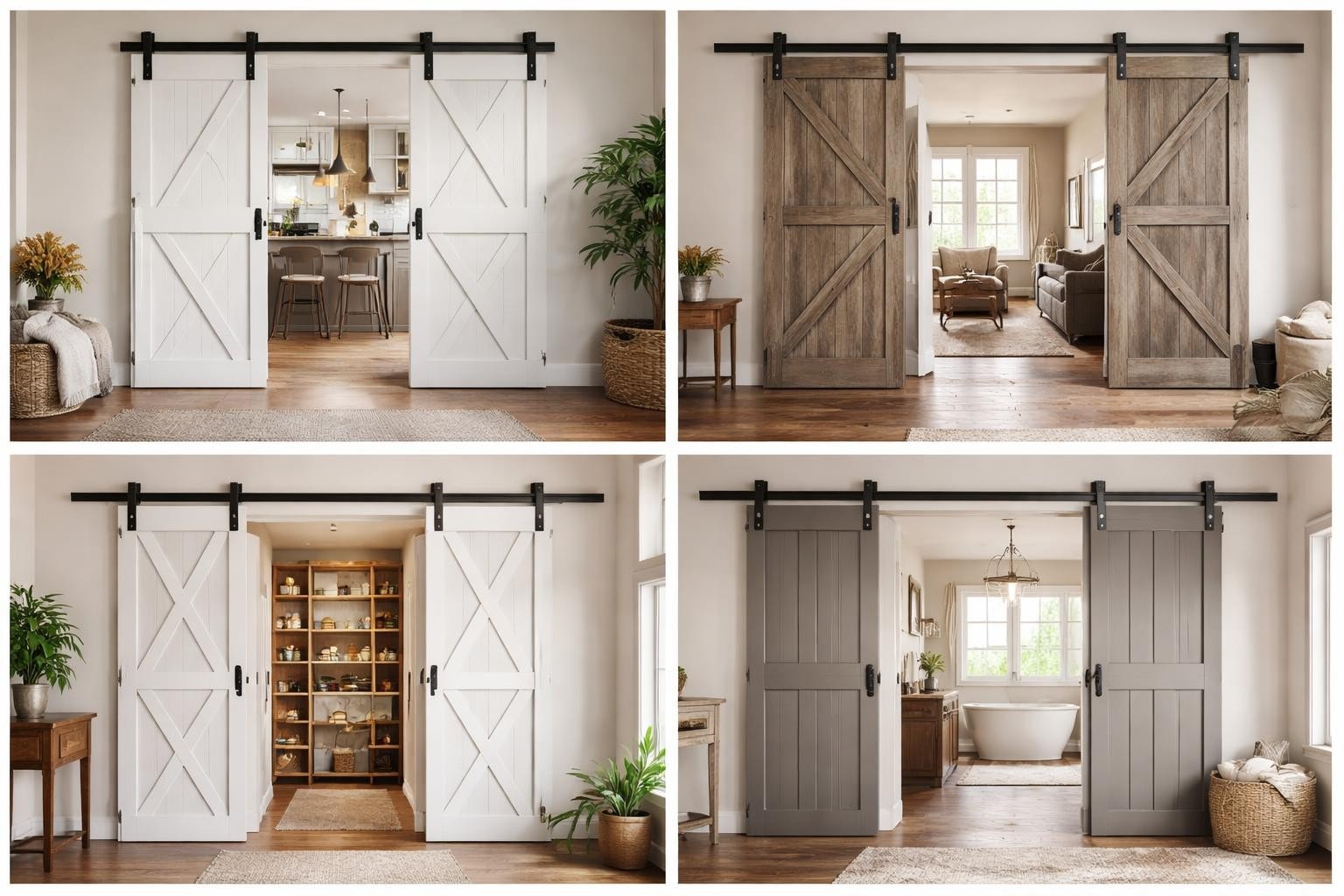
A biparting setup — sometimes called a converging double door, or simply two sliding doors side by side — uses a single shared track. Two door panels each hang from opposite ends of the track and slide toward each other, meeting in the center when closed. When opened, each door slides to its own side, leaving the full opening clear.
This is the configuration most people picture when they think "double barn doors" — the symmetrical split from the center, the closest sliding equivalent to a set of French doors. It reads as intentional and balanced from both sides of the opening, which is why it's popular for wide interior openings, room dividers, and any situation where the hardware is a design feature.
Wall clearance
Each door needs clear wall space equal to one door panel width on its respective side. For a 60" opening with two 32" doors, you need 32" of clear wall on each side. Walk the full travel path on both sides before ordering — light switches, outlets, and trim within the door's travel are the most common obstruction.
Sizing
- Each door width: (opening ÷ 2) + 2" — each panel overlaps the wall 2" per side when closed
- Track length: 4× door width
Privacy and soft close
When closed, the door edges meet in the center on the same plane — there is no overlap. For bedroom and bathroom applications, size each door with enough width that the edges meet cleanly with no gap. A latch keeps the doors reliably closed and prevents drift. Soft close is available on biparting configurations. Browse our single track hardware for standard and Goldberg Brothers options, or see our ready-made double door barn door kits if you want the two panels and biparting hardware together in one box.
Configuration 2: Bypass (two doors that slide past each other)
Bypass covers two variants that both slide the doors past each other rather than to separate sides: single bypass runs two doors on one shared track with a telescoping mechanism, and double bypass runs two doors on two parallel tracks that operate independently. Both are good answers when wall clearance is limited on each side, since the doors don't each need a full door width of clear wall the way biparting does. The differences are in how they park and whether soft close is available.

Single bypass (one shared track)
Single bypass hangs both panels from a single shared rail and slides them past each other through a telescoping mechanism — pushing or pulling one door engages the other, so both open and close together with one movement. The telescoping action lets the doors clear the opening without each needing a full door width of side wall, which is its advantage over biparting in tight spaces such as closets, pantries, and laundries. The tradeoffs: when parked to one side the panels stay partially offset rather than fully stacking, so single bypass parks less compactly than double bypass, and when closed the panels carry a fixed center overlap — 6" for standard rollers, 9" for spoke wheel rollers — so they never sit flush against each other.
- Each door width: (opening + 10"; 13" for spoke wheel hangers) ÷ 2 — the added width covers the mandatory center overlap plus 2" of wall overlap per side
- Door height: opening height + 1"
- Track length for fully clear opening: 3× door width
- Soft close: not available on single bypass
Single bypass also scales to 3 or 4 doors on wider openings, with longer track-length multipliers for each additional door. Browse our single bypass hardware for those options, or see our single vs. double bypass guide for a full comparison.
Double bypass (two parallel tracks)
Double bypass uses two parallel tracks mounted one in front of the other. Each door panel runs on its own track independently. By default there's no telescoping link between them — each door is operated separately — though telescoping is available as an add-on with Goldberg Brothers double bypass kits, linking the doors for coordinated movement. The panels slide past each other (one in front, one behind) and fully stack behind each other when pushed to one side, occupying approximately one door width of wall space when open — the least lateral footprint of any two-door slider, which suits pass-through openings and room dividers you want to walk through from either side.
If bypass is the right fit, the Arrow Black Double Bypass kit and Diamond Black Double Bypass kit are both quick-ship options that work well for standard two-door openings.
- Each door width: (opening + 6") ÷ 2 — the 6" accounts for overlap when closed (plan for 2–3" overlap per side for privacy applications)
- Door height: opening height + 1"
- Track length for fully clear opening: 3× door width
- Soft close: available on double bypass
When closed, the panels overlap by 2–3" per side — no permanent center gap. Browse our double bypass hardware.
Bypass hardware comes in kit form with the track(s), correct spacing hardware, and all mounting hardware included. Don't attempt to build a bypass system from two single-track kits — the track spacing and roller geometry are different.
Configuration 3: Bifold (panels fold accordion-style beside the opening)
Bifold barn door hardware uses panels hinged together that fold accordion-style as the door opens. On a standard 2-door bifold, one end of the assembly slides along the track while the other end pivots from a fixed bracket. When opened, the panels fold and stack compactly beside the opening — requiring much less lateral wall space than a standard sliding door.
Bifold is the right choice when wall clearance is limited on both sides of the opening and even bypass stacking would require more space than you have. The folded stack is compact enough to work in spaces where no other configuration fits.
Wall clearance
Minimal — the folded stack is approximately 5" per pair of panels — two 30" panels fold down to roughly 5" wide. This is what makes bifold the most space-efficient option for tight installations: a 60" opening covered by two 30" panels requires only about 5" of wall space beside the opening when open.
Sizing
- Total panel width (symmetrical, fully clear): Opening + 10" (5" overlap per side)
- Track length: Total panel width — not 2× as with standard sliding hardware
For a 36" opening: total panel width = 46", track = 46", each panel approximately 23" wide.
Key differences from standard sliding hardware
- Bottom pivot: Goldberg Brothers bifold hardware uses a wall-mounted bottom pivot on the pivot side. Quick Ship uses a floor-mounted pivot.
- No floor guide: Bifold uses a bottom pivot rather than a floor guide.
- No soft close: Soft close is not available for bifold configurations.
- No ceiling mount: Ceiling mount is not an option for bifold hardware.
Browse our bifold hardware collection for 2-door and 4-door biparting configurations. The 2-door bifold works for openings up to 93"; the heavy duty 4-door biparting bifold handles openings up to 188".
Which configuration is right for your opening?
| Biparting | Single bypass | Double bypass | Bifold | |
|---|---|---|---|---|
| Tracks | 1 track | 1 shared track | 2 parallel tracks | 1 external-mount track |
| Door action | Each slides to its own side | Telescoping — one push moves both | Each door independent, stacks behind the other | Panels fold compactly to one side |
| Wall clearance needed | One door width on each side | Less than biparting; parks partially offset | Least — doors fully stack | Minimal — panels fold |
| Frontal clearance needed | No | No | No | Yes — panels project as they fold |
| Center overlap when closed | None — edges meet in the center, same plane | 6" (or 9" spoke wheel) — fixed | 2–3" per side | No center gap |
| Soft close available | Yes | No | Yes | No |
| Best for | Wide openings with wall clearance on each side; symmetrical look | Tight walls where the opening must fully clear; closets, pantries | Limited wall clearance; pass-through access | Very limited wall clearance; closets and pantries |
Sizing quick reference
The most common ordering mistake: sizing the track to the opening instead of to the door. The door must be wider than the opening, and the track must accommodate the door — not just the opening.
| Configuration | Each door width | Track length |
|---|---|---|
| Biparting | (Opening ÷ 2) + 2" | 4× door width |
| Single bypass (2 doors) | (Opening + 10"; 13" spoke wheel) ÷ 2 | 3× door width |
| Double bypass (2 doors) | (Opening + 6") ÷ 2 | 3× door width |
| Bifold (symmetrical) | (Opening + 10") ÷ 2 | = Total panel width (not 2×) |
Worked examples for a 60" opening:
- Biparting: Each door = 32" · Track = 128" (4× 32")
- Single bypass: Each door = 35" · Track = 105" (3× 35")
- Double bypass: Each door = 33" · Track = 99" (3× 33")
- Bifold: Each panel = 35" · Track = 70" (= total panel width)
For the full sizing breakdown including bedroom and bathroom overlap recommendations, see our barn door dimensions guide.
Hardware and what's included
All hardware kits include track, rollers, hangers, track stops, anti-jump disks, floor guide, and all mounting hardware. Door panels are not included — we recommend sourcing locally from a lumber yard or millwork supplier rather than shipping a door panel, which adds significant freight cost.
What kits don't include — plan for these before ordering:
- Handles: Standard and heavy duty kits don't include handles. Browse our handles collection.
- Latch: Not included in any kit. Browse our locks and latches collection.
- Wall-mounted floor guide: Kits include a floor-mounted guide. If you have finished flooring you can't drill into, a wall-mounted guide is needed. Browse our floor guides.
One thing you don't need to buy separately: the trim clearance kit. Standard duty kits already include it — 1" and 1/2" spacers plus longer lag bolts that stand the track off the wall to clear existing casing, baseboard, or trim up to 1-1/4". On heavy duty kits it's an optional add-on you select with the product options rather than a separate order. Over 1-1/4" of trim, email us before ordering.
Choose hardware rated at or above your door's weight. No safety factor multiplier is needed — the capacity ratings are working limits. For door weight estimates by material, see our barn door weight guide.
Installation basics
All of these configurations mount to a solid header above the opening. In most installations this means a 1×6 hardwood board (oak, maple, or poplar — not pine) spanning the full track length, secured into the wall studs behind it. Drywall alone will not support the load.
Level is the most important installation step. Even a small grade causes doors to drift toward the low end. Check level across the full track length before tightening any mounting hardware.
Specific installation considerations by configuration:
- Biparting: Standard single track installation. Same header board and track mounting as any single sliding door setup.
- Bypass: Single bypass mounts one shared track; double bypass needs a header board deep enough to carry two parallel tracks side by side. For double bypass, both tracks must be level with each other — check level both individually and relative to each other.
- Bifold: The bottom pivot must be precisely aligned vertically with the track pivot point above. Misalignment causes the panels to bind rather than fold smoothly.
For the full step-by-step installation walkthrough, see our barn door installation guide.
Common ordering mistakes
- Sizing the track to the opening, not the door. The track must accommodate the door panel, which must be wider than the opening. This is the most frequent ordering mistake across every configuration.
- Not walking the door's travel path before ordering. A light switch or outlet 30" from the opening edge limits how far a biparting door can slide — the door can only open until it hits the obstruction. Walk both sides of a biparting opening and both stack zones of a bypass opening before ordering.
- Ordering bypass hardware when biparting is what you want. Bypass hardware is not interchangeable with single track. The track spacing, roller geometry, and mounting hardware are different. Buy the right configuration to begin with.
- Not accounting for trim around the opening. If casing, baseboard, or trim projects 1/2" or more, the track needs to stand off the wall to clear it. Standard duty kits already include the trim clearance kit for this; on heavy duty, add it with the product options at checkout. It handles trim up to 1-1/4" — over that, email us before ordering.
- Forgetting the header board. Drywall alone will not support any barn door system, including light bypass and bifold configurations. A solid wood header board spanning the full track length is required unless blocking was installed during construction.
- Assuming bifold doesn't need frontal clearance. Bifold panels project away from the wall as they fold. Confirm there's clearance in front of the opening — furniture, appliances, and people in the door's arc are the most common overlooked issue.
Maintenance
Goldberg Brothers hardware uses sealed bearings that run dry — no lubrication is required or recommended for any configuration. Do not apply silicone spray, WD-40, oil, or any lubricant to the track or rollers. Lubricant attracts debris, builds up over time, and increases rolling resistance rather than reducing it.
The main maintenance task is keeping the track channel clear of dust and debris — wipe with a dry cloth periodically. For double bypass configurations, check that both tracks remain parallel and that the spacing between them hasn't shifted. For bifold configurations, check the bottom pivot bracket and center hinge for wear and tightness. See our hardware maintenance guide for the full breakdown.
Not sure which configuration fits your opening?
Email us at info@thebarndoorhardwarestore.com with your opening width, available wall clearance on each side, and whether you need the opening fully clear or can manage with partial access — we'll confirm the right configuration and track length before anything ships. Browse our full hardware collection or use our hardware finder to get started. Available 7 days a week.
