
By Evan Christensen · Owner, The Barn Door Hardware Store
Published October 5, 2024 · Updated April 2026
Evan has owned and operated The Barn Door Hardware Store since 2016. Classic single-panel sliding doors are where most of our customers start — and the project most people find more approachable than they expected. He and the team are available 7 days a week at info@thebarndoorhardwarestore.com.
If you've been thinking about adding a classic sliding barn door to your home, you're in good company. Over the past decade we've helped more than 10,000 customers through the process — from first-time DIYers measuring a doorway for the very first time to contractors outfitting entire homes. The most common thing we hear once someone's door is up? "I wish I'd done this sooner."
This guide covers everything you need to know: what makes a classic sliding barn door different from other styles, how to choose the right door material and hardware finish, what measurements actually matter, and how to avoid the installation mistakes we see most often. By the end, you'll know exactly what to order and have the confidence to install it yourself.
What Is a Classic Sliding Barn Door?
A classic sliding barn door is a single panel door that hangs from a top-mounted track and slides horizontally along the wall rather than swinging open on hinges. Because the door moves parallel to the wall, it never needs clearance in front of or behind it — which is exactly why it works so well in spaces where a traditional hinged door feels awkward.
The "classic" designation refers to the mounting style (external overhead track) and panel design (typically a flat, Z-brace, or X-brace plank construction). This is distinct from bypass barn doors (two panels on overlapping tracks), bifold barn doors (panels that fold accordion-style), or pocket doors (which disappear inside the wall). If someone refers to a barn door without any other qualifier, they almost always mean this classic single-panel sliding style.
Why Homeowners Choose Classic Sliding Barn Doors
Space savings that actually make a difference. A standard 36" hinged door sweeps through roughly 7 square feet of floor area when it opens. A sliding barn door takes up zero floor space. In a hallway, a small bathroom, a laundry closet, or a pantry, that difference is immediately noticeable — especially in homes under 2,000 square feet where every square foot counts.
Design flexibility that suits almost any style. Classic barn doors work across a remarkably wide range of interior aesthetics. A white shaker-panel door with matte black hardware feels right at home in a modern farmhouse kitchen. The same opening outfitted with a reclaimed wood plank door and an industrial steel track reads as urban loft. A painted MDF door with silver metallic hardware can disappear into a contemporary condo. The door and the hardware do a lot of the design heavy lifting — which is why choosing them together matters.
A DIY-friendly project. For most homeowners with basic tools and a free afternoon, this is genuinely manageable. Our kits include everything you need — track, rollers, floor guide, stoppers, and mounting hardware — along with detailed installation guides. The main thing that trips people up isn't the actual installation, it's the measuring. We'll cover that in detail below.
Choosing Your Door Panel: Material and Style
The door panel itself is separate from the hardware. Here's how to think about the main options.
Solid wood gives you the most authentic look and the most natural variation in grain. Pine is the most affordable option, but we'd caution against very soft pine for heavy daily-use doors — it dents and warps more easily over time. For durability, hardwoods like white oak, red oak, or maple are significantly better. On a solid wood panel wider than 60 inches, add a third roller to prevent warping across the span. Between 48 and 60 inches a third roller is optional; under 48 inches, two rollers are plenty.
Panel construction and style. Beyond the material, the way a panel is built sets its look. Plank and Z-brace or X-brace doors read the most rustic; board-and-batten is the classic farmhouse profile; Shaker and flat-panel doors lean cleaner and more transitional. A louvered panel trades some privacy for airflow, which works well on a closet, pantry, or laundry door that needs to breathe.
MDF and engineered wood are more dimensionally stable than solid wood and take paint extremely cleanly, making them a great choice for contemporary or painted looks. They're heavier per square foot than solid pine, so verify the weight capacity of your chosen hardware kit before ordering.
Pre-built barn door panels and kits — like our Classic Single Door Barn Door Kits and Classic Double Door Barn Door Kits — pair a finished door panel with matching hardware, which takes the guesswork out of compatibility. These are a smart starting point if you don't want to source the door and hardware separately.
Choosing Your Hardware: Finish, Style, and Function
This is where the character of your barn door really comes together. A few things to think through:
For a full breakdown of the hanger styles and what each one holds, see our guide to choosing single track barn door hardware.
Finish. Matte black is by far the most popular finish right now and suits both modern farmhouse and contemporary styles. Silver metallic reads cleaner and more minimal, while arch bronze brings a warmer, more traditional tone. If your project is in a coastal environment or a space with high humidity exposure, we strongly recommend our stainless steel barn door hardware — standard powder-coated steel can rust over time in those conditions.
Roller style. The roller is the most visible part of the hardware and the most expressive design element. Our collection includes options ranging from a simple J-strap or straight-top-mount for a minimal look, to decorative styles like the Horseshoe, Spoke Wheel, Spoked Gear, and Flame designs for something with more visual character. Each roller style has its own dimensional profile — always check the clearance specs for your chosen roller before finalizing your track height.
Track weight rating. Standard hardware kits handle most interior single-panel doors. If your door is heavy (solid hardwood, large format, or over 200 lbs), move up to our heavy duty barn door hardware kits, which are engineered for heavier loads and provide a more robust long-term installation.
What comes in a hardware kit. Every kit from us includes the track (custom-cut to your specification), rollers, floor guide, stoppers, and mounting hardware. You'll add handles and pulls separately based on your preference — from flush pulls (which sit recessed into the door face for a clean look) to barn door handles in both farmhouse and modern profiles.
Getting the Measurements Right
This is the step most people underestimate, and it's the one that determines whether your door works properly.
Door width. Your door panel should be 2 inches wider than the opening on each side (3 inches for bedrooms and baths) — so for a 36" opening, you want a door that's about 40" wide. This ensures the opening is fully covered when the door is closed.
Track length. As a rule of thumb, your track should be approximately twice the width of the door panel. For a 40" door, that means an 80" track, which gives the door room to slide fully open without the panel still partially covering the opening. Our tracks are custom-cut to any length — for tracks over 7'6", we ship in sections with junction plates for a seamless connection.
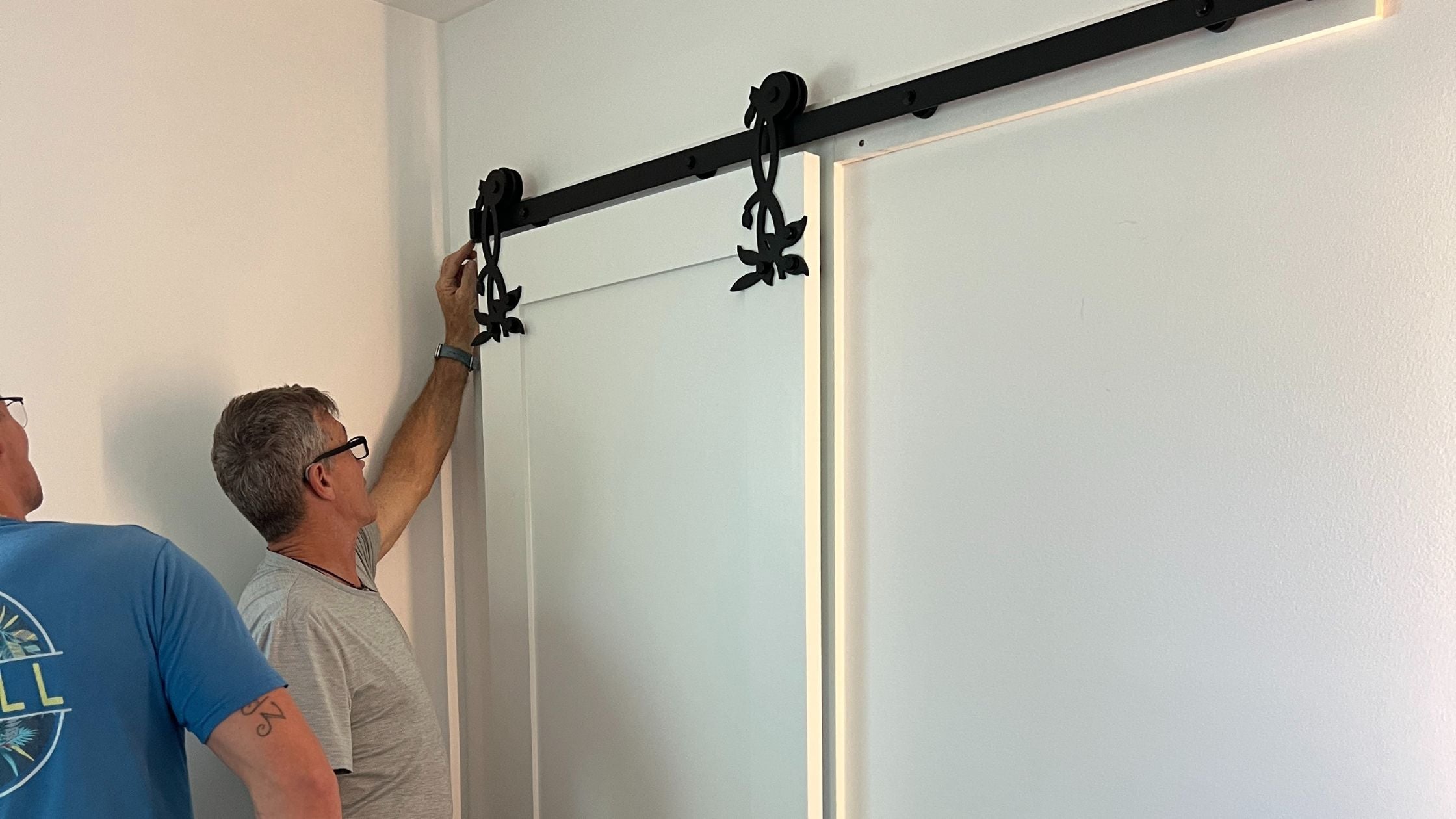
Header board. This is non-negotiable. Because barn door hardware mounts externally to the wall above the opening, it carries the full weight of the door from two or three mounting points. You need either solid blocking inside the wall or an external header board (ledger board) mounted securely into studs. At minimum, the header board should be 1" thick and 6" wide, extending to the next stud beyond each end of the track on both sides.
Wall clearance. The door panel needs to sit out from the wall enough to clear the door trim and any molding around the opening. Check the clearance specs for your specific roller — each model has a published "projection from wall" measurement in our Hardware Measurements guide.
Floor guide. The included floor guide is essential. It attaches to the floor and keeps the bottom of the door aligned, preventing it from swinging away from the wall. Don't skip it.
Classic Sliding Barn Door vs. Other Barn Door Types
Not sure whether a classic single-panel sliding door is the right choice for your space? Here's a quick comparison:
| Classic Sliding | Bypass | Bifold | |
|---|---|---|---|
| Number of panels | 1 | 2 | 2–12 |
| Wall space needed | Equal to 1 door width | Equal to 1 door width | Minimal |
| Opening covered when open | Partially | Fully | Fully |
| Best for | Single doorways up to ~48" wide | Wider openings (closets, room dividers) | Wide openings where wall space is limited |
| Complexity to install | Low | Moderate | Moderate–High |
The classic sliding door is the right choice when you have a standard single doorway and enough wall space beside the opening for the door to slide clear. If the wall beside your opening is interrupted by another door, a window, or a corner, bypass or bifold hardware may be a better fit.
Common Installation Mistakes (and How to Avoid Them)
After helping thousands of customers, here are the issues we see most often:
Mounting into drywall only. The track needs a solid 1×6 hardwood header board — oak, maple, or poplar, not pine — spanning the studs behind it. Anchoring into drywall alone will result in the hardware pulling away from the wall under the weight of the door — sometimes immediately, sometimes over time. Use a stud finder and confirm your mounting points before drilling.
Track too short. When the track length equals only the width of the door rather than twice the door width, the door can't fully open. Double-check this calculation before you order.
Skipping the floor guide. A sliding barn door without a floor guide will swing outward from the wall, potentially damaging the door, the wall, or anything in its path. The floor guide is included in every kit for a reason.
Skipping a third roller on a wide door. A door over 60 inches wide needs a third roller to spread the load and keep it from warping across the span. Between 48 and 60 inches it's optional; under 48 inches, two rollers are enough.
Frequently Asked Questions
Do classic sliding barn doors provide privacy? They provide a reasonable level of visual privacy — the door fully covers the opening when closed. They are not airtight and will allow some sound to pass through, so they're not ideal as a primary bedroom door if noise isolation is a priority. For a bathroom or closet, they work well.
Can I lock a sliding barn door? Yes. We carry locks and latches specifically designed for sliding barn doors, including options that work from both sides.
How much wall space do I need beside the opening? You need at least as much clear wall space as the width of your door panel (plus a few inches of buffer). For a 40" door, you need roughly 42–44" of clear wall beside the opening.
What is the right track length for my door? Approximately twice the width of the door panel. Use our Hardware Finder or reach out to our team and we'll confirm the right size for your specific setup.
Can barn doors be used as exterior doors? Standard powder-coated hardware is not designed for direct weather exposure. For covered exterior applications (a screened porch, a covered entryway), it can work, but we recommend our Stainless Steel Hardware for any application where moisture is a factor.
Can I install a barn door myself? Yes — it's one of the most popular DIY home improvement projects we support. Our kits come with step-by-step instructions, and our team is available 7 days a week by email if you run into questions during installation.
What wood is best for a barn door panel? For a natural wood look, white oak and red oak are strong choices. For painted doors, MDF paints more smoothly and is dimensionally more stable. Avoid very soft pine for high-traffic applications.
Ready to Get Started?
Browse our full range of Classic Sliding Barn Door Hardware Kits — every track is custom-cut to your exact length at no extra charge. Not sure what you need? Our Hardware Finder walks you through the selection process step by step, or email us at info@thebarndoorhardwarestore.com and our team will get back to you, usually the same day.
