
By Evan Christensen · Owner, The Barn Door Hardware Store
Published November 11, 2025 · Updated April 2026
Evan has owned and operated The Barn Door Hardware Store since 2016. The bedroom is the room he gets asked about most when it comes to barn doors — privacy and sound are real considerations, and setting honest expectations upfront makes for much happier customers. He and the team are available 7 days a week at info@thebarndoorhardwarestore.com.
The bedroom is a trickier call than most rooms for a barn door. It's the one space where privacy and sound genuinely matter day to day, so it's worth going into the decision with a clear picture of what a barn door does well in a bedroom and where it falls short — not just the styled photos.
What barn doors do well in a bedroom
The look
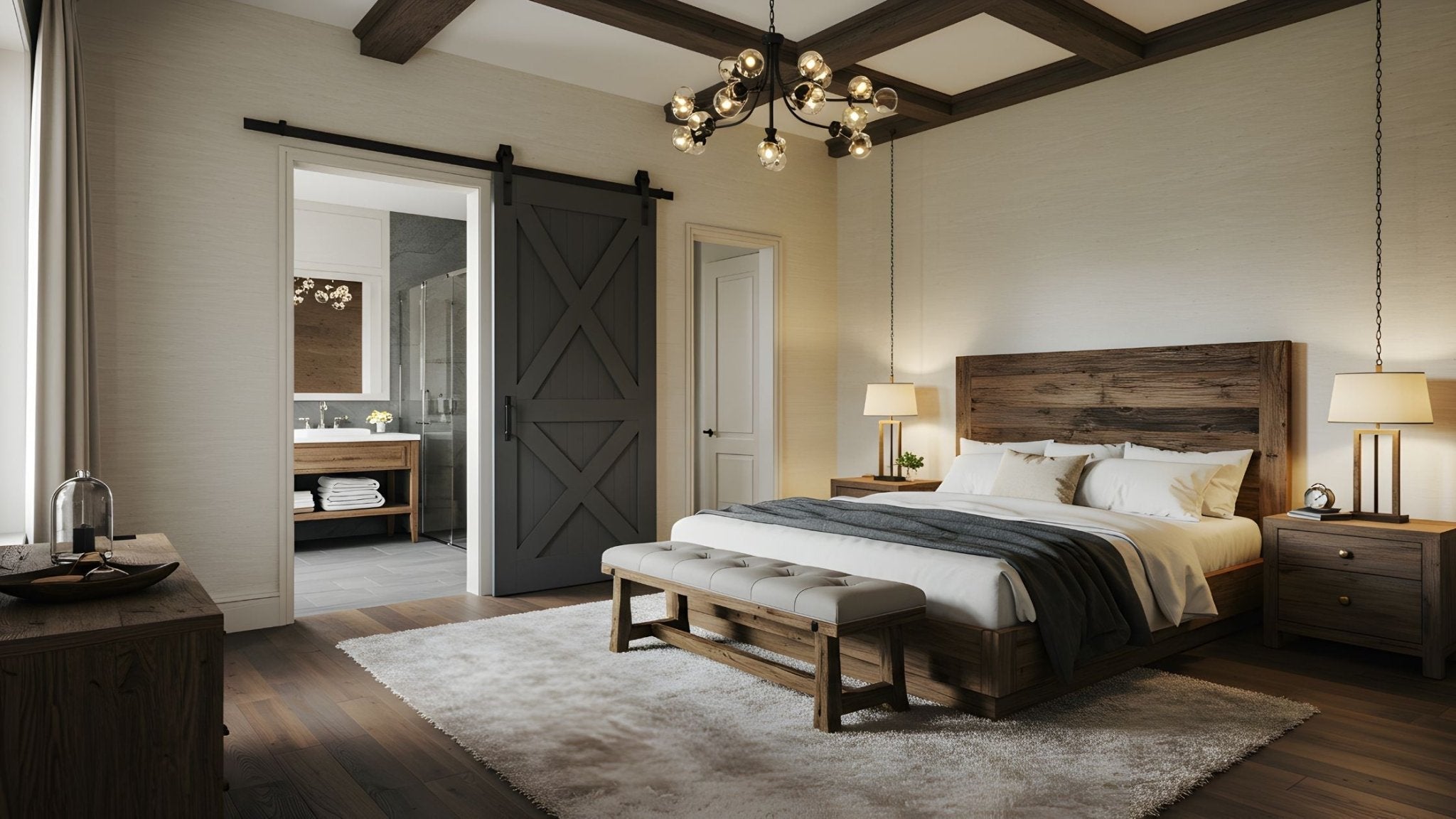
A barn door is a visible design element in a way a standard hinged door isn't — the hardware, the door panel, the track all read as intentional rather than incidental. It works across a wide range of styles: matte black hardware with a clean panel reads modern, bronze or strap hardware with a wood panel reads farmhouse, and the same basic system adapts to industrial or eclectic spaces with the right hardware selection.

Space savings
A hinged door needs clearance to swing — often eating into a corner that could otherwise hold a dresser or let you place the bed differently. A barn door eliminates that swing entirely, which matters more in smaller primary bedrooms where every square foot of usable layout counts. How much floor space you actually recover depends on your room layout, but if you've been working around an awkward door swing, the difference is noticeable — our barn door ideas for small spaces guide covers tight-room layouts in more detail.
Partial opening
A sliding door can be left open to any position, not just open or closed. That's useful for air circulation overnight, letting a pet through without dealing with a door stop, or keeping a partial line of sound to hear if kids wake up. It's also easier to operate one-handed when your hands are full — no doorknob to turn.
Practical hardware benefits
Soft-close hardware is worth calling out specifically here. A hydraulic damper catches the door in the last few inches of travel and brings it to a controlled stop rather than letting it slam — genuinely useful for light sleepers. Beyond that: the door can't swing open on its own from HVAC pressure changes, kids and pets can't accidentally lock themselves in a room with no interior lock, and sliding requires less grip strength than turning a knob, which matters for anyone with mobility or arthritis concerns.

What to weigh before committing
Privacy
Standard barn door installations have gaps — typically 1/4 to 1/2 inch around the edges. Light passes through more than with a hinged door, sound travels more easily than through a solid door sealed into a frame, and there's no lock unless you add one separately.
These are addressable, not eliminated. Pile or brush pile weatherstrip meaningfully reduces edge gaps — it's the only weatherstrip type that works on a sliding door without creating drag. A privacy latch keeps the door from sliding open on its own, though it's not a security lock. Soft-close hardware cuts down operational noise significantly. Combined, these address most day-to-day privacy concerns for a bedroom. For the full rundown of gaps, light bleed, and sound, see our barn door privacy guide; for lock choices specifically, see how to lock a sliding barn door or browse our locks and latches collection.
Even with all of that, a barn door's privacy is different from a hinged door's — not necessarily worse, but different, and worth being honest with yourself about which situation you're in:
Matters more when:
- It's a guest bedroom where visitors expect traditional privacy
- It's a teen's room where some separation supports their independence
- The bedroom shares a wall with main living areas
- You have roommates or a multi-generational household
Matters less when:
- It's the primary bedroom in a single-family home with only you in it
- The bedroom is on a separate floor from common areas
- You already use white noise or a fan
- You're comfortable with the tradeoff for the aesthetic
Wall space
The door needs clear wall space roughly equal to its width to slide open — no light switches, no artwork you're attached to, no outlets you need regular access to in that path.
Do the math before deciding: for a bedroom, size the door to 3 in of overlap per side (versus the 2 in standard for other rooms), so a standard 36 in opening should get a 42 in door — which needs roughly 42 in of clear wall space to slide fully open. Measure your actual wall before committing — furniture placement, a gallery wall, or a nightstand position may need to change to make room.
Resale considerations
Reception varies by market and room. Some buyers see a barn door as a style upgrade; others see it as something they'd want to undo. Primary bedrooms tend to get more acceptance than kids' rooms, and markets that lean modern farmhouse respond better than more traditional or formal markets.

If you're planning to sell within the next two or three years, it's worth understanding your specific local market before installing one. If this is a longer-term home, design for what you actually want to live with.
Installation
This isn't a like-for-like swap with a hinged door. The hardware needs solid backing — either wall studs in the right position or a header board installed to distribute the weight. Bedroom barn doors typically run 60–100 lbs, and the track needs to support that load while sliding smoothly. If your wall is just drywall with no backing behind it, you'll need to add structural support first.
This is a manageable DIY project for someone reasonably comfortable with tools, but it takes more care than a lot of video tutorials suggest. The header board and track leveling are the two steps that determine how well everything else works. A floor guide at the base keeps the door from swinging or rattling against the wall — a small part that makes a big difference in how solid the door feels day to day.
Where barn doors are a good fit in a bedroom
- A small bedroom where the door swing is taking up space you need
- A primary suite in a single-family home, where privacy concerns are lower
- A room with high ceilings, where the door becomes a real visual feature
- A loft or open-concept layout
- Anyone willing to invest in quality hardware and proper installation
Where a traditional hinged door is the better choice
- Roommate or multi-generational living situations
- Limited or no wall space for sliding clearance
- Maximum soundproofing is a hard requirement
- You're renting and need landlord approval for a permanent installation
- A child's bedroom, if you're not comfortable with the sliding mechanism or door weight
- A formal traditional home where the style wouldn't fit
- You're renovating specifically for resale in a conservative market
A middle-ground approach
If you're torn, a hybrid approach is common and works well: install a barn door for the spaces with no privacy tradeoff — a walk-in closet, an ensuite bathroom entrance, a home office nook — and keep the primary bedroom door, kids' rooms, and guest rooms traditional. Plenty of homeowners do exactly this rather than committing to barn doors throughout.
Four questions worth answering before you decide
- Do you have the wall space? Measure it. Don't estimate.
- Is the privacy gap addressable for your situation, or a dealbreaker? If pile weatherstrip, a latch, and soft close get you to "good enough," it's workable. If you need absolute soundproofing or a real lock, be honest about that now.
- Does this fit your home's style for the long term — not just right now, but in five to seven years?
- Are you doing this for yourself, or for resale? If it's primarily for resale, research your specific market first.
The bottom line
Barn doors work well in bedrooms when the decision is made with realistic expectations about privacy, wall space, and installation. They're not the right fit for every bedroom, and that's a fine outcome too — knowing what won't work in your space is just as useful as finding what will.
If you've decided a barn door is right for your bedroom, start by measuring your wall space and browsing hardware options. If you want to talk through your specific room before ordering, email us at info@thebarndoorhardwarestore.com — we're available 7 days a week.
Common questions about bedroom barn doors
Are barn doors a good choice for a bedroom?
Yes, in the right situation. A barn door works well in a primary suite, a room with the wall space to slide it, or any bedroom where an awkward door swing is wasting floor space. It's a weaker choice where you need a hard lock or true sound isolation — a guest room, a shared-wall bedroom, or a rental that needs landlord sign-off.
Do barn doors give enough privacy for a bedroom?
For most bedrooms, yes — with the right setup. Size the door to 3 in of overlap per side (a 42 in door over a 36 in opening), add pile or brush weatherstrip at the edges, and fit a privacy latch, and the day-to-day privacy is fine. What a barn door won't do is seal like a hinged door in a frame. Our barn door privacy guide walks through each concern in detail.
Can you lock a bedroom barn door?
Yes — barn doors can be latched, not deadbolted. A privacy latch keeps the door closed and signals the room is occupied, which covers normal bedroom use, but it isn't a security lock. See how to lock a sliding barn door for every option.
Are barn doors noisy, and can you make one quieter?
There are two different noises to think about. Operational noise — the door slamming — is handled by soft-close hardware, which catches the door and closes it under control. Sound transfer through the door is a separate issue: a solid-core door dampens sound noticeably better than a hollow-core one, and pile weatherstrip helps at the edges. Neither makes a barn door soundproof, so if absolute quiet is a hard requirement, a sealed hinged door is the better call.
