
By Evan Christensen · Owner, The Barn Door Hardware Store
Published November 12, 2025 · Updated June 2026
Evan has owned and operated The Barn Door Hardware Store since 2016. Ceiling mount hardware comes up when there's no solid wall surface above the opening to mount a standard track into — it's a practical solution to a specific structural problem, not just an aesthetic choice. He and the team are available 7 days a week at info@thebarndoorhardwarestore.com.
What ceiling mount barn door hardware is
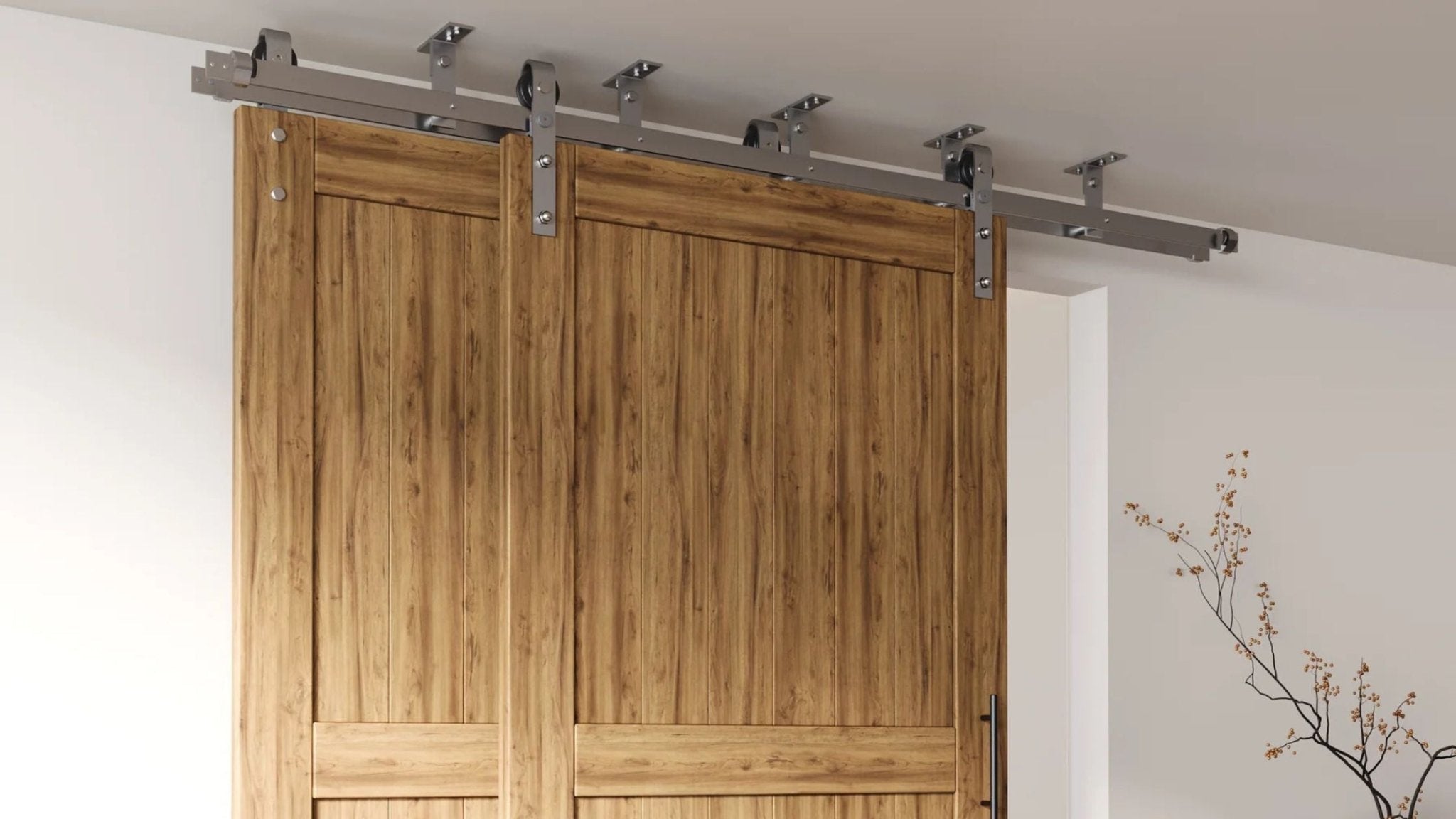
Ceiling mount barn door hardware works the same way as standard sliding hardware — a track, rollers, and hangers — except the track mounts to the ceiling rather than the wall above the opening. Ceiling-mounted brackets drop down from the ceiling and connect directly to the track, holding it at the correct height below the ceiling surface.
The primary reason to use ceiling mount hardware is structural: there's no solid header or blocking above the opening to mount a standard track into. This is common in spaces with open beam ceilings, exposed concrete or masonry above doorways, or new construction where blocking wasn't installed during framing. It also covers extra-wide openings and floor-to-ceiling room dividers, where there's no wall above the opening to mount into, and cases where the wall above an opening runs to a height that makes standard mounting impractical.
Ceiling mount hardware is not required for most standard installations — if you have a solid wall surface above the opening, standard hardware mounted into a header board is simpler and more stable. It's available for single-track sliding and bypass configurations (single and double bypass), but not for bifold doors. Ceiling mount is the right choice when wall mounting isn't an option. Browse our ceiling mount hardware collection.

How to check if you qualify before you measure anything
Before you grab a tape measure, look up. If there's a visible header board or solid wall surface above the opening, standard wall-mounted hardware is almost always the better choice — simpler installation, more finish options, higher weight capacity. Ceiling mount is for openings where that wall surface genuinely isn't there: floor-to-ceiling doorways, open beam ceilings, or masonry walls you don't want to drill into.

When ceiling mount is the right choice
- No solid header above the opening. The most common reason. If there's no blocking or solid framing above the opening and adding a header board isn't feasible, ceiling mount routes around the problem by mounting to the ceiling instead.
- Exposed masonry or concrete above the opening. Drilling lag bolts into brick or concrete for a standard header board is possible but significantly more involved. Ceiling mount avoids that surface entirely.
- Open beam or industrial ceilings. When exposed joists or beams run above the opening, they provide excellent mounting points for a ceiling-mounted track.
- Design preference for a floating look. Ceiling-mounted tracks create more visual distance between the track and the wall — the door appears to float. For customers who prefer this aesthetic, it's a valid reason to choose ceiling mount even when standard mounting is technically feasible.
When ceiling mount is not the right choice
- You have a solid wall surface above the opening — standard hardware is simpler and more stable
- Your door is heavier than 220 lbs — ceiling mount tops out at 220 lbs total system
- You want Goldberg Brothers hardware — ceiling mount is offered in our Quick Ship line only, not the Goldberg Brothers lineup
- You have less than 6 in between the top of the door and the ceiling
Mounting requirements
The ceiling must have solid structure to mount into — drywall alone will not support the load. Use a stud finder to locate the ceiling joists before installation, and make sure the track brackets hit solid framing at every mounting point. The most reliable approach is the same one we recommend for wall installations: run a 1×6 hardwood board (oak, maple, or poplar — not pine) across the joists, spanning the full track length, and fasten it securely into the framing. That gives you a continuous mounting surface and lets you position the track exactly where the door needs it, rather than being limited by joist spacing. Mounting brackets directly into the joists works too, as long as a bracket lands on solid framing at every point.
If your ceiling is finished drywall with joists above it, this is standard — the brackets lag into the joists (or into a header board fastened across them) through the drywall. If your ceiling is concrete or masonry, appropriate concrete anchors are needed and the installation is more involved.
The wall does not play a structural role in ceiling mount hardware — mounting is ceiling-only. However, you will still need to install a floor guide to keep the bottom of the door aligned and prevent swing.
For the full step-by-step, see our guide on how to hang a barn door from the ceiling, or refer to the instruction manual included with your kit. Our team is also available at info@thebarndoorhardwarestore.com to advise on your specific ceiling and wall situation before you order.
Measuring your 6-inch clearance correctly
Measure from the floor to the top of your door panel, then measure from the floor to your ceiling. Subtract the two. If you get exactly 6 in, you're set. If you're off by even half an inch, ceiling mount won't engage correctly — email us before ordering rather than guessing on a half-inch difference. Doors aren't always a uniform height if they've been trimmed; measure the actual panel, not the spec sheet.
Sizing
Ceiling mount hardware follows the same sizing rules as standard sliding hardware:
- Door width: Opening + 4 in minimum (2 in overlap per side). For bedrooms and bathrooms, opening + 6 in (3 in per side).
- Track length: At minimum 2× the door width for a single sliding configuration. Size to the door, not the opening.
- Clearance above door top: Exactly 6 in between the top of the door and the ceiling surface. Less than 6 in and the door won't fit; more than 6 in and the door won't engage the floor guide correctly.
For double bypass configurations, track length is 3× the door width for a fully clear opening. See our barn door dimensions guide for the full sizing formulas.
Not sure if ceiling mount is right for your situation?
Email us at info@thebarndoorhardwarestore.com with a photo of the wall and ceiling above your opening, plus the opening dimensions — we'll confirm whether ceiling mount is the right solution or whether standard hardware is feasible for your space. Browse our ceiling mount hardware collection. Available 7 days a week.
