
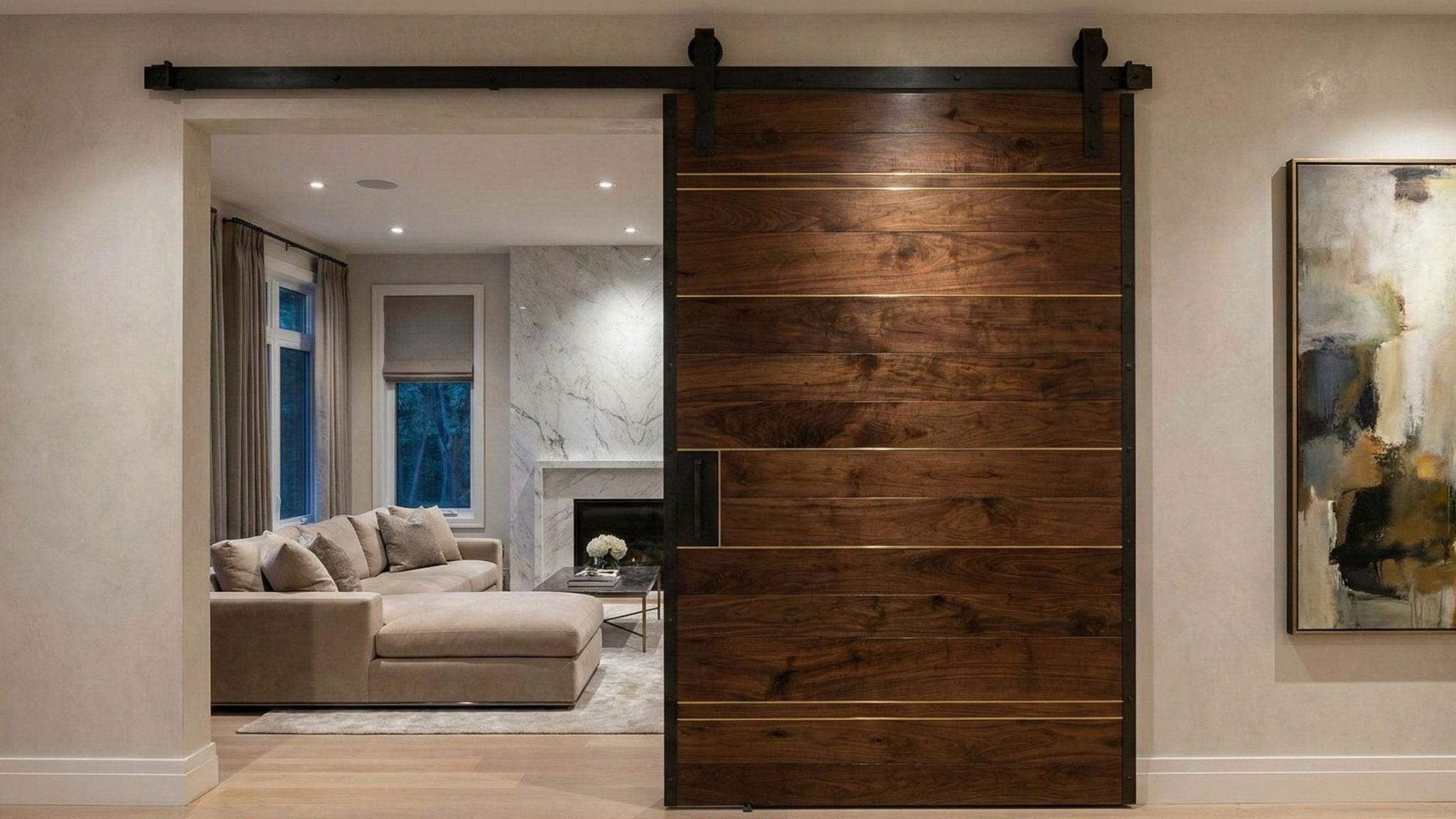
You've seen barn doors everywhere—Pinterest, home shows, your neighbor's kitchen renovation. You love the look. But when you start pricing them up, the numbers are all over the place.
One site says $400. Another says $1,800. Hardware alone ranges from $50 to $500.
The truth? Both numbers can be accurate. It depends on your door material, hardware quality, and whether you install it yourself. Here's precisely what barn doors cost in 2025 and how to get the look you want without overspending.
What Does a Barn Door Actually Cost?
Let's start with the quick answer. Here's what you can expect to pay for a complete barn door installation:
|
Budget Level |
Total Cost |
What You Get |
|
Budget DIY |
$200–$450 |
MDF or pine door, basic hardware, self-install |
|
Mid-Range |
$500–$1,000 |
Solid wood door, quality hardware, DIY or pro install |
|
Premium |
$1,100–$1,900+ |
Hardwood or glass door, premium hardware, professional install |
The average for a single interior barn door with mid-range hardware, professionally installed, sits around $850–$1,100.

Here's the important bit: these figures include door, hardware, and installation. Many quotes you'll find online only include one or two of these components—which is why prices seem so wildly inconsistent. A $250 quote probably covers the door only. A $200 quote might be hardware only. Always check what's actually included before comparing.
Door Costs by Material
The door itself typically represents 40–60% of your total cost. Material choice is the single biggest variable.

- MDF and hollow-core doors ($100–$375) are the lightest and easiest to hang. They work well for closets and pantries where you want the barn door look without the weight or price. They won't warp like solid wood, but they can't be refinished and look less authentic up close.
- Pine and softwood ($200–$500) give you the classic barn door aesthetic. These can be stained or painted to match any decor. They're prone to dents and scratches over time, but offer the best balance of cost and authentic appearance for most homeowners.
- Oak, maple, and hardwood ($375–$1,000) deliver a premium appearance and durability. These doors are heavy—typically 90–150 lbs—so they require robust hardware. With proper care, they'll last decades. Worth it for high-visibility installations like living rooms or master bedrooms.
- Glass panel and modern designs ($500–$1,500+) suit contemporary homes and let light flow between rooms. These require more careful handling during installation.
- Metal and industrial styles ($375–$1,900) are extremely durable and maintenance-free. They're heavy, so premium hardware is essential.
The sweet spot for most homeowners? A solid pine or engineered wood door in the $250–$500 range offers the authentic barn door look without premium pricing.
Hardware Costs: Why Is the Track So Expensive?
Hardware is where many people get surprised—and where quality genuinely matters. Here's what you're looking at for a standard single-door setup:
|
Component |
Budget |
Mid-Range |
Premium |
|
Track kit (6ft) |
$50–$100 |
$100–$190 |
$190–$375+ |
|
Soft-close mechanism |
— |
$25–$65 |
$65–$150 |
|
Handle or pull |
$15–$40 |
$40–$75 |
$75–$190 |
|
Floor guide |
$10–$20 |
$20–$30 |
$30–$50 |
|
Total hardware |
$75–$160 |
$185–$360 |
$360–$765+ |
Why does hardware quality matter? Cheap rollers create a noisy, jerky operation. Undersized tracks cause the door to wobble or jump off the rail. And weight ratings aren't suggestions—solid wood doors weigh 65–150 lbs, and underrated hardware will fail.

Budget hardware works fine for lightweight MDF doors on closets you open occasionally. But for solid wood doors you'll use multiple times daily? Mid-range minimum. The $100 difference between budget and mid-range hardware pays for itself in smooth, quiet operation that actually lasts.
Installation: DIY vs Professional
DIY installation saves you $125–$375 in labor. You'll need a stud finder, spirit level, and drill. Most first-timers complete the job in 2–4 hours, and roughly 85% manage it without issues.
The biggest challenge? Finding studs and leveling the track perfectly. If the track isn't level, your door will drift open or closed on its own.
Professional installation costs $125–$375, depending on complexity. A pro completes the job in 1–2 hours and guarantees proper leveling.
Go professional when your walls are old plaster, when electrical outlets need moving, when the door is particularly heavy, or when you'd rather spend your Saturday elsewhere.
If you can hang a shelf and own a stud finder, you can probably install a barn door. But for non-standard situations, professional installation is worth every penny.
Hidden Costs Most People Forget
These extras catch people off guard. Budget for them upfront.
- Header board ($15–$50) — Required if mounting to drywall without studs directly behind.
- Electrical relocation ($100–$250) — If your door covers outlets or switches when open.
- Floor guide ($10–$30) — Essential to stop the door swinging. Often not included in basic kits.
- Finishing or staining ($40–$125) — Unfinished doors need sealing to prevent warping.
- Extended track ($25–$75) — Standard 6ft tracks don't fit all doorways.
- Privacy additions ($20–$65) — Weatherstripping or gap fillers for bathrooms and bedrooms.
- Soft-close upgrade ($50–$100) — Prevents slamming. Recommended for bedrooms.
Pro tip: Add 15–20% to your initial quote for these extras. Better to budget $750 and spend $625 than budget $625 and find yourself scrambling at $800.
6 Ways to Save Money on Your Barn Door
- Convert an existing door. Add barn door hardware to a solid-core interior door you already have. Total cost: $100–$190 for hardware plus minor modifications.
- Buy door and hardware separately. Pre-packaged kits often mark up components by 20–40%. Source individually for better value.
- Choose mid-range hardware with a budget door. The track matters more than the door for smooth operation. A $190 pine door with $150 hardware outperforms a $375 door with $65 hardware.
- Skip the soft-close for now. Most soft-close mechanisms retrofit easily later. Add the upgrade when the budget allows.
- DIY the install, invest in the door. Labor savings ($125–$375) can go toward a better quality door you'll enjoy for years.
Shop for hardware bundles. Complete kits—track, rollers, guide, and handle together—often cost 15–25% less than buying separately.
Barn Door vs Regular Door vs Pocket Door
Barn doors aren't your only option for space-saving. Here's how they compare:
|
Factor |
Regular Door |
Barn Door |
Pocket Door |
|
Total installed cost |
$190–$450 |
$375–$1,125 |
$750–$2,500 |
|
Space saved |
None |
Yes |
Yes |
|
Install complexity |
Easy |
Moderate |
Difficult |
|
Privacy and sound |
Excellent |
Limited |
Good |
|
DIY-friendly |
Yes |
Yes |
No |
Barn doors cost 2–3x more than standard hinged doors. But they're significantly cheaper than pocket doors while solving the same space problem. Pocket doors require cutting into the wall and are rarely a realistic DIY project. If you need a space-saving door you can install yourself, barn doors hit the sweet spot between cost, complexity, and style.
Is a Barn Door Worth the Cost?
Worth it when: You have a space-constrained room where swinging doors don't work. You're fitting out a pantry, closet, or laundry room where full privacy isn't critical. You want a statement piece that adds character to your home. You genuinely love the aesthetic rather than just following a trend.

Reconsider when: The door is for a bedroom or bathroom where sound privacy matters. You need a tight seal for temperature control or air conditioning. You're doing it purely for resale value—barn doors are mainstream now, but still polarizing for some buyers.
A well-chosen barn door in the right location adds character, saves space, and lasts decades. Just be realistic about where they work best.
Getting Started
The best barn door for your home isn't necessarily the most expensive one. It's the door that fits your space, matches your style, and uses hardware rated to perform reliably for years.
Start with accurate measurements—you'll need the opening width and height, plus the wall space beside the doorway where the door will slide. Choose hardware rated for your door's weight, not the minimum. And don't skip the floor guide—it's a small cost that prevents the door from swinging and banging against the wall.
Those three things prevent 90% of barn door problems before they start.
Browse our range of barn door hardware kits — from budget-friendly basics to premium soft-close systems — and find the right fit for your project.
