
By Evan Christensen · Owner, The Barn Door Hardware Store
Published February 2, 2024 · Updated May 2026
Evan has owned and operated The Barn Door Hardware Store since 2016. Swinging barn doors are one of the most common post-installation questions his team fields — almost always the result of a missing or incorrectly installed floor guide. He and the team are available 7 days a week at info@thebarndoorhardwarestore.com.
A barn door that swings away from the wall isn't a defective door or a bad installation — it's a door that's only held at the top. The track and rollers support the door's weight vertically, but they do nothing to control lateral movement. Without a floor guide, a barn door is essentially a large panel hanging from a ceiling-mounted track. Any force applied to it — someone pushing it open, an air pressure differential, a draft from an open window — has nothing to resist it from swinging outward.
The fix is a barn door floor guide. It's included with every hardware kit we sell and is a required part of the installation, not an optional accessory. If your barn door is swinging, the most likely explanation is that the floor guide wasn't installed, was installed incorrectly, or is the wrong type for your flooring situation.
Why barn doors swing
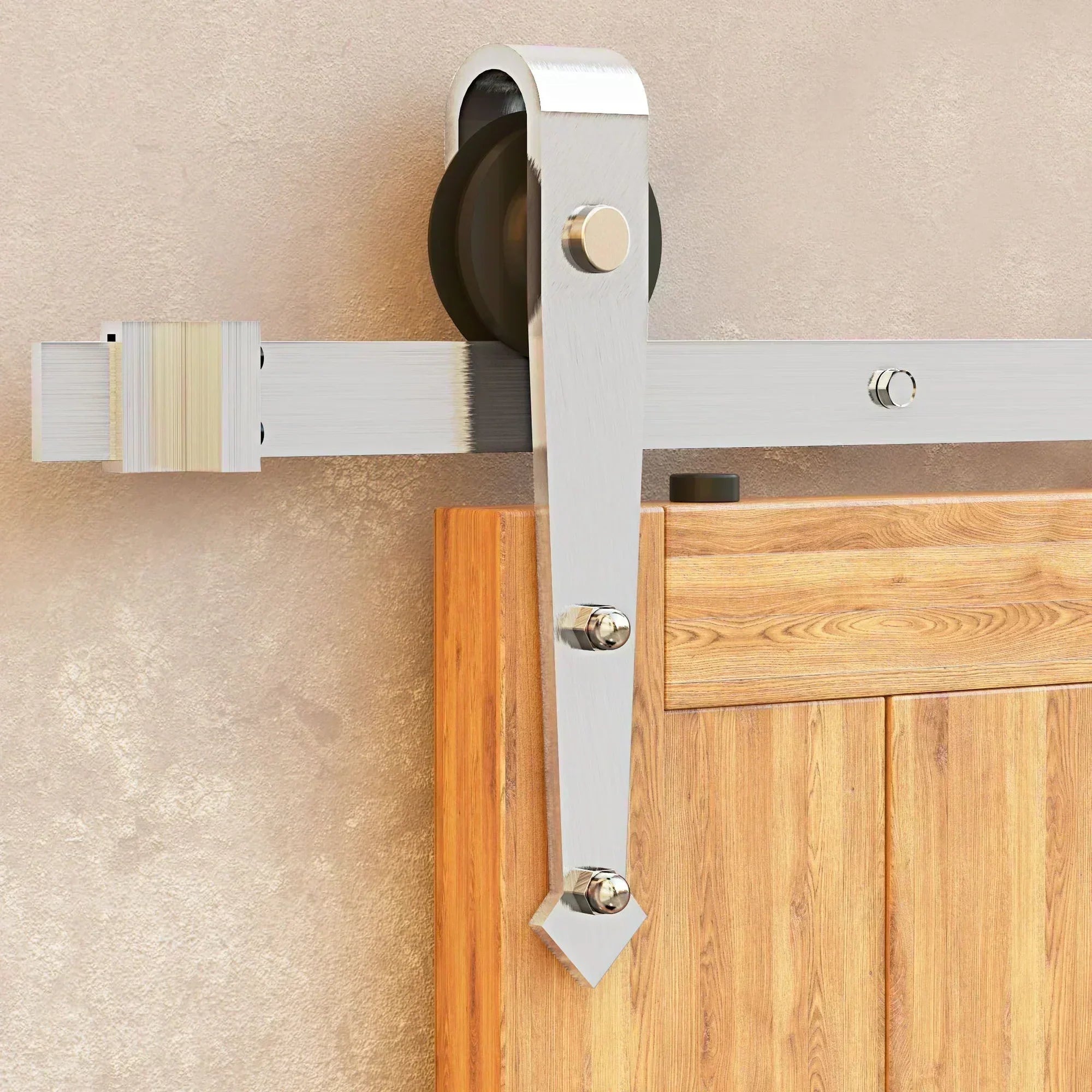
Standard barn door hardware holds the door approximately 3/8 in off the wall. The door hangs vertically from rollers on the track — gravity keeps it plumb, but only in the vertical plane. There's nothing holding the bottom of the door in place laterally.
At 3/8 in off the wall, it doesn't take much force to push the bottom of the door outward and have it contact the wall, scuffing the baseboard and marking trim over time. A person opening the door even carefully can impart enough lateral force to cause swing — let alone a child running through, someone in a hurry, or a pressure differential between rooms when HVAC kicks on. Add drafts from open windows or doors elsewhere in the home and the door can swing on its own without anyone touching it.
Door weight doesn't change this. A heavier door has more mass but the same lack of lateral constraint at the bottom. All barn doors will swing without a floor guide — the weight of the door is irrelevant.
The solution: floor guides
A floor guide constrains the bottom of the door to a fixed lateral position as it slides. It doesn't stop the door from moving along the track — it prevents the bottom from swinging away from the wall. Every hardware kit we sell includes a floor guide and it should be installed as part of every barn door installation without exception.
There are four floor guide types — T guide (most common, included in most kits), wheeled guide (quieter, with a tripping-hazard tradeoff), wall-mounted (for finished flooring you don't want to drill into), and continuous (for long bypass travel distances). For the full breakdown of each type, when to use it, and installation positioning principles, see our floor guide guide. Browse the full floor guides collection.
What if you also want to keep the door from sliding?
A floor guide prevents swing but doesn't lock the door in position along the track — it can still slide freely. If your door also tends to slide open on its own, that's a related issue with its own fixes. If you want to hold the door in a closed position so it doesn't drift open, that's a different problem with a different solution: a latch or lock.
Latches and locks are not included in hardware kits and are not required for most installations — they're an optional addition for situations where you want the door to stay reliably closed. If gaps around the door are also a concern, a barn door gap filler addresses that separately from the locking question. Browse our locks and latches collection for options compatible with barn door installations.
Frequently asked questions
My barn door came with a floor guide — why is it still swinging?
Most likely the floor guide wasn't installed, was installed too far from the door to be effective, or the slot in the door bottom wasn't cut correctly. The guide needs to be positioned so the T bracket sits inside the door slot with minimal clearance — enough for the door to slide freely but not so much that the door can swing before the bracket contacts the slot wall. If the guide is installed but the door still swings, check the clearance between the bracket and the slot sides.
Do I need a floor guide on both sides of the door?
For a single sliding door, one floor guide positioned within the door's travel range is sufficient — typically placed near the center of the door's travel so it constrains the door whether it's open, closed, or anywhere in between. For bypass configurations with multiple doors, each door needs its own floor guide. If a door travels more than a single door width, consider whether multiple floor guides or a continuous floor guide is the right solution for your travel distance.
Can I use a wall-mounted guide instead of a floor-mounted one?
Yes — wall-mounted and floor-mounted guides are functionally identical. The wall-mounted version mounts to the baseboard or wall rather than the floor, making it the right choice for any finished flooring you don't want to drill into. Browse our floor guides collection for wall-mounted options.
Is the wheeled floor guide better than the T guide?
For swing prevention, both work equally well. The wheeled guide has an advantage for noise — it eliminates the rattle that can occur when a T guide contacts the slot walls. The tradeoff is that the wheeled guide projects past the door face at floor level, which can be a tripping hazard. For most installations where the goal is simply preventing swing, the T guide is the better choice.
Will a heavier door swing less than a lighter one?
No — door weight doesn't affect swing. All barn doors hang from the top with no lateral constraint at the bottom. A heavier door has more mass but the same lack of resistance to lateral force. The floor guide is the solution regardless of door weight.
Still having trouble with a swinging door?
Email us at info@thebarndoorhardwarestore.com with a description of your floor guide setup — what type, how it's mounted, and where it's positioned relative to the door. We can usually diagnose a swinging door problem in one reply. Available 7 days a week.
