
By Evan Christensen · Owner, The Barn Door Hardware Store
Published March 22, 2024 · Updated May 2026
Evan has owned and operated The Barn Door Hardware Store since 2016. Latch selection is one of the more commonly misunderstood parts of a barn door installation — mostly because barn door latches work differently from hinged door hardware and provide privacy rather than security. He and the team are available 7 days a week at info@thebarndoorhardwarestore.com.
Privacy vs. security — what barn door latches actually do
Barn door latches provide privacy, not security. This is an important distinction. A barn door has a 3/8" wall offset gap running the full perimeter of the door face — that gap exists by design and is required for the door to slide. No latch changes the fact that the door can be pushed open from the gap side, lifted off the track, or reached around. Barn doors are not appropriate for spaces requiring keyed locks or meaningful resistance to forced entry.
What a latch does provide is reliable, deliberate closure — the door stays closed when you want it closed, with a physical action required to open it. For bedrooms, bathrooms, home offices, and any space where incidental drift or casual entry is the concern, a latch does exactly what you need. For spaces requiring genuine security, a hinged door with a keyed lock is the right product.
With that said, here are the latch types we carry and when each makes sense. Browse our full locks and latches collection for current availability.
Flip latch (90-degree)
A flip latch consists of two parts: a strike plate that mounts to the face of the door (and travels with the door), and a latch body that mounts to the door jamb (stationary). When the door slides closed, the latch arm flips down to catch the strike plate on the door face, holding the door in the closed position.
The flip motion is fast and simple — one hand, one motion to latch or unlatch. This makes it one of the most practical day-to-day latch options for bedrooms and bathrooms.
We carry the flip latch in powder-coated and stainless steel versions. For bathroom applications or any installation with significant humidity, stainless is the better long-term choice. The stainless version is also rated for outdoor and coastal environments.
Best for
- Bedrooms and bathrooms — any door where quick, reliable closure matters
- High-traffic doors with frequent latching and unlatching
- Humid environments where powder coat may not hold up long-term (use stainless)
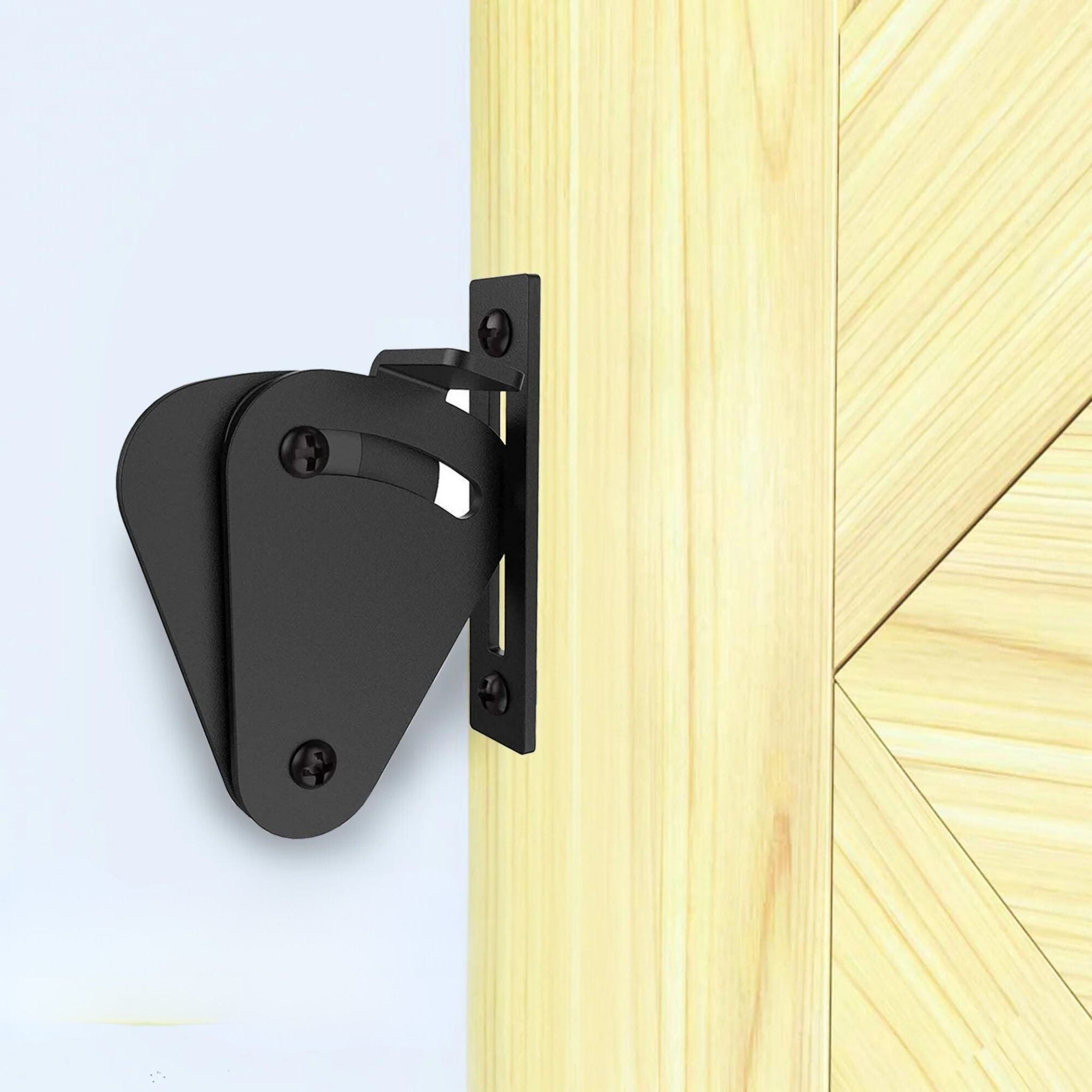
Teardrop latch
The teardrop latch is a surface-mounted privacy latch with a distinctive teardrop-shaped handle. It mounts to the door jamb (stationary). The strike is surface-mounted to the door face, but the door face requires a slot cut into it to accept the teardrop as it swivels to engage. When the door slides closed, the teardrop swivels into the slot to hold the door. Rotate the handle to release.
The teardrop profile gives it more visual presence than a flip latch, making it a natural fit for installations where the latch is part of the hardware aesthetic rather than something to minimize. It's one of the more decorative latch options in the lineup.
Best for
- Spaces where the latch is a visible design element
- Bedrooms and offices where the latch will be used regularly
- Installations where a more decorative latch profile suits the space. Note: requires cutting a slot in the door face before installation.
Hook latch — for biparting doors
The hook latch is designed specifically for biparting barn door setups — two doors meeting in the center. It consists of a hook on one door that catches on a bar or eye mounted to the other door, latching both panels together in the closed position. This prevents the doors from drifting apart without requiring a wall-mounted latch strike on either side.
For biparting applications, this is the most practical latch choice. A wall-mounted flip latch on one door only keeps one panel closed — the other can still drift. The hook latch holds both doors to each other simultaneously.
Best for
- Biparting barn doors — two doors meeting in the center
- Any setup where both panels need to be held closed together
- Room dividers and wide opening applications
Paddle latch
A paddle latch uses a flat paddle-shaped handle that rotates to engage a strike, holding the door in the closed position. It's a lower-profile option than the teardrop — the handle lies closer to the door surface and has a cleaner, more minimal appearance when latched.
Paddle latches are a good fit for modern and contemporary aesthetics where hardware minimalism is the goal. The flat paddle handle sits closer to the door surface than a teardrop, giving it a lower visual profile when latched.
Best for
- Modern and contemporary interior aesthetics
- Installations where a lower-profile latch is preferred
- Pantries, home offices, and laundry rooms
Choosing the right latch for your installation
| Situation | Recommended latch |
|---|---|
| Single door — bedroom or bathroom | Flip latch (stainless for bathroom) |
| Single door — pantry, office, or laundry | Flip latch, teardrop, or paddle — any works |
| Biparting doors meeting in the center | Hook latch — holds both panels together |
| High-humidity application (bathroom, coastal) | Stainless steel flip latch |
| Latch as visual design feature | Teardrop latch |
| Minimal, low-profile hardware aesthetic | Paddle latch |
| Space requiring keyed lock or security | Not a barn door application — use a hinged door with keyed lock |
All latches requiring a mortise use a Goldberg Brothers-specific acrylic router template, which is available as a separate purchase. Contact us before ordering if you're unsure whether a specific latch requires a router template for installation.
Improving privacy beyond the latch
A latch keeps the door deliberately closed, but it doesn't address light bleed or sound transmission through the perimeter gap. For bedrooms and bathrooms, three additional measures are worth considering alongside the latch:
- Size the door with more overlap. Standard sizing adds 2" per side. For privacy applications, use 3" per side — the extra coverage reduces edge gaps and light bleed at the sides of the door.
- Add pile or brush pile weatherstrip. Attaches to the door edges and reduces the gap between the door face and the wall. Use pile or brush pile specifically — foam and rubber compression seals create drag on a sliding door and will prevent it from closing fully over time.
- Flush pull on the wall-facing side. Gives you a way to pull the door closed from inside the room without reaching around the gap. Browse our flush pulls collection.
For a full guide on barn door privacy, see our barn door privacy guide.
Not sure which latch is right for your setup?
Email us at info@thebarndoorhardwarestore.com with your door configuration (single, biparting, bypass), the room it's for, and whether humidity is a factor — we'll confirm the right latch and whether a router template is needed for installation. Browse our locks and latches collection. Available 7 days a week.
