
By Evan Christensen · Owner, The Barn Door Hardware Store
Published December 26, 2025 · Updated April 2026
Evan owns and operates The Barn Door Hardware Store, specializing exclusively in sliding barn door hardware. The most common reason customers come to him is simple: they've run out of room for a swinging door and need a better solution. He and the team are available 7 days a week at info@thebarndoorhardwarestore.com.
The appeal of a barn door in a small space isn't really about aesthetics — it's about what you get back. A swinging door needs clearance to open. In a tight bedroom, a narrow hallway, or a compact bathroom, that clearance costs you furniture placement, floor space, and usability. A sliding barn door takes none of that. It moves along the wall and stays out of the way completely.
Here are seven specific ways to put that to work in a small space, with the hardware that makes each one possible.
1. Studio apartments — dividing without building
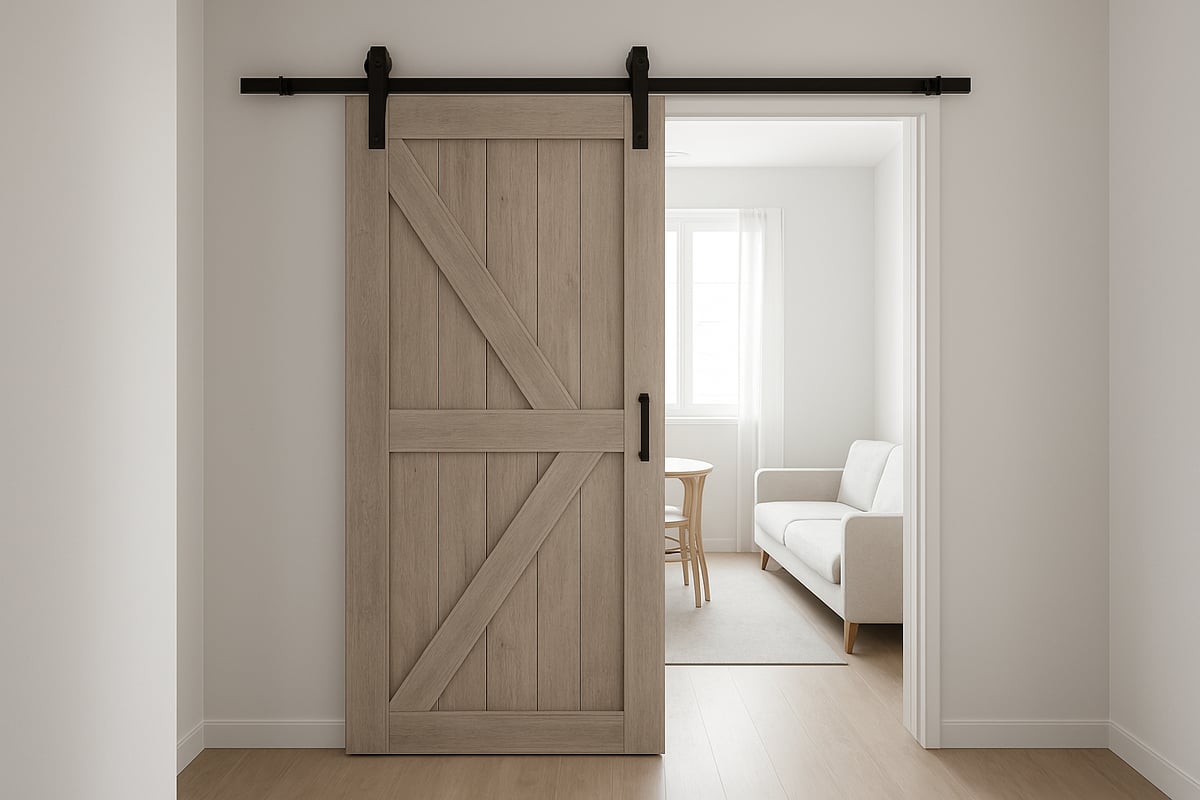
In a studio, the challenge is creating distinct zones — sleeping, working, living — without permanent walls that shrink the space further. A single sliding barn door on a standard track lets you close off a sleeping nook or home office when you need separation, and slide it open when you don't.

Single-track systems work well here because the hardware is minimal and unobtrusive. Frosted glass panels are a popular choice — they keep light moving through the space while still giving a sense of separation when the door is closed. A solid panel works if you want a full visual break.
Hardware: Sliding barn door hardware kits — single track, available in quick-ship finishes from $218.50.
2. Closets — bypass doors for full access without swing
A standard hinged closet door swings into the room. In a small bedroom, that means either giving up floor space in front of the closet or leaving it permanently open. Double bypass barn doors solve this cleanly — two doors slide past each other on parallel tracks, giving you full access to the entire closet width without any swing clearance required.

This is one of the most common installs we see in small bedrooms and narrow hallways. The doors stack behind each other when open, keeping the full opening clear and letting you reach everything inside without repositioning furniture.
Hardware: Double bypass hardware kits — available from $299.99 in multiple finishes.
3. Laundry nooks — bifold doors that fold out of the way
Laundry areas tucked into closets or alcoves often don't have enough wall space beside them for a standard sliding door to fully retract. Bifold barn doors fold as they slide, which means they need very little clearance to open — making them the right choice when wall space is the constraint.

They're also a clean solution for hiding appliances and utility shelving from the rest of the room. A painted panel matches the wall; a natural wood finish makes the nook a feature rather than something to hide.
Hardware: Bifold barn door hardware kits — designed for two-panel folding setups.
4. Small bathrooms — sliding doors when swing isn't an option
In a small bathroom or powder room, a swinging door can block the sink, collide with the toilet, or simply make the room feel impossible to navigate. A sliding barn door mounted on the outside of the bathroom wall eliminates all of that.
The gap around a sliding barn door means it's better suited to a guest powder room or secondary bathroom than a main bathroom in a shared living space — if sound and privacy are a priority, add weatherstripping around the edges to reduce the gap. Frosted glass panels let light in from the hallway while keeping the interior private.
Hardware: Sliding barn door hardware kits — standard single track works for most bathroom applications.
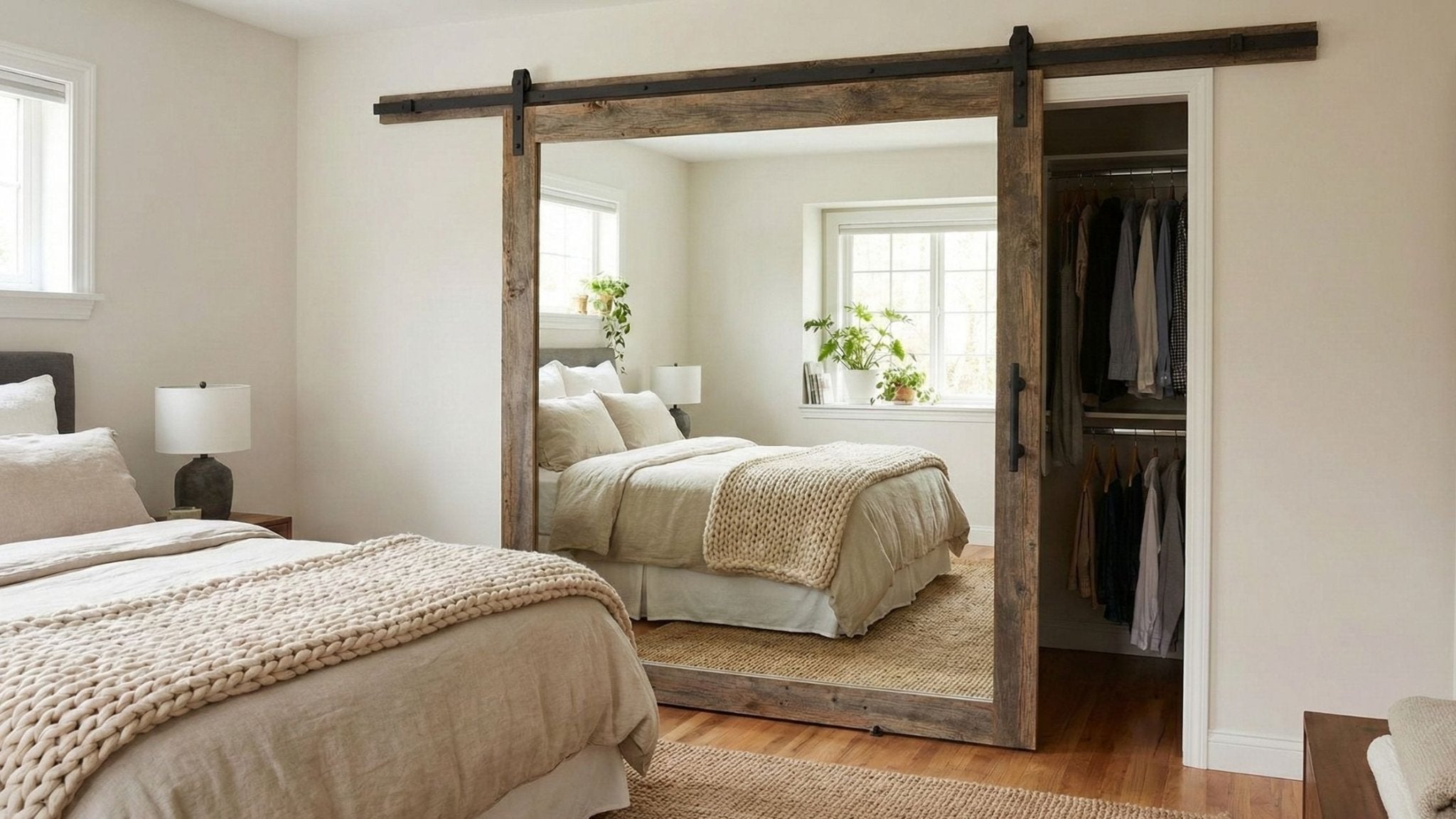
5. Bedrooms — mirrored doors that do double duty
A mirrored barn door gives you a full-length mirror and a sliding door in one panel — useful in any bedroom, but especially valuable in a small one where a freestanding mirror would take up floor space you don't have. Position it on a closet opening and it reflects light back into the room, making the space feel noticeably larger and brighter.

Make sure your hardware kit is rated for the weight of a mirrored panel — glass doors are heavier than standard wood doors and need hardware matched to that load.
Hardware: Heavy duty barn door hardware kits — for heavier mirrored or glass panels.
6. Kitchen cabinets and pantries — mini barn doors for compact storage
The barn door principle scales down. Cabinet-size sliding doors on a mini track work for pantry openings, open shelving, and kitchen storage — keeping things accessible without a door swinging out into a narrow kitchen aisle. This is particularly useful in galley kitchens and small apartments where cabinet doors constantly compete with each other for clearance.
Mini barn doors are also a practical choice for media units and built-in shelving in living rooms, hiding cables and equipment behind a sliding panel.
Hardware: Cabinet mini barn door hardware — scaled for smaller applications with lower weight requirements.
7. Open-plan spaces — ceiling mount for flexible room division
When you want to divide an open-plan living and dining area — or carve out a temporary home office — but don't want to commit to a permanent wall, ceiling mount barn door hardware gives you a flexible divider that disappears when you don't need it.

Because the track mounts to the ceiling rather than the wall, you're not limited by wall framing or the space above a door opening. This makes ceiling mount the right choice for loft-style spaces, converted rooms, or anywhere the wall structure makes standard mounting difficult.
Hardware: Ceiling mount barn door hardware — available in standard and bypass configurations.
Getting the sizing right
Whatever the application, the measuring principles are the same. Your door needs to be 2"–4" wider than the opening (1"–2" overlap per side) to cover it fully. The wall beside the opening needs to be at least as wide as the door panel so it can slide completely clear. And the track needs to be at least twice the door width for a single sliding door.
For a full measuring walkthrough, see our barn door dimensions guide or our step-by-step installation guide.
Hardware tips for small spaces
In tight spaces, hardware profile matters. Low-profile and hidden roller systems keep the visual weight of the hardware minimal — important when the room is already compact. Soft-close mechanisms are worth adding in bedrooms and offices where a slamming door is disruptive.
Match your hardware finish to the other metal fixtures in the room — door handles, light fittings, cabinet hardware — for a cohesive look that doesn't add visual clutter to a small space.
Browse our full range of barn door hardware kits or reach out at info@thebarndoorhardwarestore.com — we're available 7 days a week to help you find the right configuration for your space before you order.
Related guides:
