
By Evan Christensen · Owner, The Barn Door Hardware Store
Published June 22, 2024 · Updated April 2026
Evan owns and operates The Barn Door Hardware Store, specializing exclusively in sliding barn door hardware. The barn door vs. French door question is one his team fields regularly — and the answer almost always comes down to how the door affects the usable space in the room. He and the team are available 7 days a week at info@thebarndoorhardwarestore.com.
Barn doors and French doors both divide spaces without fully closing them off — but they do it in completely different ways, at very different price points, and with very different space requirements. If you're trying to decide between the two, the answer usually comes down to four things: how much floor space you have, how much privacy you need, your budget, and the style of your home.
Here's an honest breakdown of both.
Barn doors: what they are and how they work
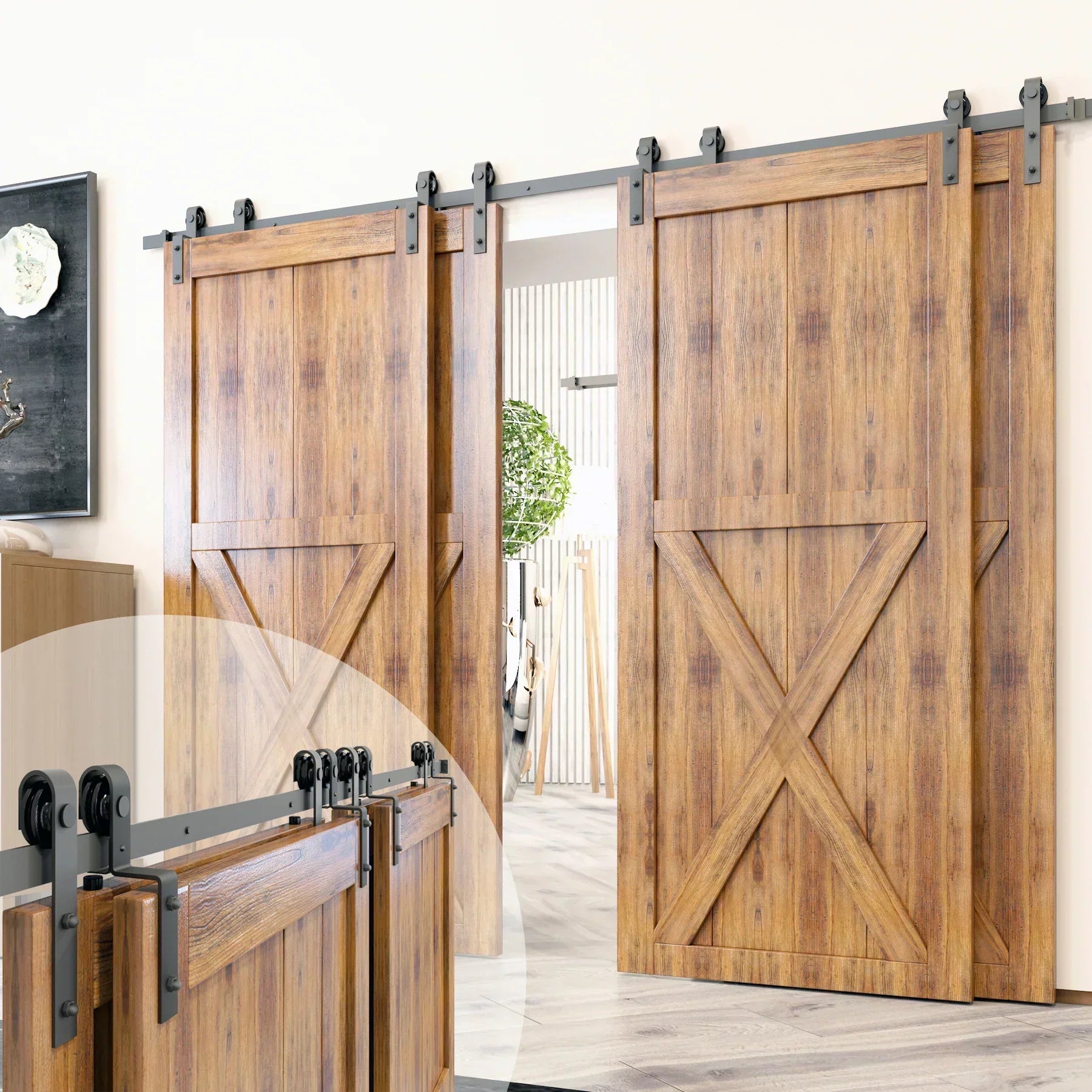
A barn door mounts on a track above the opening and slides along the wall to open and close. The hardware — track, rollers, and hangers — is external and visible, which is part of the aesthetic appeal. Single barn doors work for standard doorways; double doors, bypass configurations, and bifold setups handle wider openings and spaces where wall space is limited.
The style range is wide. Classic rustic wood with wrought iron hardware is what most people picture first, but barn doors also come in sleek flat panels, glass inserts, industrial metal, chevron patterns, and more. The door is sold separately from the hardware, which means you can pair almost any door with the right kit for your style.
What barn doors do well:
The single biggest advantage of a sliding barn door is what it gives back to the room. A swinging door — including French doors — carves out a permanent arc of unusable floor space. A sliding barn door takes none. In our experience helping customers plan their installations, this is the reason most people ultimately choose a barn door: they want to get more use out of the room itself.

This matters most in two situations we see regularly. The first is home offices, where a barn door means chairs can sit closer to the desk without being blocked by a swinging door — the difference between a cramped setup and a comfortable one. The second is dining rooms, where the same principle applies to chairs along the wall: a swinging door forces you to either leave a gap or constantly move furniture when the door opens. A sliding door eliminates that entirely.
Beyond space, barn doors are significantly easier to install than French doors or pocket doors. The hardware mounts to the wall above the opening, and most homeowners complete the installation in a few hours with basic tools. See our step-by-step installation guide for a full walkthrough.
Maintenance is straightforward — occasional track cleaning and lubrication keeps the hardware running smoothly for years.
Where barn doors have limitations:
Because a barn door slides in front of the wall rather than sealing inside a frame, there's an inherent gap around the edges. This means barn doors don't seal sound, light, or smell as effectively as a traditional hinged door. For a main bathroom off a living area, or a bedroom where noise isolation matters, the gap is worth factoring in.
Security is also more limited than a traditional door — barn doors can be latched but not deadbolted. For interior applications this is rarely a concern, but it's worth noting.
What does a barn door cost?
The door itself — sourced from a lumber yard or specialty supplier — typically runs $400–$900 for standard sizes, depending on material. Shipping costs can add to this if ordering online. Hardware kits start from $184 and go up depending on the configuration and brand. Most homeowners install the hardware themselves; if you hire someone, budget $125–$375 for labor. See our full barn door cost guide for a detailed breakdown.
French doors: what they are and how they work
French doors are double swinging doors, typically built from wood frames with glass panes — either individual divided panes or larger glass panels. They originated in 16th and 17th century French Renaissance architecture, where the goal was to bring light into rooms while maintaining some separation between spaces. That core idea hasn't changed — French doors still do exactly that.
They're commonly used for exterior back doors, patio entries, sunrooms, and connections between large interior spaces like dining rooms and living areas.
What French doors do well:
The glass-heavy design lets natural light flow between spaces even when the doors are closed, keeping interiors feeling open and connected. For rooms that benefit from light — sunrooms, studies, dining rooms — that's a genuine functional advantage.
French doors also work well as exterior doors in a way that barn doors typically don't. They can be weather-sealed, properly insulated, and fitted with secure locking hardware. Metal-framed French doors in particular offer strong security and good thermal performance.
Opening both panels at once creates a wide, unobstructed entry — useful for moving furniture, entertaining, or simply enjoying the connection to an outdoor space.
Where French doors have limitations:
Space is the biggest constraint. Each panel swings 90 degrees into the room — for a standard 60" French door, that's roughly 30" of swing clearance on each side. Furniture placement around French doors requires careful planning, and in smaller rooms they can dominate the entire layout. This is the trade-off customers most often mention when they come to us after reconsidering French doors — they realized the swing clearance was eating into the room in a way they hadn't fully accounted for at the planning stage.

They're significantly more expensive than barn doors, and installation is more demanding. French doors must be perfectly plumb and level within the frame — an imperfect installation results in doors that won't close properly, drafts, or long-term alignment issues. Most homeowners hire a professional for installation.
The glass panes also reduce privacy — frosted glass helps, but clear-pane French doors offer very little visual separation between rooms.
Side-by-side comparison
| Barn Door | French Door | |
|---|---|---|
| Average door cost | $400–$900 | $500–$5,000+ |
| Hardware/installation | From $184 hardware + $125–$375 labor if needed | $2,000+ installed typically |
| Space required | Wall space beside opening for door to slide | ~30" swing clearance per panel |
| Privacy | Good with solid panel; limited with glass | Low to moderate; frosted glass improves it |
| Sound insulation | Limited — gap around edges | Better when properly sealed |
| Natural light | Only if glass panel chosen | Yes — glass panes standard |
| Works as exterior door | Specialized hardware required | Yes, standard use case |
| DIY-friendly | Yes — most installs take a few hours | Possible but challenging — level installation critical |
| Style range | Very wide — rustic to modern | Moderate — glass panel aesthetic is defining |
How to choose
Choose a barn door if:
- Floor space matters — you want to get more use out of the room itself
- You're furnishing a home office and need chairs to sit comfortably in front of a desk
- You have a dining room where chairs along the wall can't afford to lose 30" of clearance
- You're covering a closet, pantry, laundry room, or interior room divider
- Budget is a consideration
- You want a DIY-friendly installation
- You want flexibility in door style and hardware finish
Choose French doors if:
- You're connecting two large interior spaces and natural light flow is the priority
- You need an exterior door for a patio, sunroom, or back entry
- You have enough room for both panels to swing fully open without affecting furniture layout
- You prefer the classic glass-panel aesthetic and it suits your home's style
- Budget allows for professional installation
The spaces where barn doors and French doors genuinely compete are interior room dividers — connecting a dining room to a living area, separating a home office from a common area, or defining zones in an open-concept layout. For those applications, the space savings a sliding door delivers is almost always the deciding factor. French doors make the most sense where the glass aesthetic is the point, or where exterior use is required.
Ready to explore barn door options?
Browse our full range of barn door hardware kits — from single sliding systems to double bypass and bifold setups. If you're not sure which configuration fits your opening, email us at info@thebarndoorhardwarestore.com or reach out 7 days a week and we'll help you work it out before you order.
Related guides:
