
By Evan Christensen · Owner, The Barn Door Hardware Store
Published April 21, 2026 · Updated May 2026
Evan has owned and operated The Barn Door Hardware Store since 2016. Combining a barn door with shelving is one of the more popular space-saving requests his team helps customers plan — the door and the shelves need to be sized and sequenced together, or the installation runs into trouble. He and the team are available 7 days a week at info@thebarndoorhardwarestore.com.
If you're working with a small bathroom, laundry room, or pantry and wondering whether a barn door and shelving combination might work for your space, you're asking the right question. The two pair well — but the added weight and clearance considerations mean this needs a bit more planning than a standard barn door install.
Why Barn Doors with Shelves Make Sense
Smaller footprints, open-concept living, and a need for multi-functional design all push toward getting more out of every wall. Traditional swinging doors waste valuable wall space, while barn doors with shelves turn that same wall into a vertical storage opportunity.
A standard hinged door requires a clearance radius — dead space you can't use for anything else. When you install a sliding barn door, you reclaim that area entirely. Add shelving around or beside the door, and you've created a feature wall that's both decorative and practical.
When you're working with a small bathroom, laundry room, or pantry, that reclaimed space matters — it's often enough to eliminate the need for a freestanding cabinet.
Popular Configurations for Barn Doors with Shelves
There are several ways to approach this, and the right choice depends on your space and what you're storing.
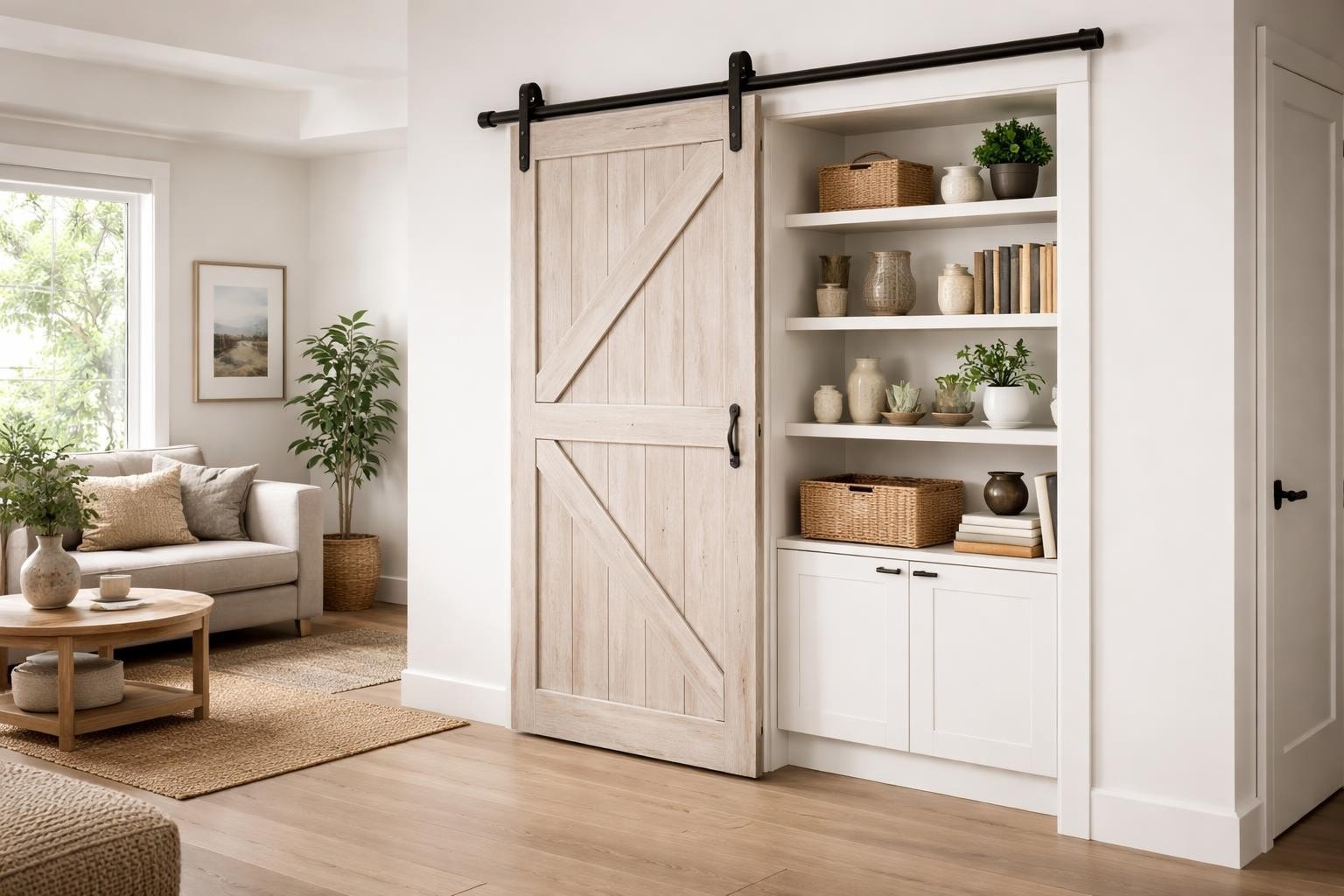
Flanking shelves. This is the most common setup. You mount shelving units on both sides of the barn door opening. When the door slides open, it covers one set of shelves while revealing the other. This works well in bathrooms where you want some items — like guest towels — always visible, and others — like cleaning supplies — tucked behind the door when it's open.
Integrated shelf doors. These are barn doors with built-in shelving on the door panel itself — the bookshelf-style, shelf-front doors you'll often see sold as furniture pieces. The most striking versions feature three to five shallow shelves mounted directly to the door face, and you can build one with any solid-core panel from our barn door collection. For this style, hidden roller hardware is usually the right call: the rollers mount to the back of the door instead of the face or top edge, so the entire front stays open for shelving, and the Hidden Roller Kit carries a loaded shelf door — 125 lbs with the standard roller, 250 lbs with the heavy-duty roller — without the 100 lb ceiling you hit with a top mount. Keep the shelves shallow, around 4–6 inches, so the loaded door stays within its roller's rating and doesn't project too far into the room.
Above-door storage. Installing a shelf across the top of your barn door track creates storage that doesn't interfere with the door's operation at all. This spot works well for items you don't access daily — seasonal decor, extra linens, or bulk paper goods.
Hardware Considerations
Installing barn doors with shelves requires more planning than a standard barn door project. The added weight from shelf contents affects your hardware selection, and shelf placement impacts clearance measurements.
Track weight capacity. Capacity depends on hanger style, and it adds up faster than people expect once shelf contents are factored in:
| Horseshoe Hanger | J-Strap / Other Standard Hangers | Straight Strap | |
|---|---|---|---|
| Standard Duty Capacity | 250 lbs | 200 lbs | 125 lbs |
| Heavy Duty Capacity | 600 lbs | 400 lbs | — |
Add up the door panel weight and the fully loaded weight of anything mounted to the door itself (integrated shelving counts — flanking shelves mounted to the wall don't add to the door's load). If that total is within about 15–20% of your hanger style's standard duty cap, step up to Heavy Duty Barn Door Hardware Kits rather than running right at the limit — the extra cost is minimal compared to dealing with a failed installation.
Clearance and shelf depth. This is where people make mistakes. Your barn door needs clearance from the wall to slide smoothly, and that clearance varies by roller style. If shelves protrude too far, the door can't move properly. Check the exact projection measurement for your chosen roller in our Hardware Measurements guide before drilling anything.
Standard shelf depths that work well with most hardware:
- Bathroom shelves: 6–8 inches
- Kitchen/pantry shelves: 10–12 inches
- Decorative display shelves: 4–6 inches
Always measure from your wall to the back of your door panel when closed. That number sets your maximum shelf depth.
Design Ideas That Work
A few combinations consistently deliver both style and function.
Bathroom spa vibe. Mount a barn door at your bathroom entrance with floating shelves on both sides. Stock the always-visible shelves with rolled towels, plants, and matching containers. Keep everyday items like hair tools and medications behind the door when it's open. Limiting your color palette to a few shades helps the shelves read as curated rather than cluttered.
Pantry powerhouse. A barn door leading to your pantry with floor-to-ceiling shelving on the adjacent wall maximizes every inch of a narrow kitchen. Clear containers for dry goods make the storage easier to navigate at a glance.
Home office solution. Replace a standard closet door with a barn door, then install desk-height shelving beside it. When you're working, the door slides open to reveal office supplies inside the closet. When you're done, slide it closed.
Mudroom organization. Install a barn door leading to your garage or basement, with coat hooks and shoe shelves flanking it. Everything has a place, and the barn door slides to conceal the utility area when guests arrive.
Media center. Create a full wall unit with barn doors that slide to reveal or conceal your TV and components. Shelving holds media equipment, books, and decorative items on either side — one of the more dramatic and frequently requested applications of this concept.
Installation Steps
This assumes you're moderately handy. If you're not comfortable with power tools, there's no shame in hiring help — more on that below.
Planning phase:
- Measure your opening width and height
- Determine shelf placement and depth
- Calculate total weight (door plus loaded shelves, if shelves mount to the door panel)
- Select appropriate hardware based on weight (use the table above)
- Verify wall stud locations for both track and shelf mounting
Installation order — sequence matters. Mount the track and shelving in the wrong order and you may end up removing finished shelving to get at the track.
The correct sequence is: install barn door track and test fit → mount the door and verify smooth operation → install shelving brackets → add shelf boards → load shelves and recheck door function.
That last step is critical. Loading shelves can add enough weight and wall flex to affect door operation, particularly with heavier materials like reclaimed wood or a full book collection. Loading and testing before you call the project done catches this before it becomes a bigger fix — extra studs or redistributed weight — after the fact.
Our step-by-step installation guides cover the track and door installation in detail for every hardware kit we sell.
Material Choices
Door materials. Solid wood gives you the best weight-to-strength ratio for barn doors with shelves. It handles hardware stress better than hollow-core alternatives and won't warp in high-humidity areas like bathrooms. Our assembled barn doors are a strong starting point if you don't want to source and build a panel separately.
Engineered wood works well if you're on a budget and installing in climate-controlled spaces. Avoid it in bathrooms or laundry rooms where moisture cycles can cause deterioration over time.
Shelf materials by location:
| Location | Best Material | Why It Works |
|---|---|---|
| Bathroom | Sealed wood or coated wire | Resists humidity damage |
| Kitchen/Pantry | Wood or laminate | Easy to clean, durable |
| Bedroom/Office | Any material | No environmental stress |
| Laundry room | Coated metal or plastic | Handles moisture and detergent spills |
The finish matters as much as the material. In bathrooms, water-based polyurethane is a strong choice — it doesn't yellow over time and holds up against humidity better than oil-based alternatives.
Common Mistakes to Avoid
Undersized hardware. The biggest mistake — using standard hardware for a setup that carries significant weight. If you're adding shelf load to your door panel, or mounting heavy flanking shelves that stress the same wall as your track, you need hardware rated for the total weight, checked against your specific hanger style's capacity. Our Heavy Duty Kits are backed by a limited lifetime warranty and are the right call any time your total weight approaches your hanger style's standard duty limit.
Poor shelf placement. Installing shelves too close to the door track creates interference. Leave enough clearance between your track and the nearest shelf edge based on your roller's projection spec — otherwise you'll hear scraping every time you open the door.
Ignoring weight distribution. When you load one side of your shelving much heavier than the other, you create uneven wall stress. Distribute weight evenly across shelves, and use anchors appropriate for your wall type — drywall anchors fail well below the weight a loaded shelf can reach, so find the studs.
Finishing Touches
Match your hardware finish. Matte black barn door hardware looks odd with brass shelf brackets. Keep your barn door hardware finish consistent with your shelf brackets — it's the detail most people notice even when they can't articulate why something feels off.
Add lighting. LED strip lighting under shelves or behind the barn door track creates ambiance and makes items easier to find. Battery-operated options work well if you don't want to run electrical.
Style with purpose. Group displayed items in odd numbers, mix heights and textures, leave some empty space, and use matching baskets or bins for small items. Don't overcrowd — the shelves should feel curated, not crammed.
Maintenance and Long-Term Care
Barn doors with shelves need minimal upkeep, but a few simple habits keep them performing well.
Monthly: wipe down the track with a dry cloth to remove dust, tighten any loose shelf brackets, test door movement, and verify wall anchors remain secure.
Annual: deep clean all surfaces, check hardware mounting bolts and tighten as needed, inspect rollers for wear, and touch up paint or finish on door and shelves. Our installation guides include hardware-specific maintenance notes for every kit we sell.
Budget Planning
Cost comes down to a few decisions rather than one fixed number. The hardware tier is the main lever — a standard-duty kit costs less than a heavy-duty one, and your total loaded weight decides which you need. The door panel is next, whether you buy an assembled panel or build your own. Shelving materials, brackets, and anchors round out the parts list, and hiring a pro for the install adds labor on top of materials. For current hardware pricing, check the live Sliding Barn Door Hardware Kits and Heavy Duty Kits — the collection pages always show today's numbers.
Professional vs. DIY Installation
DIY makes sense when: you're comfortable using a drill and level, your walls are standard drywall over wood studs, total weight stays comfortably within your hanger's standard duty rating, you have a helper for heavy lifting, and you've read the installation specs for your chosen hardware.
Hire a pro when: you're installing on concrete, brick, or steel-framed walls; working with custom or extra-heavy doors; you need electrical work for integrated lighting; or the installation involves structural modifications. If you're unsure about any of this, our team can help you think through it — reach out at info@thebarndoorhardwarestore.com or request a custom quote for your specific situation.
Frequently Asked Questions
What hardware do I need for barn doors with shelves? It depends on your total weight (door plus anything mounted to the panel) and which hanger style you choose. Standard duty handles up to 200 lbs for J-strap and similar styles, or 250 lbs for Horseshoe. For a full bookshelf built onto the door face, our Hidden Roller Kit is the cleanest solution — the rollers mount behind the door so the face stays clear, in a standard (125 lb) and a heavy-duty (250 lb) version, both well above the 100 lb ceiling of a top mount. For heavier setups — especially wide door panels — step up to our Heavy Duty Hardware Kits, rated to 400 lbs (600 lbs for Horseshoe).
How far should shelves be from the barn door track? Leave clearance between the track and the nearest shelf edge based on your roller's projection spec, and keep shelf depth within the wall-to-back-of-door measurement minus your roller's clearance requirement. Check the exact roller projection for your hardware in our Hardware Measurements guide.
Can I add shelves to an existing barn door installation? Yes, as long as you verify that your existing hardware can handle any additional weight (if you're mounting shelves to the door panel), and that your shelf placement respects the clearance requirements above. The track and wall mounting don't need to change for flanking shelves — they're independent of the door system.
What's the best barn door setup for a pantry with shelves? A single sliding door with flanking floor-to-ceiling shelving on the wall beside the opening is the most popular and practical setup. Skip a bypass here — the rear door has to slide behind the front one, so only the front door could ever carry a shelf, which defeats the point. For a wide pantry, keep the single door and add the extra storage on the flanking wall shelving rather than on a second door.
Do barn doors with shelves work in small bathrooms? They're particularly well-suited to small bathrooms. The sliding door eliminates swing clearance, and flanking shelves replace the freestanding storage that would otherwise eat into floor space. Keep shelf depth to 6–8 inches and match your hardware finish to your existing fixtures for a cohesive look.
How long does this type of installation take? A straightforward single-door setup with flanking shelves typically takes a full day — a couple of hours for the door hardware, the rest for shelving. More complex configurations with integrated shelf panels or floor-to-ceiling shelving on multiple walls can take a weekend. Our installation guides walk through each step, and our team is available 7 days a week if you hit a snag.
Barn doors with shelves solve the eternal struggle between style and storage. Whether you're working with a tiny bathroom or reimagining your entire pantry system, this combination delivers real functionality without sacrificing aesthetics.
When you're ready to start, browse our Sliding Barn Door Hardware Kits and Heavy Duty Kits, or use our Hardware Finder to get a personalized recommendation based on your opening and door size. Free shipping to the continental US, expert support 7 days a week, and a limited lifetime warranty on all hardware.
