
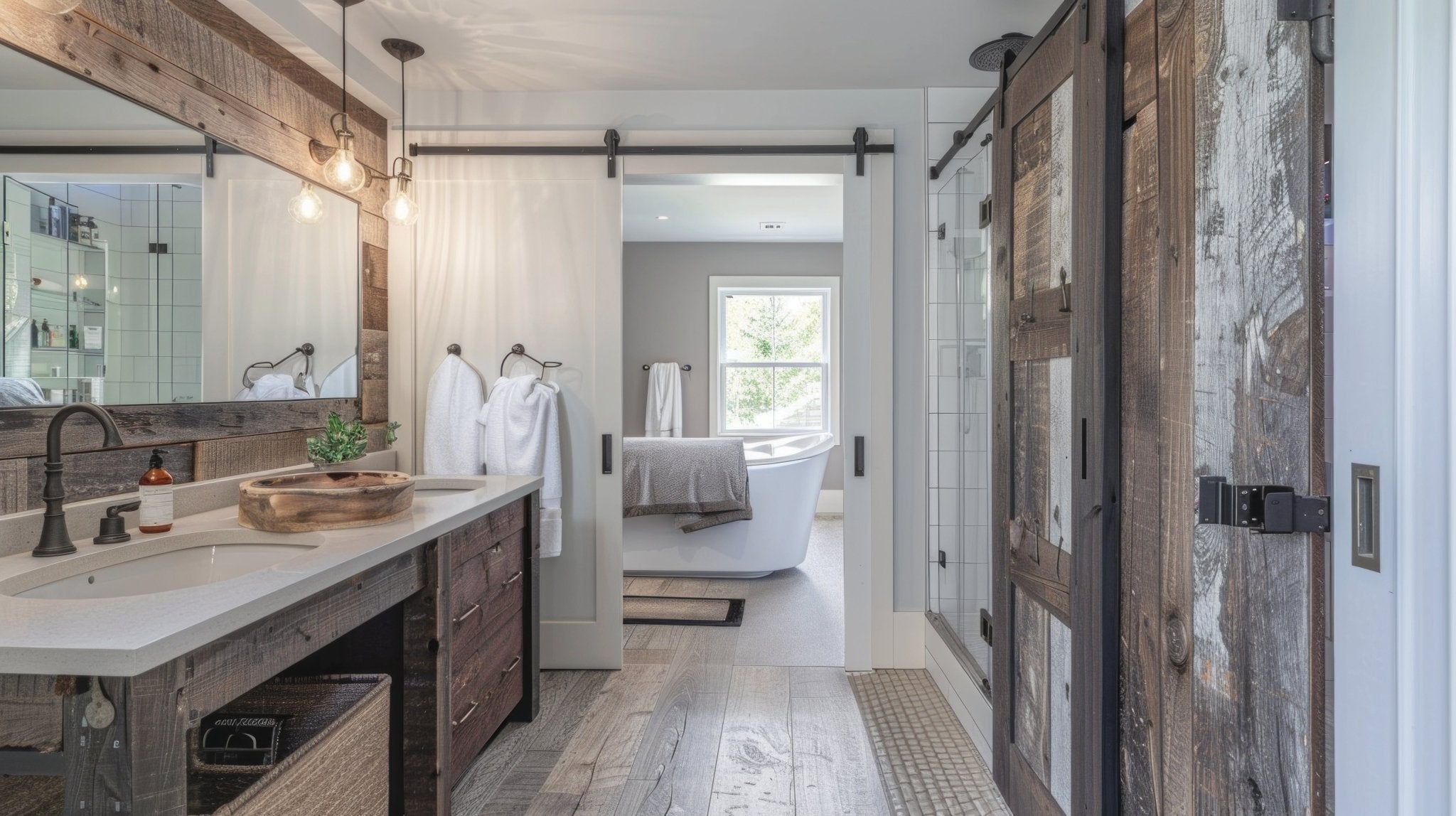
By Evan Christensen · Owner, The Barn Door Hardware Store
Published June 14, 2024 · Updated May 2026
Evan has owned and operated The Barn Door Hardware Store since 2016. "Barn door lock" is one of the most common terms customers use when they're actually looking for a latch — and the distinction matters more than most guides acknowledge. He and the team are available 7 days a week at info@thebarndoorhardwarestore.com.
Locks vs. latches — what barn doors actually use
If you're searching for a barn door lock, the honest answer is: barn doors don't use locks. They use latches — and the difference is significant.
A lock resists forced entry. A latch keeps a door deliberately closed with a physical action required to open it — but it doesn't resist force. Barn doors have a 3/8" wall offset gap running the full perimeter of the door face. That gap exists by design and is required for the door to slide. No latch changes the fact that the door can be pushed from the gap side, lifted off the track, or reached around. Barn doors are not appropriate for spaces requiring genuine security.
What a barn door latch does provide is reliable privacy — the door stays closed when you want it closed, and someone needs to deliberately operate the latch to open it. For bedrooms, bathrooms, home offices, and pantries, that's exactly what's needed. For spaces requiring a keyed lock, a hinged door with a keyed deadbolt is the right product, full stop.
We deliberately use the word "latch" rather than "lock" for this reason. Our locks and latches collection uses both terms because that's what customers search for — but every product in it is a latch.
Latch types we carry
| Latch type | How it works | Best for | Door modification |
|---|---|---|---|
| 90-degree flip latch | Strike plate on door face; latch body on jamb. Flip arm catches strike when closed. | Single doors — bedroom, bathroom, high-traffic | None |
| Goldberg Brothers privacy latch | Mortise and strike plate mechanism — more substantial engagement than the flip latch. | Single doors — bedroom, bathroom | Yes — mortise and strike plate required |
| Goldberg Brothers biparting latch | Hook mechanism holds both doors together at the center when closed. | Biparting doors only — two doors meeting in the center | None |
| Cabin hook | Hook on door face catches an eye on the wall. Works at any door position. | Any single door — also holds door open to prevent drift | None |
| Teardrop latch | Latch body on jamb swivels into a slot in the door face to hold it closed. | Single doors — pantry, office | Yes — slot required in door face |
Browse our locks and latches collection for current availability and finishes.

Which latch for which situation
- Single door, bedroom or bathroom: Flip latch (no modification, fast to operate) or Goldberg Brothers privacy latch (more substantial). For bathrooms with significant humidity, choose the stainless steel version of either.
- Single door, pantry or home office: Any latch works. Flip latch or cabin hook are the simplest. Teardrop if you want a lower-profile, more decorative option and are willing to route a slot in the door.
- Biparting doors — two doors meeting in the center: Goldberg Brothers biparting latch. A single-door latch on one panel only keeps one panel closed — the other can still drift. The biparting latch holds both panels to each other at the center simultaneously.
- Door that drifts open (not just privacy): Cabin hook. It's the only latch in the lineup that works at any door position — you can hook it when the door is fully open to keep it from drifting, as well as when closed for privacy.
- High-humidity or outdoor-adjacent application: Stainless steel version of the flip latch or Goldberg Brothers privacy latch. Powder coat holds up well in most interior environments including bathrooms, but stainless is the more durable long-term choice where sustained moisture is a factor.
Improving privacy beyond the latch
A latch keeps the door deliberately closed, but it doesn't address the perimeter gap that allows light and sound through. For bedrooms and bathrooms, three additional measures work alongside any latch:
- Size the door with more overlap. Standard sizing adds 2" per side. For privacy applications, use 3" per side — the extra coverage reduces the edge gaps and light bleed on each side of the door.
- Add pile or brush pile weatherstrip. Attaches to the door edges and reduces the gap between the door and wall. Use pile or brush pile specifically — not foam or rubber compression seals, which create drag on a sliding door and will prevent it from closing fully over time.
- Flush pull on the wall-facing side. Lets you pull the door closed from inside the room without reaching around the edge gap. Browse our flush pulls collection.
For the full privacy guide including sound reduction, see our barn door privacy guide.
Not sure which latch fits your setup?
Email us at info@thebarndoorhardwarestore.com with your door configuration (single or biparting), the room it's for, and whether humidity is a factor — we'll confirm the right latch and whether any door modification is required before you order. Browse our locks and latches collection. Available 7 days a week.
