
By Evan Christensen · Owner, The Barn Door Hardware Store
Published July 12, 2024 · Updated May 2026
Evan has owned and operated The Barn Door Hardware Store since 2016. Bathrooms are one of the most common barn door applications — and also the one where customers have the most questions about privacy, humidity, and whether it's actually a good idea. He and the team are available 7 days a week at info@thebarndoorhardwarestore.com.
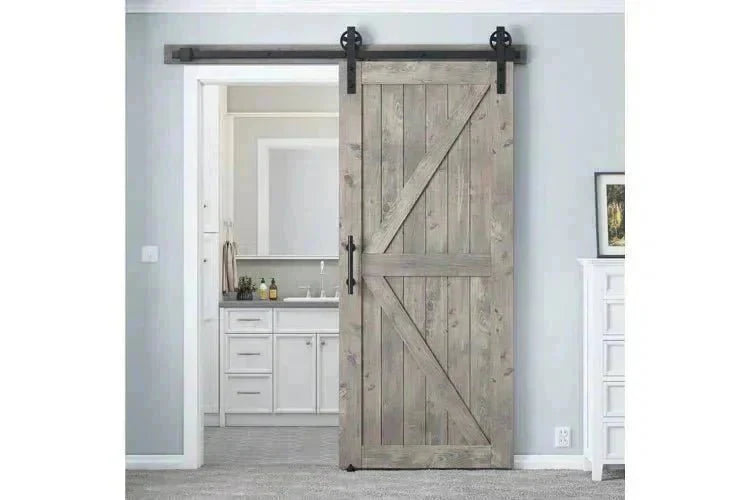
Barn doors work well in bathrooms — probably more often than people expect. The space-saving advantage is real: a bathroom door that doesn't need swing clearance is a genuine improvement in a tight layout. But bathrooms also raise specific concerns around privacy, noise, and hardware durability that don't come up in other rooms. This guide addresses each one honestly.

Why bathrooms work well for barn doors
- No swing clearance required. Bathroom doors that swing into the toilet, vanity, or a person stepping out of the shower are a common frustration in smaller bathrooms. A sliding barn door eliminates that entirely — it travels parallel to the wall and requires no floor arc.
- Wall clearance is often available. Bathroom walls beside doorways are frequently clear — no switches, outlets, or furniture in the path. This makes the single most common barn door constraint (clear wall beside the opening) easier to satisfy in a bathroom than in many other rooms.
- The hardware is visible and part of the look. In a bathroom renovation, the hardware becomes a design element. The track, hangers, and finish contribute to the aesthetic in a way that hinged door hardware never does.
- Bifold works when wall clearance is limited. If there isn't clear wall beside the opening for a standard sliding door, bifold hardware folds the panels compactly beside the opening — a common solution for bathrooms with closets or cabinetry adjacent to the doorway. Browse our bifold hardware collection.
The real concerns — and the honest answers
Privacy
A barn door has a 3/8" wall offset gap running the full perimeter of the door face. That gap allows some light through and means the door doesn't seal against the frame. For a bathroom, this is a manageable limitation — not a dealbreaker — with the right setup:
- Size the door with more overlap. Standard sizing adds 2" per side. For a bathroom, use 3" per side — the extra inch reduces edge gaps on both sides. Your door width formula becomes: opening + 6".
- Add pile or brush pile weatherstrip. Attaches to the door edges and reduces the visible gap. Use pile or brush pile specifically — foam and rubber compression seals drag on a sliding door and will prevent it from closing fully over time.
- Install a latch. A latch keeps the door deliberately closed and prevents drift. Browse our locks and latches collection. For a bathroom, a flip latch in stainless steel is the most practical choice — fast to operate and resistant to humidity over time.
The combination of 3" overlap, pile weatherstrip, and a latch produces a bathroom barn door that's private for all normal residential purposes. It won't match a sealed hinged door in a frame — that's an honest limitation — but it's adequate for a bathroom that isn't shared through a thin wall with a bedroom.
Humidity and hardware durability
Standard powder-coated hardware holds up well in most bathroom environments, including bathrooms with showers. Powder coat is designed for interior use and handles normal bathroom humidity without issue.
For bathrooms with heavy daily shower use — a steam shower, a small bathroom with poor ventilation, or a coastal home — stainless steel hardware is the more durable long-term choice. Stainless is a corrosion-resistant alloy throughout (not just a surface coating), and it's the hardware we'd recommend if you're building a bathroom that will see sustained moisture over many years. Browse our stainless steel hardware collection.
Regardless of hardware finish, a stainless steel latch is always worth specifying for bathroom applications — latches get handled constantly and stainless holds up better than powder coat in that specific context.
Sound transmission
A barn door transmits more sound than a hinged door in a sealed frame — the perimeter gap is the reason. For a bathroom in a high-traffic household where sound isolation genuinely matters, a hinged door performs better. The barn door tradeoff is real and worth acknowledging before committing.
The practical solutions — pile weatherstrip at the edges, 3" overlap per side — reduce sound transmission meaningfully but don't eliminate it. If the bathroom shares a wall with a bedroom or a regularly occupied living space, consider whether the sound tradeoff is acceptable for your specific situation. See our barn door soundproofing guide for specific techniques.
Ventilation
Barn doors are typically solid panels — they don't have ventilation slats. However, the perimeter gap that creates the privacy challenge also provides some passive airflow. For most bathrooms with an exhaust fan, this is adequate. If your bathroom has no exhaust fan and relies on door ventilation, a barn door may reduce airflow compared to a louvered hinged door.
What to confirm before ordering for a bathroom
- Opening width and wall clearance. Measure the rough opening width and the clear wall space beside it. Your door should be opening + 6" wide (3" per side for bathroom coverage). Track length = 2× door width minimum.
- Hardware finish. Standard powder coat for most bathrooms. Stainless steel for heavy steam or coastal environments. Stainless latch regardless of which hardware finish you choose.
- Ceiling clearance above the door. Standard duty J-strap requires 4-1/2"; straight strap and horseshoe require 4"; stainless requires 5-1/2". Measure before choosing a hanger style.
- Handles. You'll need a bar pull or D-pull on the room-facing side and a flush pull on the wall-facing side (the inside of the bathroom) so the door can be operated from both directions. Browse our handles collection and flush pulls collection.
For the full pre-order checklist, see our barn door measuring guide.
Questions about your bathroom barn door installation?
Email us at info@thebarndoorhardwarestore.com with your opening dimensions, bathroom size, and whether you have a shower — we'll confirm the right hardware finish, hanger style, and latch for your specific setup. Browse our full hardware collection. Available 7 days a week.
