
By Evan Christensen · Owner, The Barn Door Hardware Store
Published January 15, 2025 · Updated May 2026
Evan has owned and operated The Barn Door Hardware Store since 2016. Junction plates come up most often for wide openings — room dividers, wide closet walls, or garage bays — where a single standard track section isn't long enough. He and the team are available 7 days a week at info@thebarndoorhardwarestore.com.
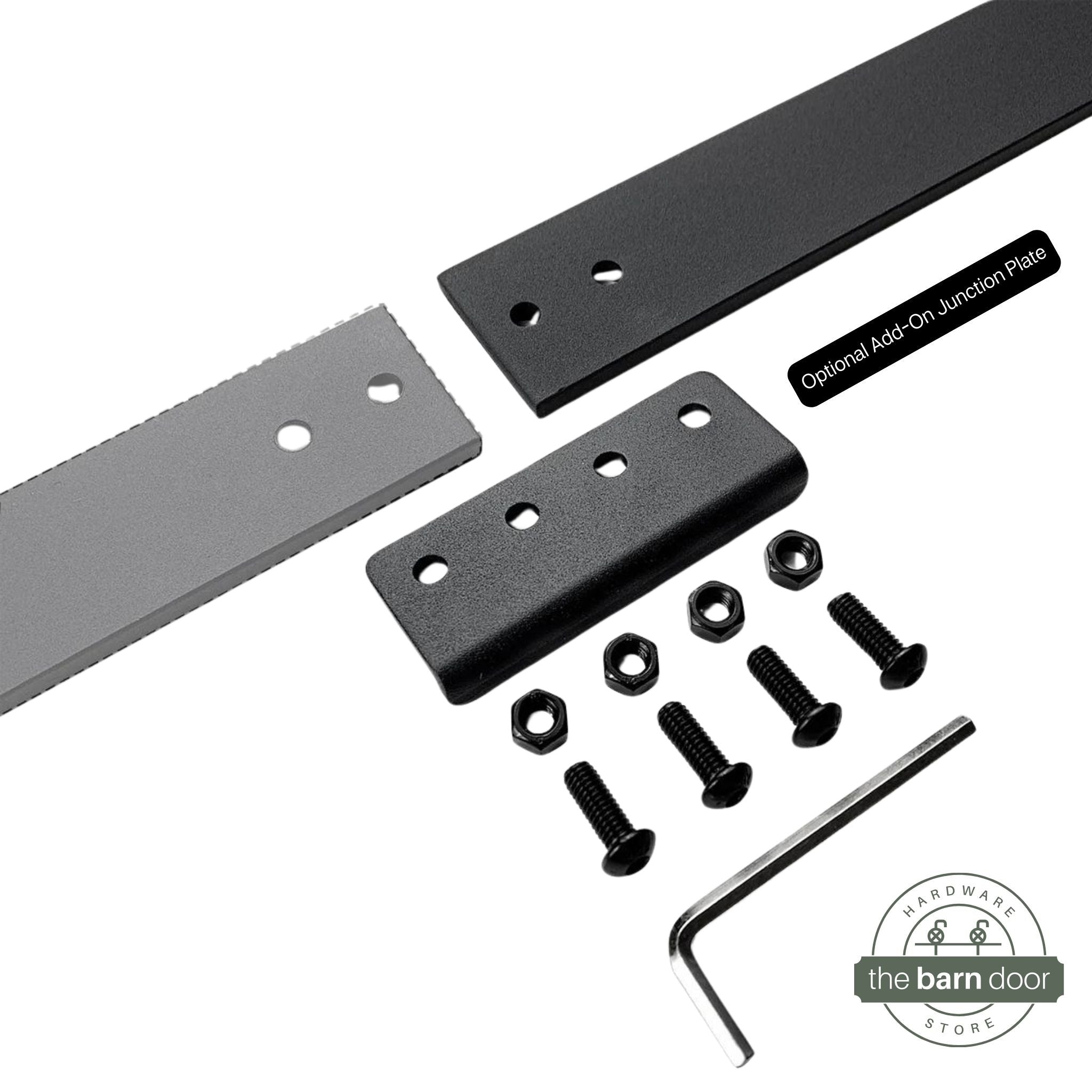
What junction plates do
A junction plate — also called a track connector, connector plate, or track joiner — joins two barn door track sections end-to-end, creating a continuous run of any length. The plate bridges the joint between the two sections, keeping them aligned so the rollers cross from one section to the next without catching or dropping.
This is how any track length beyond a single standard section is achieved — there are no single-piece tracks beyond the standard lengths we stock. Two sections joined with a junction plate are functionally identical to a single long track once properly installed and leveled. For how the track itself works, mounts, and is sized, see our barn door track guide.
When you need junction plates
- Wide single openings. A room divider, wide hallway entry, or large closet wall where the required track length (2× the door width) exceeds a single standard section.
- Bypass configurations with long track runs. Single and double bypass systems covering wide openings need long tracks — the more door panels in the run, the longer the track, and the more likely it exceeds a single standard section.
- Garage and workshop bays. Exterior or covered applications where the opening is too wide for a single track section and a bypass configuration is needed.
For track lengths beyond what's listed on any product page, email us at info@thebarndoorhardwarestore.com before ordering. We'll confirm the right combination of track sections and junction plates for your specific run length.
How to install a junction plate
Junction plate installation is straightforward but requires care at the leveling step — an unlevel joint causes the rollers to catch or drift at the seam.
- Mount the header board first. The header board must span continuously across both track sections — it cannot stop at the joint. A 1×6 hardwood board (oak, maple, or poplar — not pine) spanning the full combined track length, secured into the studs behind it, gives you a solid mounting surface for both sections.
- Mount the first section. Install and level the first track section against the header board before attaching the second. Get the first section perfectly level before anything else.
- Align the second section. Butt the second track section end-to-end with the first, maintaining the same height. Use a long level across both sections — the level line should read true across the full combined length before the junction plate goes on.
- Attach the junction plate. Position the plate over the joint so it bridges both sections evenly. Secure with the provided screws. The plate should pull the joint tight without forcing the sections out of alignment.
- Test before hanging the door. Slide a roller across the full track length by hand before hanging the door. The roller should cross the joint smoothly without any catching, dropping, or resistance.
For the full track and header board installation process, see our barn door installation guide and header board guide.
How long a track do you actually need?
Junction plates only come into play once your total track length passes what a single standard section covers, so start by working out the length your configuration needs. As a rule of thumb, a single sliding track is 2× the door width, and bypass tracks run longer — a fully clear two-door bypass opening needs about 3× the door width, and more as you add panels. Always size to the door, not the opening.
Those are rules of thumb, not the exact figure for your setup. For the complete formulas — single, bypass, and bifold, with a quick-reference table — see our track length guide. To confirm door width, see our barn door dimensions guide.
Need a track length beyond what's listed?
Email us at info@thebarndoorhardwarestore.com with your opening width and the configuration you're planning — we'll calculate the exact track length, confirm how many sections you need, and make sure junction plates are included before anything ships. Available 7 days a week.
