

By Evan Christensen · Owner, The Barn Door Hardware Store
Published January 16, 2026 · Updated April 2026
Evan owns and operates The Barn Door Hardware Store running since 2016. Getting the size right before ordering is the single most common thing his team helps customers with — and it's almost always straightforward once you know what to measure. He and the team are available 7 days a week at info@thebarndoorhardwarestore.com.
If your barn door leaves gaps, drags on the track, or won't close flush, the problem almost always starts with sizing. Getting the measurements right before you order saves you from returns, recuts, and reinstalls.
This guide covers everything you need: standard sizes, how to measure your opening, how hardware affects sizing, and room-by-room recommendations.
What the measurements actually mean
A barn door has four key dimensions: width, height, thickness, and clearance. Unlike a hinged door that sits inside a frame, a barn door mounts on a track and slides across the wall — so it needs to be larger than the opening it covers, and the wall beside the opening needs enough space for the door to slide fully clear.
Width and height refer to the door panel itself. Thickness is front to back — this determines hardware compatibility. Clearance refers to the space above the opening needed for the track and roller system, and the wall space beside the opening where the door slides.
Standard sizes available in 2026
The most common widths are 24", 30", 36", 42", and 48". Standard heights are 80", 84", and 96".
For thickness, most standard interior barn doors are 1-3/8" thick. You'll also find 1-3/4" doors for a heavier, more solid feel, and 2-1/4" for heavy-duty applications with larger or denser panels. Always check that your chosen hardware kit is rated for your door's thickness and weight before ordering.
| Door Type | Common Width | Common Height |
|---|---|---|
| Standard hinged door | 28"–32" | 80" |
| Standard barn door | 36" | 84" |
| Large/double barn door | 42"–48" per panel | 84"–96" |
Standard sizes are less expensive, ship faster, and work with off-the-shelf hardware. If your opening falls within a typical range, start here.
If your opening falls outside standard sizes, custom doors are available from specialty suppliers. Lead times vary and can extend well beyond 8 weeks depending on the manufacturer — factor this in early if you're on a deadline.
How to measure your opening
You'll need a metal tape measure, a level, a pencil, and a notepad. Take all measurements at multiple points — floors and walls are rarely perfectly level.
Step 1: Measure the opening width and height
For a cased opening (with trim), measure from the outer edge of the trim on one side to the outer edge on the other. For height, measure from the floor to the top of the trim. For an uncased opening, measure edge to edge and floor to top.
| Opening Type | Measure Width From | Measure Height From |
|---|---|---|
| Cased (with trim) | Outer edge of trim to outer edge | Floor to top of trim |
| Uncased | Edge to edge of opening | Floor to top edge |
Step 2: Calculate your door size
Your door needs to overlap the opening on both sides to block light and provide privacy. Add 2"–4" to your opening width (1"–2" per side). For height, add 1" above the opening.
So if your opening is 32" wide, you want a 36" door. If your opening is 80" tall, an 84" door gives you the right clearance.
Step 3: Check your wall space
The wall beside the opening needs to be at least as wide as the door panel — this is where the door slides when open. A 36" door needs roughly 36" of clear wall space beside the opening, free of outlets, switches, vents, or trim that would block the slide path.
Step 4: Check vertical clearance
Most track systems need approximately 4–6 inches above the top of the opening to mount properly. Measure from the top of your opening to the ceiling. If you're tight on space, low-profile hardware can help — but always check the specs for your specific kit.
Step 5: Confirm hardware compatibility
Your door's thickness and weight determine which hardware kits will work. Standard kits accommodate 1-3/8" doors, while heavy-duty kits handle 1-3/4" and 2-1/4" panels. Heavier solid wood doors — typically 65–150 lbs — need hardware rated for that weight. Check the weight rating before you buy, not after. Browse our sliding barn door hardware kits to find a system matched to your door size and weight — kits start from $184.
Step 6: Double-check everything
Before ordering, re-measure. Mark the planned door size on the wall with painter's tape to visualize it in the space. The most common mistakes are measuring only once, forgetting to add overlap, and not accounting for trim or baseboards.
How hardware affects sizing
Hardware isn't just a finishing touch — it directly shapes what size door you can use and how much wall space you need.
The track needs to be at least twice the door width for a single sliding door. A 36" door needs a 72" track minimum. Rollers and hangers add height above the door, so that 4–6" of clearance above the opening is essential for most systems.
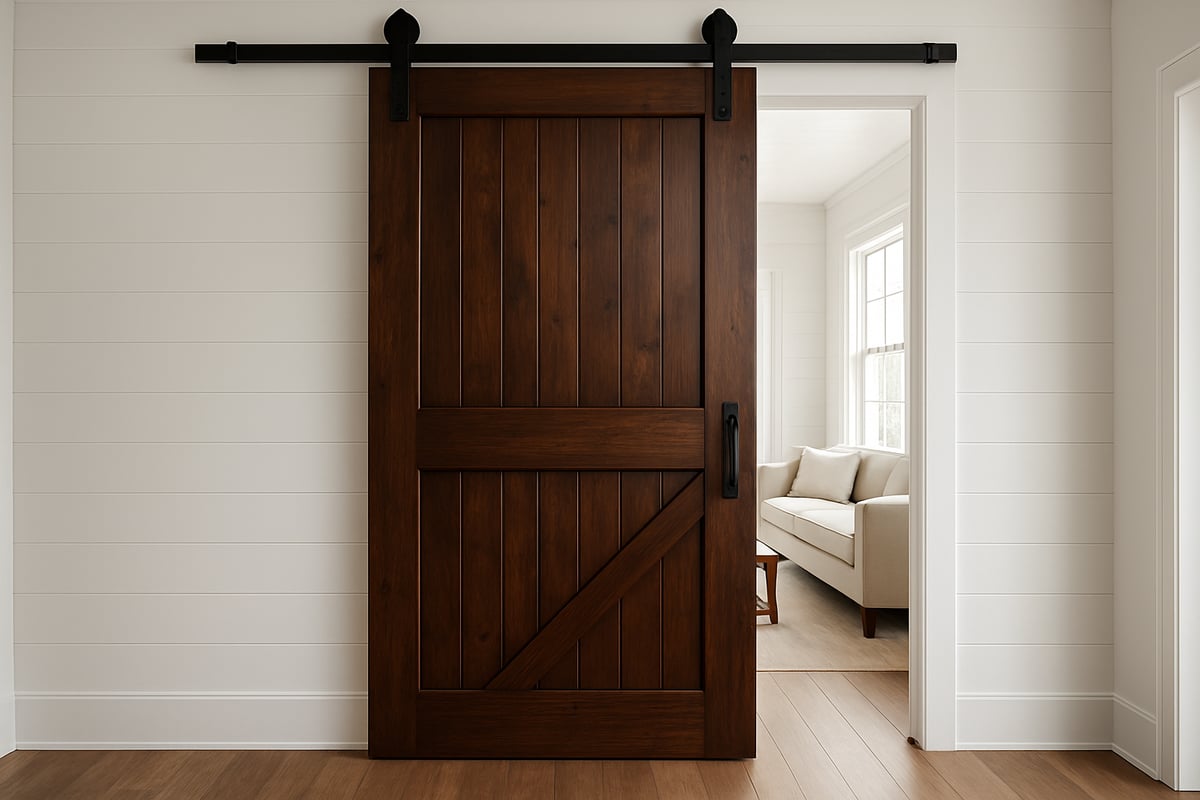
Hardware system types and their sizing implications:
Single sliding — the most common setup. One door on one track. Works for standard openings up to around 48" wide.
Bypass — two doors on parallel tracks that slide past each other. Ideal for wide openings like closets or room dividers where wall space is limited on one side. Each door covers half the opening.
Bifold — doors fold as they slide, requiring less wall space. Good for tight hallways or closets where even bypass clearance isn't available.
Ceiling mount — track mounts to the ceiling instead of the wall. Useful when wall space above the opening is limited or for a modern floating look. Our ceiling mount barn door hardware guide covers this in detail.
Heavy duty — for doors over 150 lbs or commercial applications. Reinforced tracks, larger rollers, and higher weight ratings. Essential for solid hardwood, 2-1/4" thick, or oversized panels.
For style, match your hardware finish to other metal fixtures in the room — matte black, brushed nickel, and oil-rubbed bronze are the most popular choices in 2026. Oversized doors look best with heavier, more substantial hardware; smaller doors suit slimmer, understated tracks.
Sizing by room
Bedrooms and bathrooms — a 36" × 84" door covers most standard bedroom openings. For bathrooms, prioritize overlap (2" per side minimum) to block light. Soft-close hardware is worth adding in bedrooms — it prevents slamming and keeps things quiet.
Kitchens, pantries, and laundry rooms — smaller openings here mean 24"–30" wide doors are common. Mini barn doors work well for pantry nooks and cabinet fronts. The space-saving slide makes barn doors a practical choice for tight utility spaces.
Living rooms and open-concept spaces — wider openings call for 42"–48" panels or double door setups. Heights of 96" make a strong visual statement in rooms with high ceilings. Double barn doors on a bypass track are a popular choice for defining zones in open-concept layouts without closing off the space permanently.
Commercial and office spaces — ADA compliance requires a minimum 36" clear opening width. For conference rooms or partitions, 42"–48" doors are common. Bypass systems work well for wide commercial openings. Always verify local building codes before installation.
Sheds, garages, and exterior applications — exterior barn doors run larger: 42"×96" is a typical starting point for shed or garage use. Thicker doors (2-1/4") and weather-resistant hardware are essential. See our exterior barn door hardware guide for material and hardware recommendations specific to outdoor use.
What doors cost and where to source them
The hardware and the door are purchased separately. For the door itself, local lumber yards are often the most cost-effective source for standard sizes, with prices typically starting around $400–$900 depending on material. Ordering a door online is also an option but factor in shipping costs, which can add significantly to the total.
Our hardware kits start from $184 and cover every configuration — from basic single sliding systems to heavy-duty and bypass setups. Browse our full range of barn door hardware kits to find the right fit for your door size, thickness, and weight.
Frequently asked questions
What's the most common barn door size? 36" wide by 84" tall fits the majority of interior openings and is the most widely stocked size.
How much overlap does a barn door need? 1"–2" per side is the standard. For bathrooms or anywhere light and sound control matters, go closer to 2" per side.
What's the minimum wall space needed? At least the full width of the door panel beside the opening, clear of obstructions.
How thick should a barn door be? Most standard doors are 1-3/8" thick, which works with the widest range of hardware systems. For heavier or more substantial doors, 1-3/4" and 2-1/4" options are available — just make sure your hardware is rated for the additional weight.
Do bypass and double doors use standard sizes? Yes — bypass setups typically use two standard panels, each covering half the opening. Browse our bypass barn door hardware options for kit configurations.
Do barn doors work in small spaces? Absolutely. A 24" door is ideal for pantries, laundry nooks, and tight hallways where a swinging door would be impractical.
Ready to find the right hardware for your size?
Once you have your measurements, the hardware selection becomes straightforward. Browse our full range of barn door hardware kits — from single sliding systems to heavy-duty and bypass setups — or reach out to our team at info@thebarndoorhardwarestore.com. We're available 7 days a week and happy to help you confirm the right fit before you order.
Related guides:
