

Have you ever walked into a beautifully designed home and noticed those stunning double barn doors leading to a closet? There's something undeniably captivating about them. A double barn doors closet combines rustic charm with modern functionality, transforming an ordinary storage space into a design statement that can elevate your entire room. Whether you're renovating a master bedroom, updating a walk-in closet, or reimagining a reach-in space, double barn doors offer a unique solution that's both practical and visually striking.
Why Choose a Double Barn Doors Closet?
Let's talk about the elephant in the room: why would you choose barn doors over traditional hinged doors for your closet? I get this question all the time, and the answer goes beyond just aesthetics.
Traditional closet doors swing outward, requiring clearance space that eats into your room's usable area. If you've ever had to arrange furniture around a closet door's swing radius, you know exactly what I'm talking about. A double barn doors closet slides parallel to the wall, freeing up that precious floor space.
Space-Saving Benefits
Here's what makes the space-saving aspect truly game-changing:
- No swing radius required, giving you more furniture placement options
- Wider opening access when both doors are slid to one side
- Perfect for tight spaces where traditional doors would be impractical
- Eliminates door-banging-into-furniture scenarios
Beyond practicality, there's the undeniable style factor. My neighbor Sarah installed a double barn doors closet in her master bedroom last summer, and it completely transformed the space. She chose a rustic white-washed finish that complemented her farmhouse aesthetic, and now everyone who visits asks about those doors first.
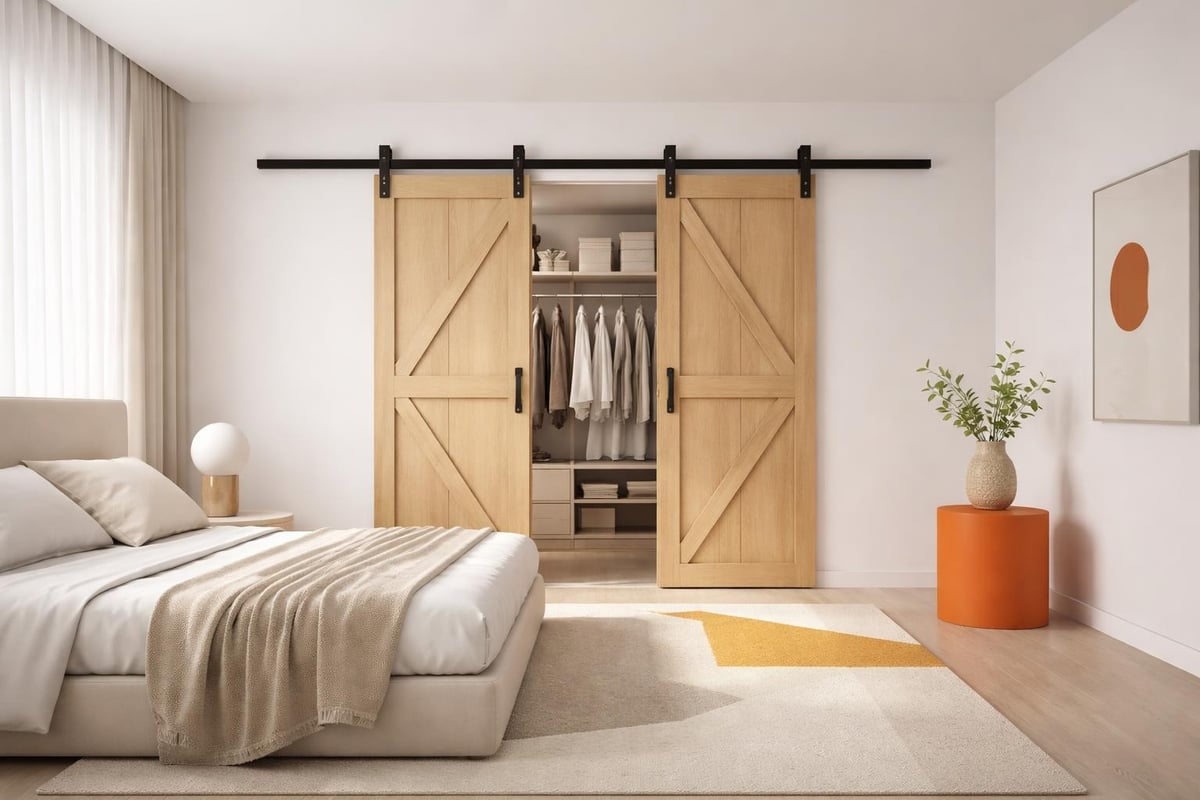
Design Styles That Work with Double Barn Doors
One of the most exciting aspects of planning a double barn doors closet is exploring the vast range of design possibilities. The beauty of barn doors is their versatility, they're not locked into one specific aesthetic.
Farmhouse and Rustic Designs
The classic farmhouse look remains incredibly popular, and for good reason. Think reclaimed wood with visible grain patterns, weathered finishes, and simple hardware. This style brings warmth and character to bedrooms, especially when paired with shiplap walls or neutral color palettes.
Popular rustic design elements include:
- X-brace patterns that add visual texture
- Natural wood stains in honey, walnut, or gray tones
- Matte black or oil-rubbed bronze hardware
- Board-and-batten construction with visible vertical planks
Modern and Contemporary Options
Don't think barn doors are only for farmhouse lovers. Contemporary designs have exploded in popularity, featuring clean lines, minimalist hardware, and unexpected materials. I recently saw a stunning walk-in closet with double sliding barn doors in a transitional-style home that perfectly balanced modern and traditional elements.
| Design Style | Door Material | Hardware Finish | Best For |
|---|---|---|---|
| Farmhouse | Reclaimed wood, pine | Matte black, bronze | Traditional homes, country cottages |
| Modern | Glass panels, smooth wood | Stainless steel, chrome | Urban apartments, contemporary spaces |
| Industrial | Metal-framed, dark wood | Raw steel, gunmetal | Loft conversions, eclectic interiors |
| Transitional | Painted wood, mixed materials | Brushed nickel, satin brass | Updated traditional homes |
Painted and Colored Finishes
Who says barn doors have to be wood-toned? Painted finishes open up a whole new world of possibilities for your double barn doors closet. Crisp white doors create an airy, coastal vibe. Navy blue makes a bold statement. Sage green brings in that trendy organic modern feel we're seeing everywhere in 2026.
Choosing the Right Hardware for Your Double Barn Doors Closet
Here's where things get technical, but stay with me because this matters more than you might think. The hardware you select determines not just how your doors look, but how smoothly they operate for years to come.
Track Systems and Configuration
When you're working with a double barn doors closet, you have two main track configuration options. You can install two single tracks with doors that slide in opposite directions, or opt for a bypass system where doors overlap on a shared track.
The two-track system provides complete access to your closet when both doors are fully open. Each door slides independently to one side, revealing the entire opening. This works beautifully for wider closets where you want maximum accessibility.
Bypass systems use less wall space since doors overlap rather than stacking side by side. However, you can only access about 50% of the closet opening at any given time. Consider your daily routine: do you need to see your entire closet at once, or are you typically accessing one section at a time?
Weight Capacity Considerations
This might seem boring, but choosing hardware with the proper weight capacity prevents future headaches. Trust me on this one.
Standard barn door hardware typically supports 150-200 pounds per door. For most residential applications, this works perfectly fine. However, if you're building doors from thick hardwood, adding glass panels, or going oversized, you'll need heavy-duty systems rated for higher weights.
Before purchasing hardware, calculate your door weight:
- Measure door dimensions (height × width)
- Multiply by door thickness
- Multiply by wood density (pine ≈ 35 lbs/cubic foot, oak ≈ 47 lbs/cubic foot)
- Add weight of any glass, metal panels, or decorative elements
- Add 20% safety margin
Hardware Style and Quality
The hardware you choose creates the entire aesthetic foundation for your double barn doors closet. The Classic J-Strap Barn Door Hardware Kit exemplifies how traditional curved designs can work beautifully in both rustic and contemporary settings. Its time-tested J-strap style supports doors up to 200 pounds while delivering that authentic farmhouse look that's defined the aesthetic for generations.
When you're comparing hardware options, look beyond just appearance. Quality hardware features:
- Sealed ball bearings in rollers for smooth, quiet operation
- Solid steel construction rather than hollow components
- Powder-coated finishes that resist scratches and corrosion
- Adjustable roller mechanisms for fine-tuning alignment
Installation Planning and Preparation
Let's get practical. You've chosen your design, selected your hardware, and you're ready to transform your space. But before you start drilling holes, proper planning makes the difference between a professional-looking installation and a frustrating DIY disaster.
Measuring Your Space
Accurate measurements are absolutely critical for a double barn doors closet. Here's your measuring checklist:
- Closet opening width (measure at top, middle, and bottom)
- Closet opening height from floor to header
- Available wall space on both sides of opening
- Distance from ceiling to top of opening
- Wall depth and stud locations
- Any obstructions (outlets, light switches, trim work)
For door sizing, add 2-4 inches to your opening width and 1 inch to the height. This overlap ensures privacy and prevents light gaps. With double doors, divide the total door width between two panels, keeping each door manageable in size and weight.
Wall Structure Assessment
Here's something many DIYers overlook: your wall must properly support the hardware. Barn door tracks carry significant weight, and they need solid mounting.
Ideally, your track mounts directly into wall studs. If studs don't align where you need them, you have options:
- Install a mounting board (1x4 or 2x4) across studs before adding the track
- Use a decorative header board that serves both aesthetic and structural functions
- Consider hidden hardware options for a cleaner look with proper support
My friend Jake learned this lesson the hard way. He mounted his double barn doors closet track directly to drywall with toggle bolts, figuring it would hold. Three months later, the track started sagging. He had to remove everything, install a proper mounting board, and reinstall from scratch.
Building vs. Buying Your Barn Doors
Should you build your own doors or purchase pre-made ones? This decision impacts your budget, timeline, and final results.
DIY Door Construction
Building your own barn doors offers customization and potential cost savings. If you have woodworking skills and tools, constructing sliding doors becomes a rewarding weekend project.
Pros of DIY construction:
- Complete control over dimensions, materials, and finishes
- Ability to match existing woodwork or specific design visions
- Potential cost savings on door panels (hardware costs remain the same)
- Satisfaction of creating something custom
Cons of building your own:
- Requires woodworking tools, skills, and workspace
- Time-intensive process from cutting to finishing
- Risk of warping if wood isn't properly dried or sealed
- No warranty or return option if dimensions are wrong
A detailed DIY tutorial can guide you through the process, showing everything from selecting lumber to applying finishes. These guides typically cover building X-brace doors, the most popular DIY style.
Pre-Made Door Options
Pre-manufactured doors arrive ready to install, saving time and ensuring professional quality. Companies offer extensive design catalogs, from simple plank styles to intricate X-design patterns with hardware included.
Purchasing pre-made doors makes sense when:
- You lack woodworking tools or experience
- Time constraints make DIY impractical
- You want manufacturer warranties and quality guarantees
- Complex designs exceed your skill level
The investment in pre-made doors often pays off in finished quality and installation speed. Many complete kits include doors, hardware, and installation guides, streamlining the entire project.
Installation Tips and Best Practices
You've got your doors, your hardware, and you're ready to install. Let's make sure this goes smoothly.
Step-by-Step Installation Process
Professional installers follow a systematic approach that ensures proper alignment and operation. Here's the proven sequence:
- Install the mounting board or header securely into studs
- Attach the track to the mounting surface, ensuring it's level
- Mount door stops at both ends of the track
- Install floor guides to prevent door swing (if needed)
- Hang the doors on rollers and test movement
- Adjust roller heights for even door alignment
- Install handles at comfortable heights
- Add soft-close mechanisms (optional but highly recommended)
Video tutorials provide visual guidance for each step, especially helpful when working with specific hardware systems. Watching someone complete the installation before you start prevents common mistakes.
Common Installation Mistakes
Let me save you from the most frequent installation problems I've seen:
Mistake #1: Not using a level Even if your floor appears level, it probably isn't. Always use a quality level when installing your track. A sloped track causes doors to drift open or closed on their own, which drives people crazy.
Mistake #2: Inadequate wall support We covered this earlier, but it bears repeating: proper structural support is non-negotiable. If your track isn't solidly mounted, everything else fails.
Mistake #3: Incorrect door overlap For privacy and light blocking, your doors need adequate overlap with the wall and each other. Plan for at least 1-2 inches of overlap on all sides.
Mistake #4: Forgetting clearance requirements Your double barn doors closet needs clearance behind the doors for the hardware. Most systems require 1.5-2.5 inches from the wall to the back of the door. Don't forget to account for baseboard trim, which might need modification.
Maintaining Your Double Barn Doors Closet
Installation day is exciting, but proper maintenance keeps your doors operating smoothly for years. Fortunately, barn doors require minimal upkeep when installed correctly.
Regular Cleaning and Care
Dust accumulation on tracks and rollers gradually impacts performance. Every few months, vacuum the track channel to remove debris. Wipe down rollers with a dry cloth to prevent buildup.
For interior barn doors, cleaning requirements depend on your finish:
- Natural wood: Dust regularly with microfiber cloths; apply wood polish quarterly
- Painted surfaces: Wipe with damp cloth and mild soap; avoid harsh chemicals
- Stained finishes: Use wood cleaner appropriate for your stain type
- Glass panels: Clean with standard glass cleaner and lint-free cloths
Hardware Inspection and Adjustment
Every six months, inspect your hardware components:
- Check roller wheels for wear or damage
- Tighten any loose mounting screws or bolts
- Test door alignment and adjust if doors have shifted
- Apply dry lubricant to rollers if movement becomes stiff
- Inspect track for bends, dents, or damage
Most quality hardware systems include adjustment mechanisms that let you fine-tune door height and alignment without major disassembly. Learning these adjustment points during installation makes future maintenance easier.
Customizing Your Double Barn Doors Closet
Once you've mastered the basics, customization options take your project to the next level.
Handle and Pull Options
The handles you choose create touchpoints you'll interact with daily. Consider both aesthetics and ergonomics:
| Handle Type | Best For | Style Impact |
|---|---|---|
| Recessed pulls | Minimalist designs, tight spaces | Clean, modern, doesn't protrude |
| Vertical bar pulls | Contemporary, industrial looks | Bold, easy to grip, statement piece |
| Decorative wrought iron | Farmhouse, rustic styles | Traditional, adds character |
| Leather straps | Eclectic, unique designs | Soft texture, unexpected element |
Stainless steel handles offer durability and modern appeal, especially in contemporary or transitional spaces. Their sleek appearance complements brushed nickel or chrome hardware finishes.
Soft-Close Mechanisms
Here's an upgrade that seems minor but makes a huge difference: soft-close mechanisms. These dampening systems prevent doors from slamming, protecting both your doors and your walls from impact damage.
Soft-close systems work through hydraulic dampers or spring-loaded mechanisms that engage as the door approaches the closed position. They're particularly valuable for:
- Homes with children who tend to slide doors forcefully
- Nighttime closet access without disturbing sleeping partners
- Protecting delicate door finishes from impact chips
- Reducing noise in open-concept living spaces
Lighting Integration
Want to elevate your double barn doors closet even further? Integrate lighting into the design. Options include:
- LED strip lights mounted above the track for ambient glow
- Motion-activated interior closet lighting
- Decorative sconces flanking the barn doors
- Backlit translucent glass panels in the doors themselves
Lighting transforms your closet from purely functional storage into a design feature that contributes to your room's overall ambiance.
Budget Considerations and Cost Breakdown
Let's talk money. What does a double barn doors closet actually cost?
Your total investment depends on several variables: door size, material quality, hardware choice, and whether you're DIYing or hiring professionals.
Material and Hardware Costs
Door panels:
- DIY lumber and materials: $150-400 for both doors
- Pre-made basic doors: $300-600 per pair
- Premium designer doors: $800-2,000+ per pair
Hardware systems:
- Basic residential kits: $150-300
- Mid-range quality systems: $300-500
- Premium heavy-duty hardware: $500-1,000+
- Specialty finishes or custom: $1,000+
Additional components:
- Mounting boards and trim: $50-150
- Handles and pulls: $20-200
- Soft-close mechanisms: $40-100
- Floor guides and stops: $15-50
Installation Labor
Professional installation typically runs $200-500 for a double barn doors closet, depending on your location and project complexity. This cost covers:
- Precise measurements and layout
- Mounting board installation
- Track mounting and leveling
- Door hanging and adjustment
- Hardware installation and testing
DIY installation costs nothing but time, usually 4-8 hours for someone with moderate DIY skills tackling their first barn door project. Subsequent installations go much faster as you develop familiarity with the process.
Real-World Applications and Success Stories
Theory is great, but let's look at how real people have transformed their homes with double barn doors closets.
Master Bedroom Transformation
Jennifer and Mark from Portland faced a common problem: their master bedroom felt cramped despite decent square footage. The culprit? Traditional bifold closet doors that required clearance space and never fully opened, making closet organization frustrating.
They replaced those bifolds with a white shiplap double barn doors closet. The change was dramatic. By eliminating the door swing radius, they gained space for a reading chair beside the window. The barn doors became the room's focal point, complementing their modern farmhouse aesthetic perfectly.
"I never realized how much those old doors bothered me until they were gone," Jennifer told me. "Now getting dressed in the morning is actually pleasant. I can see my entire wardrobe at once, and the doors slide so smoothly."
Small Space Solutions
Not all double barn doors closet projects involve spacious walk-ins. Maria's 1920s apartment featured a reach-in closet with outdated accordion doors that never worked properly. The closet opening was only five feet wide, but she desperately wanted to maximize the space.
She installed a bypass double barn doors closet system with mirrored panels. The mirrors made her small bedroom feel twice as large, while the sliding mechanism required zero clearance space. The hardware's sleek profile kept the installation shallow against the wall.
"Everyone thinks my apartment is bigger than it actually is because of those mirrors," Maria shared. "And I love not fighting with broken accordion doors every morning."
Troubleshooting Common Issues
Even well-executed installations sometimes encounter issues. Here's how to address the most common problems.
Doors Won't Slide Smoothly
If your doors stick or resist sliding:
- Clean the track thoroughly of any debris or obstructions
- Check roller wheels for damage or flat spots
- Verify the track is level (doors naturally roll toward low points)
- Apply appropriate dry lubricant to rollers and track
- Ensure adequate clearance between door and floor
Doors Don't Align Properly
Misaligned doors create gaps that compromise privacy. Solutions include:
- Adjust roller height using built-in adjustment screws
- Verify track mounting is level and secure
- Check for door warping (especially with DIY construction)
- Ensure mounting board hasn't shifted or sagged
- Confirm floor guides are properly positioned
Excessive Noise During Operation
Barn doors should glide quietly. If yours sound like a freight train:
- Tighten all loose hardware connections
- Replace worn roller bearings
- Add felt pads between door and wall stops
- Install soft-close mechanisms to eliminate slamming
- Verify wheels are rolling freely, not dragging
Quality hardware from established manufacturers typically includes support resources and warranty coverage that protects your investment and provides peace of mind.
Creating a double barn doors closet transforms both the functionality and aesthetic appeal of your space, whether you're working with a spacious walk-in or a compact reach-in closet. By carefully selecting your design style, choosing quality hardware suited to your door weight and configuration, and following proven installation practices, you'll create a stunning entrance that serves you well for years to come. The Barn Door Hardware Store provides everything you need for your project, from American-made hardware kits to expert installation support, all backed by free shipping and a limited lifetime warranty that demonstrates their commitment to quality and customer satisfaction.
