
By Evan Christensen · Owner, The Barn Door Hardware Store
Published February 2, 2024 · Updated April 2026
Evan has owned and operated The Barn Door Hardware Store since 2016. Barn door installation is one of the more achievable DIY projects for a first-time installer — the steps are straightforward as long as the sizing and wall preparation are done correctly before drilling. He and the team are available 7 days a week at info@thebarndoorhardwarestore.com.
Installing a barn door is a manageable DIY project for most homeowners — the steps are straightforward and everything you need comes in the kit. The part that trips people up most often isn't the installation itself; it's the decisions made before drilling. Door width, track length, and wall clearance need to be confirmed before any hardware is mounted.
This guide covers the full process: sizing the door and track, choosing the right hardware kit, and installing everything from the mounting board to the floor guide. For configuration-specific installation (bifold, ceiling mount), see the dedicated guides linked throughout.
Step 1: Get your sizing right before ordering
Three measurements determine everything. Get these before purchasing anything.
Door width
A barn door must be wider than the opening to overlap the wall on each side. The overlap needed depends on the room:
| Room type | Overlap per side | Door width formula |
|---|---|---|
| Standard rooms (hallway, pantry, living) | 2 in per side | Opening width + 4 in |
| Bedrooms and bathrooms | 3 in per side | Opening width + 6 in |
Door height
Opening height plus 1 in. For a standard 80 in opening, use an 81 in door. The extra inch provides top coverage while maintaining the required 1/2 to 1 in floor clearance at the bottom.
Track length
At least 2× the door width — not 2× the opening. A 40 in door needs at minimum an 80 in track. Sizing to the opening instead of the door is the most common ordering mistake.
Wall clearance
Confirm that clear wall space equal to the full door width exists beside the opening on the slide side. Walk the full path the door will travel and check for light switches, outlets, corners, and anything else in the way — before ordering.
For the full sizing breakdown including bypass and bifold configurations, see our barn door sizing guide and dimensions guide.
Step 2: Choose the right hardware kit
Hardware kits include all mounting hardware but not the door itself — the door is sourced separately. Choose based on configuration:
- Single sliding: One door on one track. The most common configuration. Browse single track hardware.
- Biparting (two doors, one track): Two doors slide from opposite ends of the same track and meet in the center when closed. For wide openings where a symmetrical look is the goal. Browse single track hardware sized for biparting.
- Single bypass: Two to four doors on a single shared track that slide past each other. Limited wall space required on either side. Browse single bypass hardware.
- Double bypass: Two to four doors on two parallel tracks, fully stacking behind each other. Best for wide openings needing full clearance and pass-through access. Browse double bypass hardware.
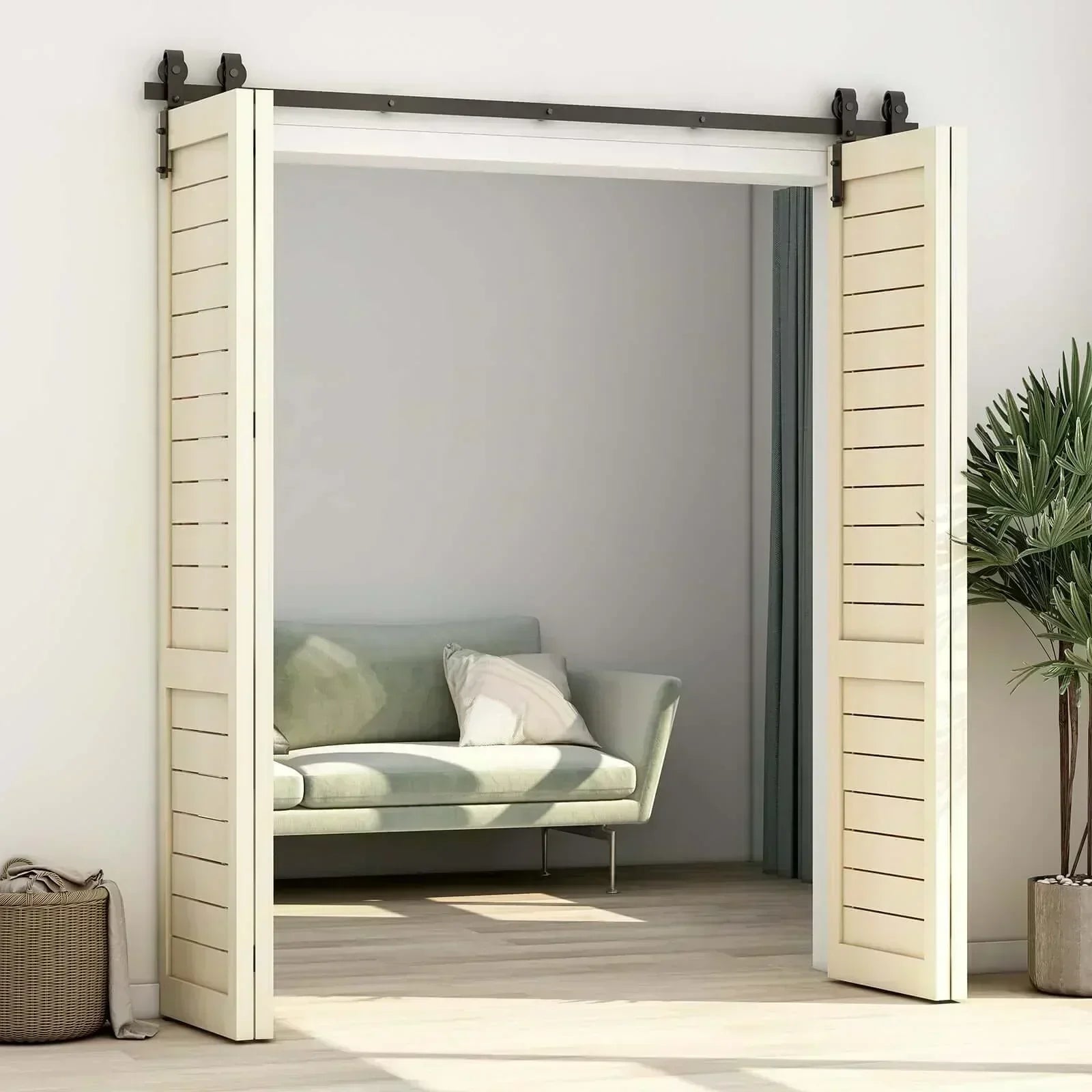
- Bifold: Panels fold accordion-style beside the opening. Best for closets, pantries, and openings with limited side wall clearance. Browse bifold hardware.
- Ceiling mount: For openings without a solid wall above. Track mounts to the ceiling instead. Browse ceiling mount hardware.
Not sure which hardware fits your door weight? Use our hardware finder or see our barn door weight guide.
Step 3: Gather your tools
Your hardware kit includes all the mounting hardware, rollers, track, stops, and floor guide. You'll need to supply:
- Tape measure
- Pencil
- Level
- Power drill with bits
- Stud finder
- Hex wrench (often included in kit)
Review the instruction manual included with your kit before starting — it contains diagrams and specifications specific to your hardware that this guide can't replicate for every configuration.
Step 4: Install the header board (if needed)
Most barn door installations require a solid header board above the opening to mount the track into. Wall studs are rarely spaced to align perfectly with every track mounting point, and drywall alone won't support the load.
Use a 1×6 hardwood board (oak, maple, or poplar — not pine, which is too soft for sustained lag bolt load) spanning the full track length, secured into the studs behind it. If blocking was installed inside the wall during construction, a separate header board isn't needed — the track can mount directly into the blocking.
For more detail on header board selection and installation, see our header board installation guide.
Step 5: Install the track
- Mark a level horizontal line on the header board at the correct track height for your hardware. The height formula varies by hanger style — refer to your kit's instruction manual for the specific measurement.
- Locate and mark stud positions across the header board.
- Lay the track against the header board, center it on your marked line, and confirm it is level.
- Mark each mounting hole position with a pencil.
- Drill pilot holes at each marked position.
- Install lag bolts and spacers at each position, following the kit's diagram. Do not fully tighten until all bolts are started — check level again before final tightening.
- Install track stops at each end of the track at the positions where you want the door to stop.
Step 6: Attach hangers to the door
- Using the measurements in your instruction manual, mark the hanger positions on the door. Hanger placement varies by style (face mount vs. top edge mount) — follow the kit diagram exactly.
- Drill pilot holes at the marked positions.
- Attach hangers with the provided bolts, hand-tightening first and fully tightening once alignment is confirmed.
- Install anti-jump disks on the top edge of the door, following the kit diagram. These prevent the door from jumping off the track if lifted.
Step 7: Hang the door and install the floor guide
- With at least one other person assisting, lift the door at a slight angle and rest the roller wheels into the track channel. For heavier doors, a third person helps significantly.
- Slide the door back and forth along the full track length to confirm smooth operation and that the door hangs level.
- Install the floor guide at the base of the door. The guide should be positioned where the door naturally hangs when closed — don't position it to force the door to a different position, as this creates friction.
For more on floor guide types and when to use each, see our barn door floor guide guide.
Step 8: Finishing touches
- Install door handle. Position the pull handle on the room-facing side at a comfortable height (approximately 35 in from the floor is standard). For the wall-facing side, use a flush pull — a projecting handle will catch on the door frame as the door slides open. Browse our handles collection.
- Add a latch if needed. Hardware kits don't include a latch. If you want the door to stay closed — especially for bathroom or bedroom applications — add a latch before considering the installation complete. Browse our locks and latches collection.
- Final slide test. Slide the door the full length of the track several times. Confirm it moves smoothly, stops at the track stops, and sits level when closed. Make any final adjustments to hanger height or floor guide position.
Common questions
Do I need a header board to install a barn door?
In most cases, yes. A header board gives you a solid, continuous surface to mount your track into, especially if your wall studs don't align perfectly with the track mounting points. Use a 1×6 hardwood board secured into the studs behind it. If blocking was installed inside the wall during construction, a separate header board isn't needed. See our header board guide for more detail.
Can I install a barn door by myself?
Most of the installation is a one-person job, but you'll want a second set of hands when lifting the door onto the track — especially for heavier solid wood doors. Everything else, from mounting the track to installing the floor guide, can be done solo.
What if my barn door swings away from the wall?
This is almost always a floor guide issue. Make sure the guide is properly installed and adjusted to your door thickness. If it's still swinging, check that the track is level — even a slight tilt can cause movement at the bottom. See our guide to keeping barn doors from swinging for the full breakdown.
Can barn door hardware be installed on any wall type?
Our hardware kits are designed for standard drywall with wood stud framing. For concrete, brick, or metal stud walls, appropriate anchors and fasteners are needed and the installation process differs. If you're working with non-standard wall construction, email us before ordering — we can advise on what's needed.
What if my barn door slides open on its own?
The track is likely slightly off level — even a fraction of a degree causes drift on quality hardware with low-rolling-resistance bearings. Apply a small piece of self-adhesive felt on top of the track at the rest position to create gentle resistance. See our door drifting guide for the full fix.
Questions before you start?
Email us at info@thebarndoorhardwarestore.com with your opening dimensions, wall type, and any unusual constraints — we'll confirm the right hardware and flag anything that needs addressing before installation. Our full installation guides are also available for every kit. Available 7 days a week.
