
By Evan Christensen · Owner, The Barn Door Hardware Store
Published September 29, 2024 · Updated April 2026
Evan has owned and operated The Barn Door Hardware Store since 2016. We sell barn door hardware, not pocket doors — so this comparison isn't a sales pitch. Both configurations have genuine advantages depending on the situation, and knowing the difference upfront saves a lot of frustration later. He and the team are available 7 days a week at info@thebarndoorhardwarestore.com.
Pocket doors and barn doors both solve the same core problem: a hinged door that swings into a tight space. Beyond that they work very differently, with different installation requirements, different maintenance demands, and different tradeoffs worth knowing before you commit to either.
A transparency note before we start: we sell barn door hardware, not pocket doors. We're going to be as honest as we can about both options because the worst outcome is a customer who buys the wrong door type for their situation — that helps no one. If a pocket door is the right answer for your space, we'd rather you know that now.
How each door type works
Pocket doors
A pocket door slides into a cavity built inside the wall when it opens — the door completely disappears from view. The track and hardware are inside the wall, invisible when the door is open or closed. From the front, all you see is the door panel and a minimal edge profile.
The main installation constraint: pocket doors require a wall cavity large enough to accept the door panel. That wall cannot contain plumbing, electrical wiring, or load-bearing structure. Retrofitting a pocket door into an existing wall is a significant construction project. In new builds, they're planned from the start and much simpler to incorporate.
Barn doors
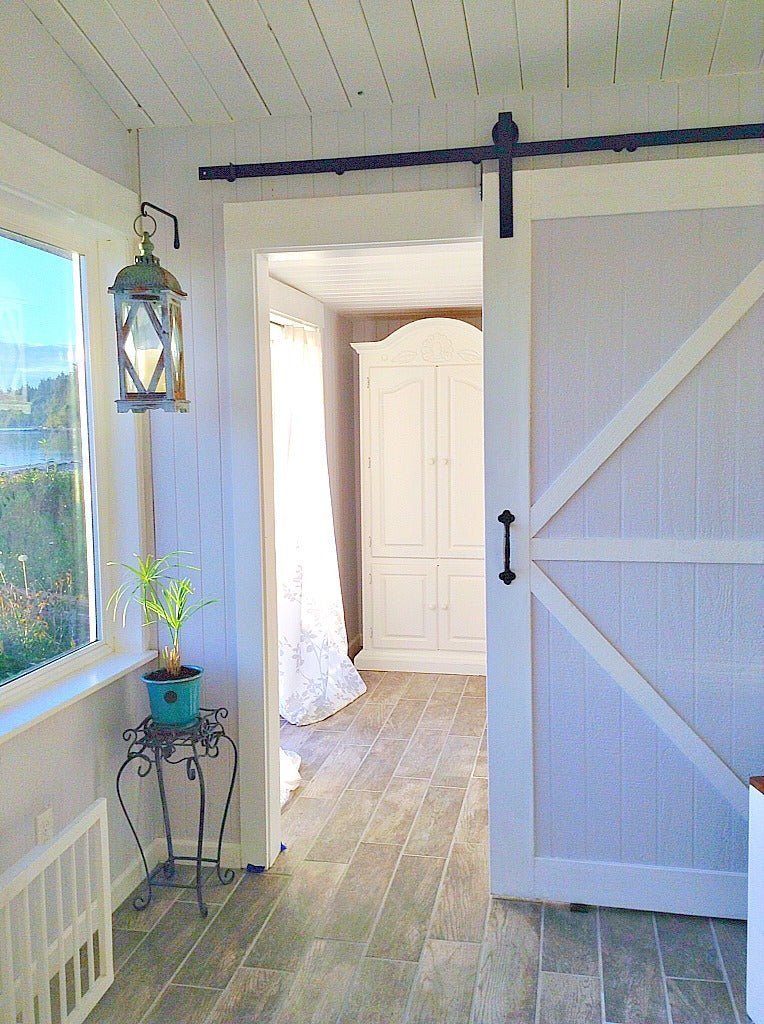
A barn door slides along a track mounted above the opening, parallel to the wall. The door and all its hardware remain visible at all times — whether open or closed. Installation requires a solid header or blocking above the opening and clear wall space beside the opening equal to the full door width.
The main installation constraint: that clear wall space beside the opening. If a light switch, outlet, corner, or window is in the door's path, the door can't fully clear the opening. Browse our hardware collections for the full range of barn door configurations.
Side-by-side comparison
| Pocket door | Barn door | |
|---|---|---|
| Hardware visibility | Fully hidden inside wall | Visible — track, rollers, and hangers on display |
| Wall space beside opening | Not required — door disappears into wall | Required — full door width of clear wall needed |
| Wall space inside wall | Required — cavity must be clear of plumbing and electrical | Not required |
| Installation complexity | High — significant construction, especially in retrofits | Lower — header board, track, and hang |
| Hardware maintenance | Difficult to impossible — hardware is inside the wall | Accessible — clean and inspect easily |
| Sound transmission | Better — door fills a frame with less air gap | More — 3/8 in wall offset creates perimeter air gap |
| Aesthetics when open | Truly invisible — wall reads as uninterrupted | Track and hardware visible above opening |
| Cost | Higher — especially for retrofits into existing walls | Lower — particularly for existing construction |
| Soft close available | Available from pocket door hardware suppliers | Yes — available on most configurations we carry |
When to choose each
Choose a pocket door when:
- You want truly invisible hardware — the door disappearing completely into the wall is the goal
- You're doing new construction or a major renovation where a wall cavity can be planned in advance
- You have no clear wall space beside the opening for a barn door to travel into
- Sound reduction is a priority — pocket doors fill a frame with less air gap than barn doors
- The wall the door would slide into is confirmed clear of plumbing, electrical, and load-bearing structure
Choose a barn door when:
- You're working with existing construction and don't want a major renovation project
- You have clear wall space beside the opening for the door to travel into
- Visible hardware is an asset to your design — the track and rollers are part of the look
- Easy hardware maintenance matters — barn door hardware is fully accessible for cleaning and inspection
- You need flexibility in configuration — bypass, bifold, and triple track options solve problems pocket doors can't
Sound and privacy
Pocket doors have a genuine advantage on sound transmission. A pocket door slides into a frame and can be fitted with seals that reduce the air path around the door edge. A barn door hangs approximately 3/8 in off the wall, creating a perimeter air gap that cannot be fully sealed — that gap allows sound to travel regardless of what weatherstrip is applied to the door edges.
For most bedroom and bathroom applications, the difference is manageable with pile weatherstrip and a latch. But if sound isolation is a hard requirement, a pocket door (or a hinged door in a properly sealed frame) will outperform a barn door. This is worth being honest about before you decide.
For barn door-specific sound reduction guidance, see our barn door soundproofing guide and barn door privacy guide.
Decided on a barn door? We can help with the hardware.
If a barn door is the right fit for your space, browse our full hardware collection or use our hardware finder to match your door to the right kit. If you're still deciding or have questions about wall clearance and configuration, email us at info@thebarndoorhardwarestore.com — we're happy to help you figure out which solution actually fits your space. Available 7 days a week.
