
By Evan Christensen · Owner, The Barn Door Hardware Store
Published January 12, 2024 · Updated May 2026
Evan has owned and operated The Barn Door Hardware Store since 2016. This guide covers what barn doors actually are, how the hardware works, what configurations exist, and the honest tradeoffs worth understanding before committing. He and the team are available 7 days a week at info@thebarndoorhardwarestore.com.
What is a barn door?
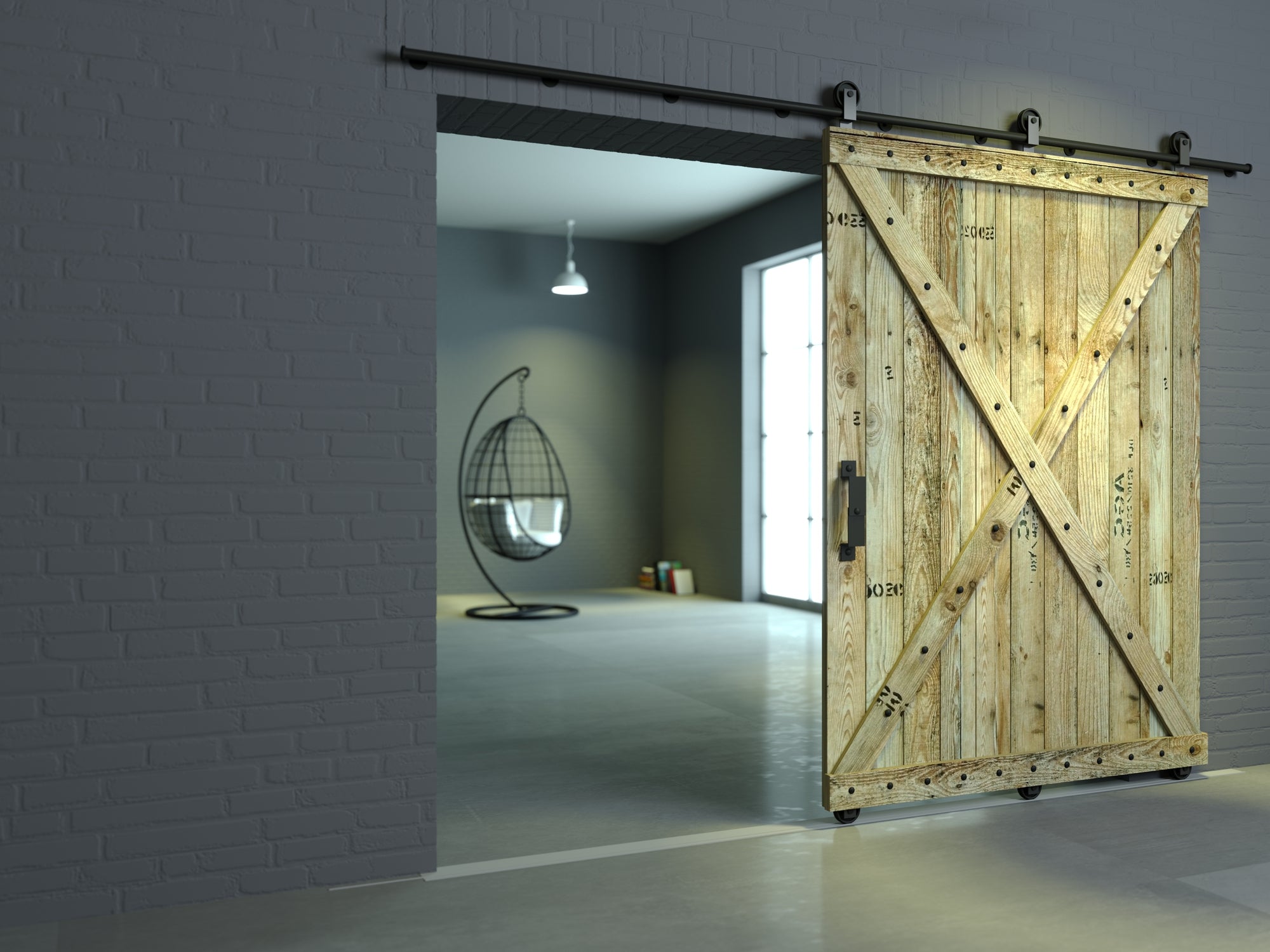
A barn door is a sliding door that runs along a track mounted on the wall above the opening, rather than swinging into the room on hinges. The door panel hangs from roller hangers that roll along the track, sliding parallel to the wall to open and close the opening. When open, the door sits beside the opening rather than inside a frame — it's always visible, just moved to the side.
The key difference from a standard door: a barn door doesn't need swing clearance. A hinged door requires a clear arc of floor space to open. A barn door requires clear wall space beside the opening for the panel to slide into. Which constraint you have determines whether a barn door is the right solution for your space.
The term "barn door" comes from the original application — large sliding wood panels on the exterior of agricultural barns. Modern interior barn door hardware applies the same sliding mechanism at residential scale, typically with finished steel hardware and wood, MDF, or glass door panels.
How barn door hardware works
A barn door hardware kit contains several components that work together:
- Track: A steel rail mounted horizontally above the opening. The track carries the full weight of the door through the rollers. It must be mounted into solid structure — a header board or wall blocking — not drywall alone.
- Hangers and rollers: The hardware that attaches to the door and rolls along the track. Hanger style (J-strap, straight strap, horseshoe, top mount, etc.) is the primary aesthetic and capacity variable. The roller wheels sit inside the track channel and bear the door's weight as it slides.
- Spacers: Small standoffs between the track and the wall that hold the track a consistent distance from the wall surface. Standard hardware holds the door approximately 3/8 in off the wall — this gap is a fixed characteristic of the design and is required for the door to slide freely.
- Track stops: Adjustable stops at each end of the track that prevent the door from sliding off the end. Positioned to determine where the door sits when fully open and fully closed.
- Floor guide: A bracket at floor level that constrains the bottom of the door and prevents it from swinging away from the wall. Required on every installation — without it, the door hangs from the top only and will swing.
- Soft close (optional): A mechanism that decelerates the door in the last few inches of travel, preventing it from impacting the track stop at full speed. Recommended for bedroom, bathroom, and shared-wall installations.
The door panel itself is not included in the hardware kit — it's sourced separately. Hardware kits are sized to support specific door weights and thicknesses. Choosing hardware requires knowing your door's weight. See our barn door weight guide for estimates by door material.
Barn door configurations
Barn doors come in several configurations depending on the opening size and wall clearance available:
| Configuration | How it works | Best for |
|---|---|---|
| Single sliding | One door slides to one side on a single track | Standard openings with clear wall beside |
| Biparting | Two doors on one track, meeting in the center when closed | Wide openings; symmetrical look from both sides |
| Single bypass | Two or more doors on one shared track, telescoping past each other | Wide openings with limited side wall clearance |
| Double bypass | Doors on two parallel tracks, fully stacking behind each other | Wide openings needing full clear access from both sides |
| Bifold | Panels fold accordion-style along the track | Limited side wall clearance; closets and pantries |
| Ceiling mount | Track mounts to ceiling instead of wall | No solid wall surface above the opening |
Configuration is almost always determined by wall clearance, not aesthetics. See our configuration guide for the full breakdown.
Pros and cons
Pros
- No swing clearance needed. The most practical advantage — no arc of floor space required when opening, which matters in tight hallways, small bathrooms, and pantries.
- Visible design element. The track and hangers are part of the aesthetic. Done well, the hardware is as much a design choice as the door panel itself — available in a wide range of styles and finishes.
- Configuration flexibility. Bypass, bifold, biparting, and triple bypass configurations scale from single doors to 12-panel setups covering very wide openings.
- Low maintenance. Quality hardware with sealed bearings runs dry — no lubrication required. A dry cloth on the track occasionally is genuinely all that's needed for most installations.
Cons
- Requires clear wall space beside the opening. The door has to slide somewhere — if there's no unobstructed wall beside the opening, a standard single sliding door won't work. Bypass, bifold, or pocket doors may be alternatives.
- Not as private or sound-isolating as a hinged door. The 3/8 in wall offset creates a perimeter air gap that can't be fully sealed. Pile weatherstrip at the edges and proper door sizing help — but won't match the performance of a solid hinged door in a sealed frame. See our barn door privacy guide.
- Not weather-sealed. Barn doors are interior sliding panels. They're not designed to seal against rain, wind, or temperature differentials for exterior use — though stainless hardware is rated for outdoor environments.
- Can drift if not latched. A barn door on a slightly unlevel floor or track will tend to drift. A felt strip on the track at the rest position addresses minor drift; a latch addresses it definitively.
For a deeper look at the tradeoffs, see our barn door pros and cons guide.
Maintenance
Quality barn door hardware requires very little maintenance. Modern Goldberg Brothers hardware uses sealed bearings that run dry — no lubrication required. Do not apply WD-40, oil, or any lubricant to the track or rollers. Oil attracts dust, builds up on the track, and creates more rolling resistance over time, not less.
The main maintenance task: wipe the track with a dry cloth periodically to remove dust. For anything more stubborn, a damp cloth followed by a dry wipe. That's genuinely most of it for the hardware.
For the door panel, maintenance depends on material — wood panels may need refinishing over time, glass panels need cleaning with a glass cleaner. See our hardware maintenance guide for the full breakdown.
Where to start
If you're considering a barn door, the first three questions to answer are:
- How much wall space is beside the opening? This determines whether a single sliding door works or whether you need a bypass, bifold, or different configuration.
- How heavy will the door be? This determines the hardware capacity you need. See our weight guide for estimates by door material.
- What are the height and width of the opening? This determines door and track sizing. See our sizing guide for the formulas.
From there, use our hardware finder to match your door to the right kit, or browse our full hardware collection.
Questions about whether a barn door works for your space?
Email us at info@thebarndoorhardwarestore.com with your opening dimensions and wall clearance on each side — we'll tell you which configuration fits and what hardware you need. Available 7 days a week.
