

By Evan Christensen, Owner of The Barn Door Hardware Store since 2016
Published January 2026 · Updated April 2026
Evan has helped thousands of homeowners and contractors choose the right barn door configuration since 2016. Every hardware recommendation in this guide comes from real installation experience. Questions about your specific project? Reach him at info@thebarndoorhardwarestore.com — he's available 7 days a week.
Most barn door inspiration content shows you beautiful photos and stops there. This guide goes further — for each of the eight ideas below, we've included which hardware configuration it requires, which finish works best, and the one practical consideration most people miss before ordering.
We've been selling barn door hardware since 2016, and the questions we get most often aren't 'which door looks good?' They're 'will this work in my space?' and 'what hardware do I actually need?' That's what this guide answers.
Jump to the idea that fits your space, or read the materials table and room guide at the end to narrow down your options before you browse.
1. Bold Color Doors
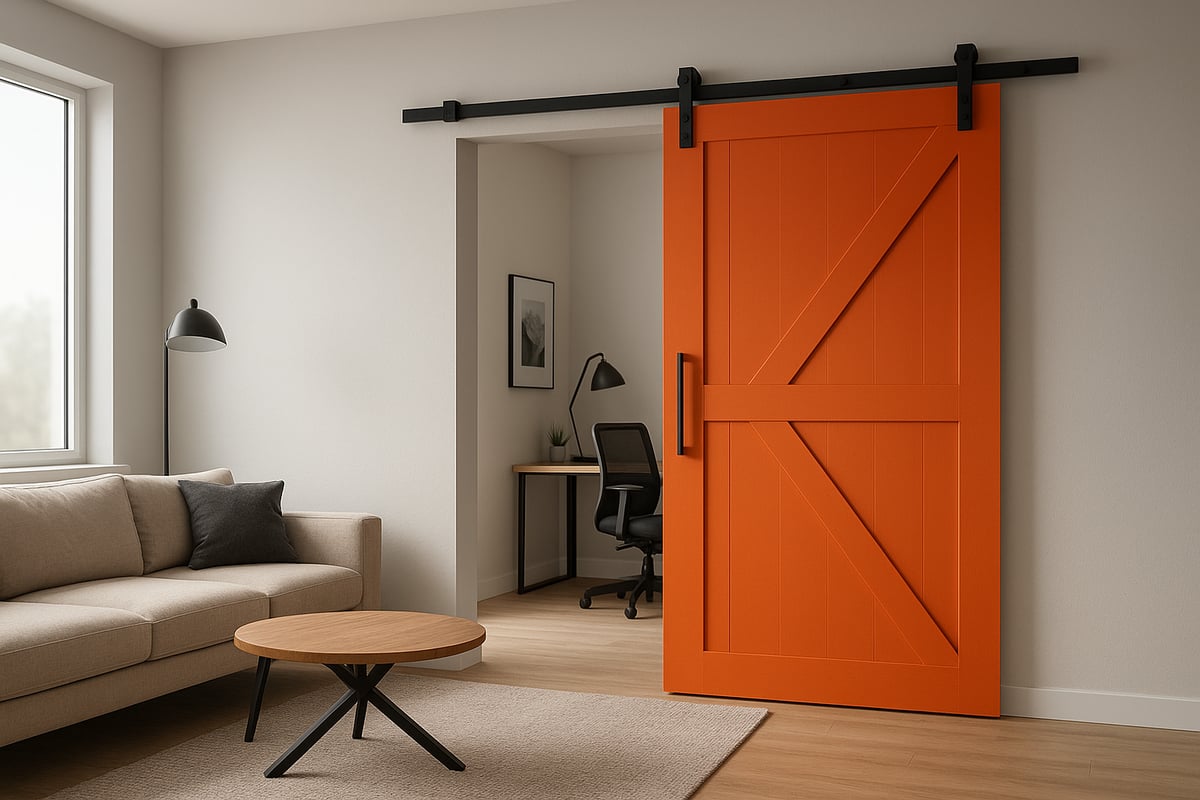
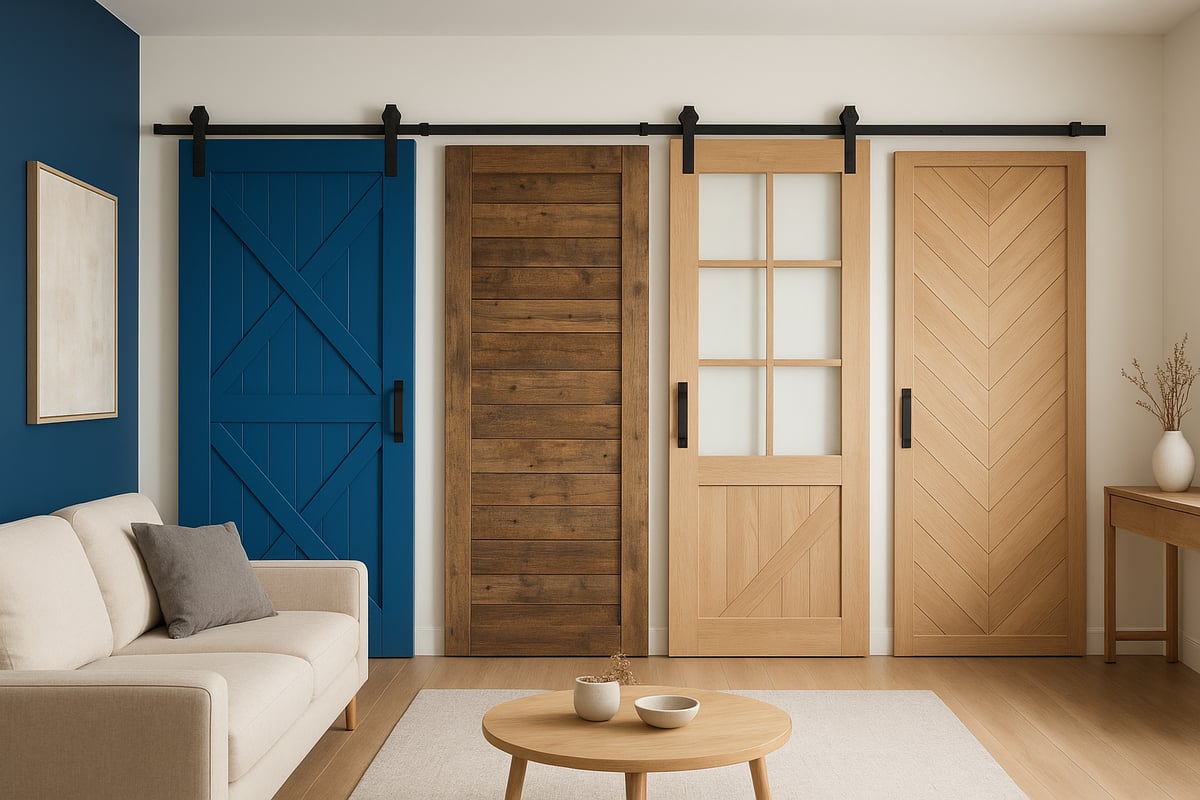
A painted barn door in a strong color — deep navy, forest green, charcoal, terracotta, dusty sage — is one of the fastest ways to add a focal point to a room without touching the walls or furniture. The door becomes the statement.
This works particularly well in rooms with neutral walls where the door is the first thing you see when you enter. A navy door against white shiplap, a deep green door against exposed brick, a charcoal door against warm plaster — the contrast does the visual work.
What makes it work: The door color needs to contrast with the wall, not blend into it. If your walls are already dark or colorful, a bold door competes rather than pops. Save bold door colors for rooms with neutral or white walls.
Hardware recommendation: Standard single-track kit. Keep hardware minimal — matte black is the most versatile finish and disappears against most door colors. Brushed nickel works if your room leans cool-toned. Avoid decorative spoked rollers here; the door color is the design element, not the hardware.
Practical note: Paint the door before installation, not after. Getting clean edges around mounted hardware is difficult. If you're using a pre-finished door, order in your color or factor in a paint day before the track goes up.

2. Reclaimed Wood
Reclaimed wood barn doors are the original version of this trend — and they still work because no two are identical. The grain patterns, nail holes, weathering marks, and color variation from decades of use give each door a character that new lumber simply can't replicate.
Reclaimed wood pairs naturally with industrial hardware — raw steel tracks, oil-rubbed bronze rollers, strap-style hangers. The contrast between weathered wood and clean metal hardware is part of the appeal.
What makes it work: Authenticity. Faux-distressed new wood usually reads as fake next to the real thing. If you're committing to this look, source genuine reclaimed material — local salvage yards, architectural antique dealers, or specialty barn wood suppliers. The imperfections are the point.
Hardware recommendation: Heavy-duty kit. Reclaimed wood is almost always heavier than new-construction lumber — a solid reclaimed plank door can easily hit 150–200 lbs depending on species and thickness. Weigh the door before ordering hardware. Standard kits are typically rated to 200 lbs; for anything heavier, use a heavy-duty kit rated to 400 lbs.
Practical note: Check moisture content before installation. Reclaimed wood that hasn't been properly dried or stored can warp after installation when it equilibrates to your home's humidity. If sourcing from outdoors or a barn, let the wood acclimate inside for at least two weeks before building the door.

3. Glass Panel Doors
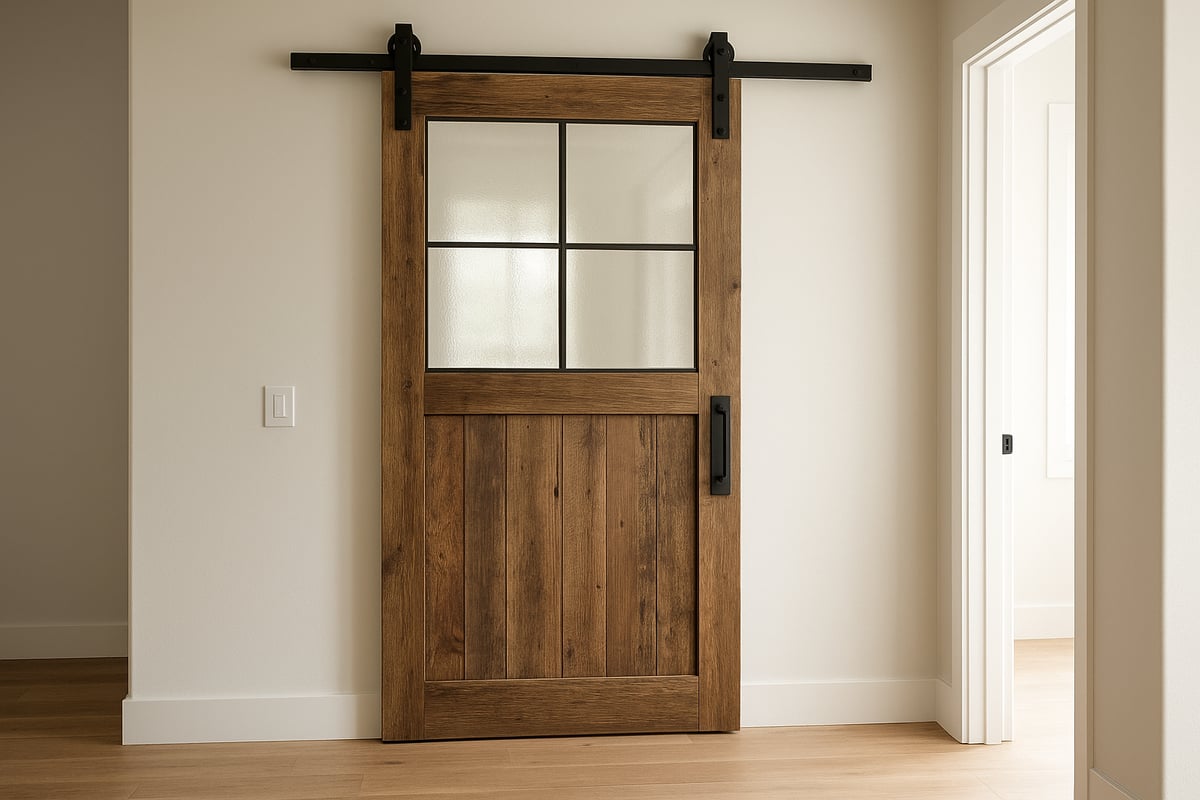
A glass panel barn door solves a specific problem: you need separation without losing light. Fully solid doors darken whatever is behind them. Glass panel doors — frosted, reeded, clear, or tinted — maintain the visual connection to natural light while still providing a physical barrier.
This is the most practical choice for pantries, home offices, and rooms adjacent to windows. A frosted glass panel on a pantry door lets you see if the light is on inside without opening it. A reeded glass panel on an office door lets light into a hallway without exposing the desk.
What makes it work: Match the glass opacity to the use case. Full clear glass offers no privacy — use it only where you want a completely open visual connection (a wine cellar, a display room). Frosted or reeded glass is the better default: it diffuses light and obscures detail without blocking it entirely.
Hardware recommendation: Heavy-duty kit in nearly all cases. Glass is heavier than most people expect — a full-lite glass door (all glass, minimal frame) can exceed 100 lbs for a standard 36" door. Even glass-insert doors with a wood frame are heavier than solid wood panels of the same size. Always verify the door's actual weight before selecting hardware. Tempered glass is non-negotiable for safety.
Practical note: The frame material matters as much as the glass. A wood-framed glass door expands and contracts with humidity; a steel-framed door doesn't. In bathrooms or steamy kitchens, a steel or aluminum frame will hold its shape better over time.

4. Chevron and Geometric Panel Designs
Chevron, herringbone, shiplap, grid, and board-and-batten patterns on barn doors add texture and movement without relying on color. These work especially well in rooms that are monochromatic or minimalist — the pattern brings visual interest while staying within a tight palette.
A chevron door in natural oak against white walls and black hardware is three neutral elements that create a sophisticated, layered look. A simple board-and-batten pattern in the same white as the walls adds dimension without adding color — useful when you want the door to blend in architecturally rather than stand out.
What makes it work: Scale matters. A chevron pattern on a narrow door (under 30") can look cramped. These patterns read best on wider doors — 36" and above — where the repeat has room to breathe. On smaller doors, stick to simpler patterns like vertical or horizontal planks.
Hardware recommendation: Standard or heavy-duty depending on material. Most patterned doors are built from dimensional lumber — 1x4 or 1x6 planks arranged into the pattern on a backer sheet. These are typically standard weight. If the pattern is built from hardwood (oak, walnut) rather than pine, weigh the finished door before selecting hardware. Finish: matte black is the near-universal recommendation here — it grounds the pattern without competing with it.
Practical note: Patterned doors are almost always custom-built rather than purchased off the shelf. If you're building one, use a solid backer panel (½" plywood) behind the pattern strips. Without a backer, individual strips can warp independently and the pattern will distort over time.

5. Double Biparting Doors
Two barn doors that slide in opposite directions to meet in the middle — double biparting — are the solution for wide openings where a single door would need a very long track and a lot of wall space on one side. They're also the most dramatic configuration visually: opening both doors simultaneously creates a grand, deliberate reveal.
Common applications include dining rooms opening to living rooms, master suite entrances, home theater entries, and wide closet openings. They work for any opening wider than about 48" where a single sliding door would feel unbalanced.
What makes it work: Symmetry. Double biparting doors look best when both panels are identical — same width, same finish, same hardware. Any asymmetry (one panel wider, one handle placed differently) is immediately noticeable because the eye is comparing the two panels side by side.
Hardware recommendation: Biparting hardware from Goldberg Brothers. We offer a pair linking kit that connects both doors so they open and close simultaneously — the cleanest solution for keeping both panels in sync. Email us at info@thebarndoorhardwarestore.com for details and pricing on the pair linking kit. This is only available for Goldberg Brothers products.
Practical note: Each door in a double biparting system needs wall space equal to its own width — a 36" door needs 36" of clear wall on its side. For a 72" opening with two 38" doors, you need 38" of unobstructed wall on each side of the opening. Measure for light switches, outlets, vents, and HVAC before ordering.
6. Space-Saving Configurations: Bypass and Bifold
Not every space has wall room for a standard sliding door. Two configurations solve this: bypass systems, where two doors slide on parallel tracks and overlap each other, and bifold systems, where panels fold accordion-style against the wall.
Bypass barn doors
Bypass doors are ideal when you have a wide opening but limited wall space on either side. Instead of one door traveling to one side, two doors each travel halfway — they overlap in the middle when closed and slide past each other when open. For single bypass, the trade-off is that the doors share one track and maintain a center overlap — you can access most but not all of the opening at once. Double bypass runs doors on separate parallel tracks and stacks fully, giving you access to the complete opening
Hardware: Single bypass kit or double bypass kit. Single bypass = two doors on a shared track width. Double bypass = two doors on separate parallel tracks. Double bypass gives independent control of each door.
Bifold barn doors
Bifold doors fold rather than slide, making them the best option for closets and openings where you want full-width access when open. A 4-panel bifold on a 72" closet opening folds completely to each side, giving you unobstructed access to the full width — something a standard sliding door can never achieve.
Hardware: Bifold kit sized to your panel count. The number of panels determines the track width and hinge configuration. 2-panel bifolds work for openings up to about 48"; 4-panel for up to 96"; 6- and 8-panel systems for very wide openings.
Practical note for both: Bypass doors are mechanically simpler — fewer moving parts, easier to maintain. Bifold systems have more hinges and pivots, which means more things to adjust over time. For high-traffic closets used daily, bypass is often the more durable long-term choice. Bifold wins where full-width access matters more than simplicity.
7. Statement Hardware: When the Track Is the Feature
Most barn door hardware is designed to be functional and clean — the door is the focus. But there's a category of hardware where the track system itself becomes a design element: exposed decorative tracks, spoked and wheel-style rollers, strap hangers with rivet detailing, and oversized handles that read as sculptural objects.
This approach works best with simpler door designs — a flat-panel door or a basic plank door where the surface doesn't compete with the hardware. If you put ornate spoked rollers on a chevron-patterned door, you get visual chaos. Let one element lead.
What makes it work: Consistency within the room's metal palette. If your kitchen has matte black cabinet pulls, matte black barn door hardware ties the room together. If your bathroom has brushed gold fixtures, brushed gold barn door hardware makes it feel intentional rather than mismatched. Hardware finish is where barn doors either harmonize with or fight against the rest of the room.
Finish guide:
- Matte black — works in almost any context; modern, industrial, farmhouse. Browse matte black hardware
- Brushed nickel / Silver metallic — clean and neutral; suits transitional and contemporary spaces. Browse silver metallic hardware
- Arch bronze — warm and traditional; pairs with wood tones and warm-toned rooms. Browse hardware kits in arch bronze
- Brushed gold / Jacob's gold — currently popular in contemporary and maximalist spaces; requires commitment to a warm metal palette throughout
- Raw steel — industrial; pairs with concrete, exposed brick, reclaimed wood. Browse industrial hardware
Practical note: Decorative hardware is still functional hardware. A beautiful spoked roller on a track that isn't level will bind and scratch. Install quality before aesthetics — get the mounting right, then enjoy the look.
8. Concealed Spaces and Multi-Function Doors
A barn door sized to cover an entire wall section — flush with adjacent panels or finished to match the wall — can make what's behind it functionally invisible. This is the barn door as architecture rather than as a door.
Common applications: a home office concealed behind a sliding panel that looks like a bookcase wall when closed. A laundry room hidden behind a floor-to-ceiling door that reads as a hallway wall. A Murphy bed behind a barn door panel that reveals a guest room on demand. The barn door is doing two jobs: providing access and maintaining the visual continuity of the room.
What makes it work: The door surface has to match or intentionally contrast with the surrounding wall — no gaps, no mismatched trim, no hardware that breaks the illusion. Flush-mounted handles instead of protruding knobs keep the surface reading as continuous. Soft-close hardware prevents the satisfying but illusion-breaking slam.
Hardware recommendation: Heavy-duty kit with soft-close and flush pulls. Concealed-space doors are typically larger and heavier than standard interior doors because they're covering a larger area. Soft-close is particularly important here — a slamming concealed door announces itself.
Practical note: This application requires precise installation. The door has to sit flush, travel smoothly, and land in the same position every time. Budget for professional installation unless you're an experienced DIYer — a door that's ¼" off level will reveal itself every time it drifts open.
Material Comparison: Which Door Works for Your Idea
The material determines the door's weight (which determines your hardware), its maintenance requirements, and how it responds to humidity. Use this table before finalizing any of the eight ideas above.
|
Material |
Best For |
Look |
Maintenance |
Weight |
|
Reclaimed wood |
Farmhouse, rustic, eclectic |
Warm, textured, unique grain |
Oil 1–2x/year; dust regularly |
Heavy — verify hardware rating |
|
New pine / poplar |
Budget-friendly, paintable builds |
Clean, customizable |
Paint or seal every few years |
Moderate — works with standard kits |
|
MDF / composite |
Painted looks; humid rooms |
Smooth, uniform |
Wipe clean; touch up paint |
Moderate — avoid water exposure |
|
Frosted glass panel |
Offices, bathrooms, pantries |
Light, airy, modern |
Glass cleaner; wipe frame |
Heavy — use heavy-duty hardware |
|
Steel / metal |
Industrial, commercial, modern |
Bold, minimal, durable |
Wipe down; check for rust outdoors |
Very heavy — commercial-grade hardware required |
|
Glass + wood frame |
Transitional, farmhouse-modern |
Warm + bright |
Clean glass; oil wood frame |
Moderate-heavy |
Weight is the most important spec: It determines your hardware. Weigh your door before ordering — or ask your supplier for the weight spec. Hardware rated for 200 lbs on a 220 lb door will wear out prematurely and eventually fail.
Hardware Reference: What Each Idea Actually Needs
This table maps each idea to the hardware configuration and finish that works best — and flags the one thing most people overlook for each.
|
Idea / Style |
Recommended Hardware |
Finish |
Key Consideration |
|
Bold color doors |
Matte black or brushed nickel |
Let the door color be the star — keep hardware clean and minimal |
|
|
Reclaimed wood |
Heavy-duty kit (200–400 lb rated) |
Raw steel or oil-rubbed bronze |
Reclaimed wood is often heavier than it looks — weigh first |
|
Glass panel doors |
Brushed nickel or matte black |
Tempered glass only; check weight rating carefully |
|
|
Chevron / geometric |
Standard or heavy-duty depending on material |
Matte black |
Pattern draws the eye — simple hardware prevents visual overload |
|
Double biparting doors |
Goldberg Brothers biparting hardware + pair linking kit (email for details) |
Matched pair in any finish |
Doors must open symmetrically — sync hardware prevents uneven travel |
|
Bypass (space-saving) |
Bypass kit (single or double) |
Any finish |
Doors overlap slightly when both closed — plan overlap into sizing |
|
Bifold |
Bifold kit sized to panel count |
Any finish |
Panel width × number of panels must equal opening width + overlap |
|
Hidden room / concealed |
Heavy-duty kit; soft-close recommended |
Matte black or finish-matched to wall |
Soft-close prevents slamming that reveals hidden spaces |
Room-by-Room Guide: Which Idea Fits Where
The right barn door idea depends as much on the room's function as its aesthetics. Here's a quick reference organized by room.
|
Room |
Best Idea |
Hardware Type |
Practical Note |
|
Bathroom |
Glass panel or solid with privacy sweep |
Add privacy lock; use EPDM weatherstripping for humidity |
|
|
Bedroom |
Bold color or reclaimed wood statement door |
Standard with soft-close |
Soft-close eliminates sleep-disrupting slam; add brush sweep for light gaps |
|
Pantry / kitchen |
Glass panel (frosted) or bold color |
Standard single-track |
Frosted glass hides clutter while letting light through |
|
Home office |
Solid wood or composite for sound reduction |
Solid-core doors reduce noise significantly vs hollow-core |
|
|
Closet / wardrobe |
Bypass or bifold |
Bypass or bifold kit |
Bypass = no folding mechanism to maintain; bifold = full opening access |
|
Laundry room |
Space-saving bypass |
Measure carefully — laundry rooms often have tight side clearances |
|
|
Open-plan divider |
Double biparting or double bypass |
Wide openings need sync hardware and a solid header board across the full span |
|
|
Mudroom / entry |
Durable finish — bold color or metal |
High-traffic entry needs hardware rated for frequent daily use |
Budget Guide: What to Expect at Each Price Point
Hardware cost varies by brand, configuration, and finish. Goldberg Brothers hardware — made to order in the USA — is priced higher than the house value line, which ships in 2–3 business days. For current pricing across all configurations, browse our hardware kits collection or use our hardware finder.
Frequently Asked Questions
What is the most popular barn door style right now?
Based on what we're seeing across orders and the install photos customers send us, the most consistently popular combination in 2026 is a simple flat-panel or V-groove plank door in a dark finish (matte black painted or dark stain) with matte black hardware. It works across modern farmhouse, contemporary, and transitional interiors without feeling dated. Bold color doors are gaining ground — especially deep navy and forest green — but the dark-neutral-with-black-hardware combination remains the broadest baseline. Browse our full hardware kit collection to see finish options.
Can a barn door be used as a room divider?
Yes, and this is one of the most practical applications. A barn door used as a room divider needs to be sized to the full opening width you're dividing, not a doorway. For wide open-plan spaces, double biparting doors are the most effective — they can span openings up to 10–12 feet and beyond with the right hardware system. Bypass doors work for narrower divisions where you don't need to fully clear the opening at once.
What's the difference between bypass and bifold barn doors?
Bypass doors slide on parallel tracks and pass each other when opened — you can only open one side at a time, but you need minimal wall clearance beside the opening. Bifold doors fold accordion-style on hinges — they give you full-width access to the opening when folded. Bypass is better for closets and pantries where you access one section at a time. Bifold is better where you need to see or access the full opening width simultaneously. Read more in our bypass vs bifold guide.
How do I choose between a standard and heavy-duty hardware kit?
Weigh your door. Standard kits are rated from 75 lbs (straight top mount) up to 250 lbs (horseshoe hanger) depending on hanger style. Heavy-duty kits handle 200–400 lbs, and commercial-grade systems go higher. Solid wood doors, glass panel doors, reclaimed wood doors, and any door over about 36" wide in solid material should be weighed before hardware selection. Getting the weight rating right upfront is cheaper than replacing hardware after a year.
Do barn doors work in bathrooms?
Yes, with the right additions. The challenge is the gap — barn doors slide in front of the wall rather than sealing into a frame. For bathrooms, close the side gaps with brush privacy sweeps or rubber weatherstripping, seal the bottom with a brush sweep, and add a privacy lock or latch. With those additions, a barn door functions practically in a bathroom. Read our complete barn door privacy guide and soundproofing guide for full details.
Where to Start
Pick the idea that fits your room's function first, then look at aesthetics. A beautiful door that doesn't solve your space's actual constraints — not enough wall clearance, wrong weight hardware, no privacy seal in the bathroom — will frustrate you every day regardless of how good it looks.
The tables in this guide are designed to make that decision concrete before you browse. Once you know your configuration, your door's material and approximate weight, and your finish preference, ordering hardware is straightforward. Use our hardware finder to get a specific recommendation for your project, or contact us directly — we've been doing this since 2016 and our team is available 7 days a week.
