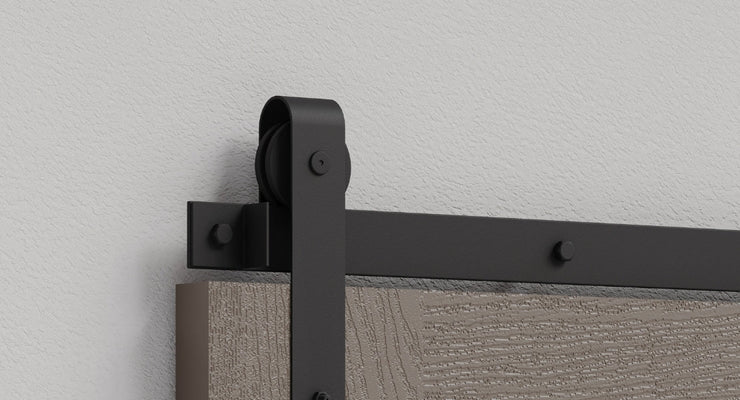
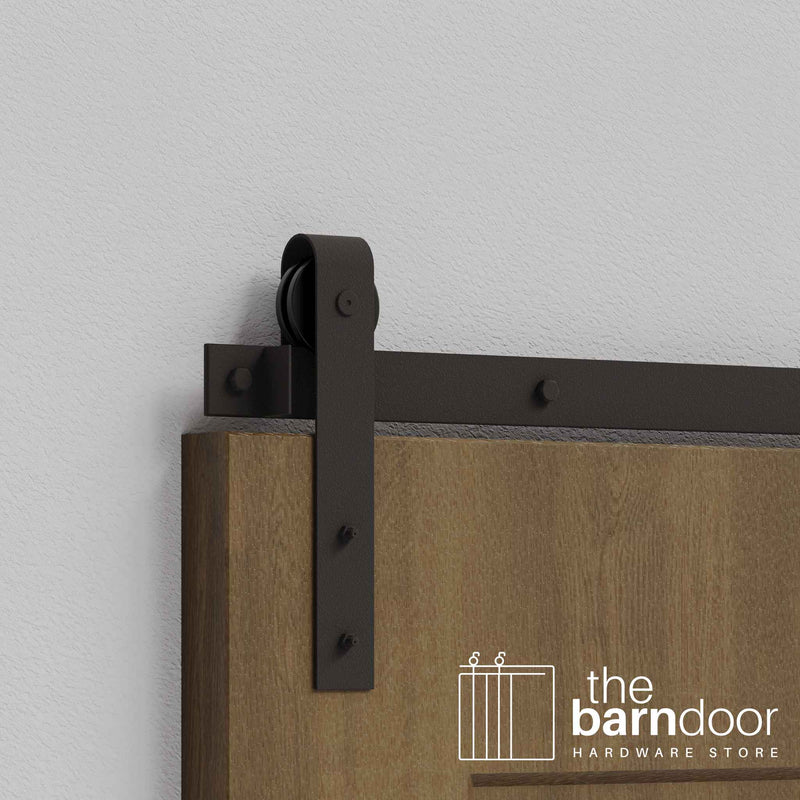
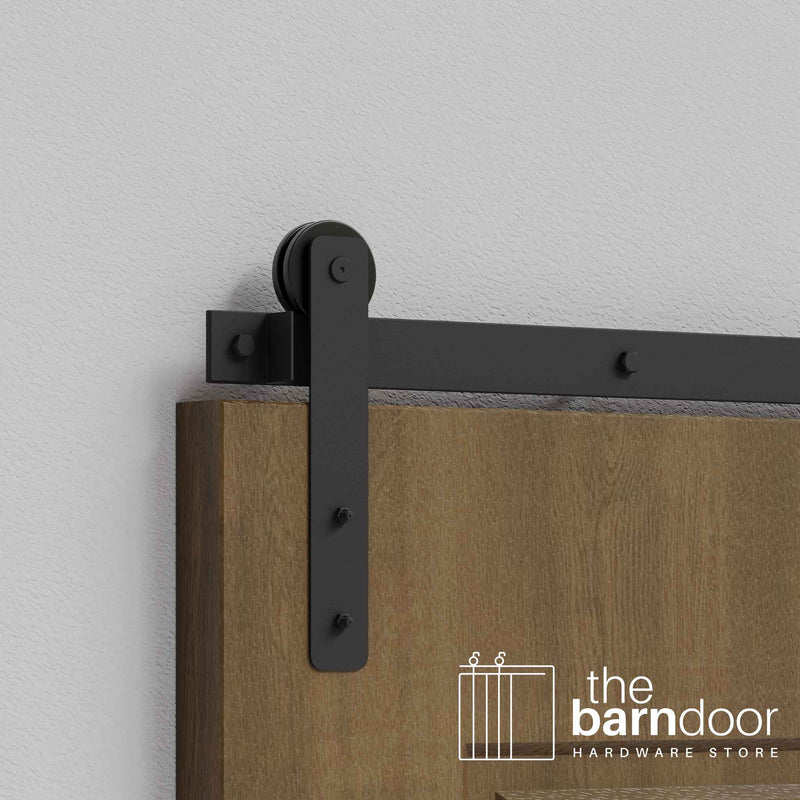
The door itself should also be wider than the rough opening — we recommend the door overlap the opening by 2" on each side (4" total) for proper coverage and privacy. So a 32" rough opening typically uses a 36" door on a 72" track.
| Rough opening |
Recommended door width |
Minimum track length |
| 24" |
28" |
56" |
| 30" |
34" |
68" |
| 32" |
36" |
72" |
| 36" |
40" |
80" |
| 42" |
46" |
92" |
| 48" |
52" |
104" |
| 60" (double door, 2× 32" panels) |
2× 36" |
144" |
For openings wider than a single stocked track can span, or installations that need to route around a light switch, return wall, or other obstacle, the track will ship in multiple pieces with junction plates included. Any track longer than 7'6" (90") is shipped in two or more sections with the junction plates needed to connect them — you don't need to order the plates separately. Track lengths we don't stock as standard are available as custom quotes, priced the same as the next longest standard length. Email us the measurement.
Worked example
Customer has a 36" wide opening into a pantry. They want privacy coverage and full access when the door is open.
- Door width: 40" (overlaps opening by 2" on each side)
- Track length: 80" minimum (2 × 40")
- Wall space required to the side of the opening: at least 40" of clear wall for the door to slide onto
- Header check: solid 2x blocking or a structural header behind the drywall to mount the track
If there isn't 40" of clear wall on one side, the door won't fully open — which is when people start asking us about bifold or ceiling-mount alternatives.
What's in a standard sliding hardware kit
Every kit on this page includes:
- Track (in the length you select — tracks longer than 7'6" ship in multiple sections with junction plates included)
- Two hangers/rollers that attach to the top of the door
- End stoppers for both ends of the track
- Anti-jump disks to keep the door from hopping off the rollers if it gets slammed
- A floor-mounted floor guide
- Mounting hardware for the track
What's not included — and what most people need to add
The floor guide that ships in the kit mounts into the floor. If you have finished hardwood, tile, LVP, polished concrete, or any flooring you don't want to drill into, you need a wall-mounted floor guide instead. It's not in the kit. This is the single most common accessory gap we see after an order ships — a customer installs the track, hangs the door, and then realizes the included guide isn't going to work for their floor.
Other common add-ons, sold as product-level options on the kit pages themselves:
-
Soft close — worth it for bedrooms, bathrooms, shared walls, and any household with kids. Less critical for pantries, laundry rooms, or lightweight hollow-core doors.
-
Trim clearance kit — used when the track needs to stand off the wall further than the standard brackets allow, typically for doors with tall trim or baseboard in the way.
Choosing the right kit for your door
Hardware capacity matters more than people expect, and it's the thing we get the most pre-purchase questions about. A 1-3/8" hollow-core slab and a 1-3/4" solid oak door with a steel frame are two completely different jobs for the rollers.
By door type
| Door type |
Approx. weight |
What we recommend |
| Hollow-core slab (1-3/8") |
25–40 lb |
House value line is fine |
| Solid-core slab (1-3/8") |
50–80 lb |
House value or Goldberg Brothers |
| Solid wood plank (1-3/4") |
80–150 lb |
Goldberg Brothers |
| Reclaimed barnwood |
100–200+ lb |
Goldberg Brothers, check capacity on the specific kit |
| Steel frame / metal clad |
150–300+ lb |
Goldberg Brothers, confirm with us before ordering |
| Glass (tempered) |
Varies widely |
Email us — glass needs specific hardware |
Why we carry Goldberg Brothers
We carry several brands, and we'll always tell you honestly which one fits your project. But for heavier doors, Goldberg Brothers is what we reach for first, and here's why: fewer warranty claims and callbacks than other brands at their price point, tighter steel tolerances (which matters most when you're hanging 150+ pounds), genuinely good customer service on the rare occasions we've had to use it, and higher weight capacity across most of their kits.
For lighter builds where the budget matters more than heavy-duty capacity, our house value line is straightforward, works as advertised, and we'll say so — we're not going to upsell a Goldberg kit for a 30-pound closet door.
Finish options
Most of our kits are available in the following finishes. Availability varies by brand and kit — check the individual product page.
-
Matte black — by far the most popular, works with almost any door style, hides fingerprints
-
Arch bronze — warm, slightly darker tone with depth, pairs well with reclaimed wood, craftsman, and traditional interiors
-
Brushed nickel / silver metallic — cooler tone, common in contemporary builds alongside stainless fixtures. Silver metallic is our alternate name for the same look on certain product lines — if you're matching brushed nickel fixtures elsewhere in the room, either finish will get you there
-
Jacob's gold — warm gold tone, softer and less yellow than a polished brass, works well in modern builds that want a metallic accent without going full brass
-
Raw steel — uncoated, develops a natural patina over time, popular for industrial looks
A note on matching: if you're trying to match existing door handles, pulls, or light fixtures in the room, order a sample or email us a photo before committing. "Matte black" from one manufacturer isn't always the same shade as matte black from another, and the same goes for bronzes and golds across different product lines.
Before you install — the things that trip people up
We've walked enough customers through post-purchase problems to know exactly where installations go sideways. If you read one section on this page, make it this one.
The five most common mistakes
-
Track too short. Already covered, but worth repeating: 2× door width, minimum. If you're unsure, measure twice and email us.
-
No solid backing for the track. The track has to be screwed into studs, a structural header, or 2x backing installed behind the drywall. Drywall anchors alone will not hold a sliding door — the door will eventually pull the track off the wall.
-
Forgetting wall clearance on the slide side. The door needs somewhere to go when it's open. Measure your clear wall space from the edge of the opening outward. It should be at least the width of the door. Light switches, outlets, and return walls all count as obstructions.
-
Wrong floor guide for the floor. Kits includes a floor-mount guide; finished floors usually need a wall-mounted guide instead.
-
Ordering before confirming door dimensions. People sometimes order hardware based on the rough opening, not the actual door. Track length is based on the door, not the opening.
Header and mounting surface
Every standard sliding kit mounts to the wall above the opening. You need either a structural header, a doubled-up 2x6 or 2x8 behind the drywall, or a mounting board that spans studs. If your wall doesn't have suitable backing, the fix is usually a stained or painted mounting board installed across the studs above the opening — it also gives you a clean, intentional look and a forgiving surface for track placement. We recommend a 1x6 hardwood minimum for the mounting board — anything thinner or softer (pine 1x4, MDF, plywood) can flex under the weight of a heavy door and let the track pull forward over time. Hardwood 1x6 gives you enough material to bite lag screws into and enough height to cover the fastener line cleanly behind the track.
If there's no header and no way to add a mounting board, ceiling-mount hardware is the alternative. That's a different collection — email us and we'll point you in the right direction.