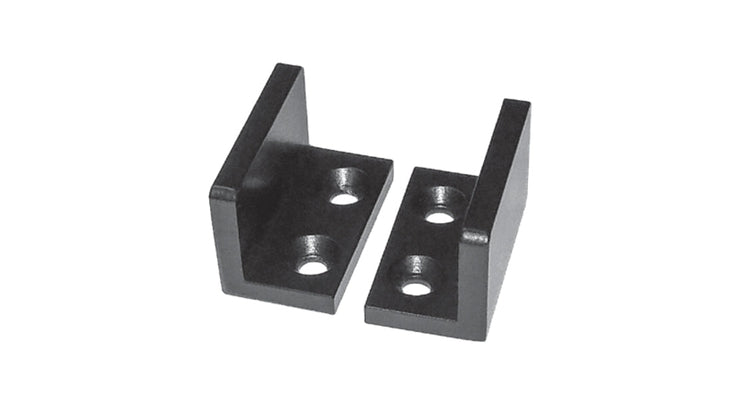
Floor guide types
Three types, each solving a different problem. The right one depends on your flooring, how far the door travels, and how much modification you're willing to make.
| Type |
How it mounts |
Best for |
Key requirement |
| Floor-mounted guide |
Screws directly into the floor below the door |
Concrete, subfloor, unfinished floors, or wood floors where the customer is comfortable screwing into the surface |
Must be willing to put screws in the floor — not removable without leaving holes |
| Wall-mounted guide |
Mounts to the baseboard, wall, or any vertical surface beside the door |
Finished hardwood, tile, LVP, or any flooring you don't want to drill into |
Needs a baseboard or wall surface within reach of the door's bottom edge |
| Continuous floor guide |
Aluminum channel embedded into a routed slot in the floor |
Doors that travel long distances where a static floor guide would disengage — the channel keeps the door controlled across the full length of travel |
Requires routing a channel into the floor — significant floor modification. Note: the channel remains visible at floor level after installation |
Which floor guide do you need?
The decision comes down to two things: your flooring and how far your door travels.
If your floor is concrete, subfloor, unfinished, or wood you're comfortable drilling into
The floor-mounted guide that came with your kit is almost certainly fine. This type works on concrete, subfloor, and wood floors — as long as you're comfortable with screws going into the surface. If you need a replacement or an additional one, the standard floor-mounted guide is the right call.
If your floor is finished hardwood, tile, LVP, or any surface you don't want to drill into
You need a wall-mounted guide. It mounts to the baseboard, wall, or any vertical surface next to the door opening — no floor penetration required. It does exactly the same job as a floor-mounted guide and leaves your flooring untouched. This is the most common reason customers come to this page after their kit arrives.
If your door travels a long distance and disengages from the guide
The continuous floor guide solves a specific problem: doors that travel long distances — longer bypasses or wide openings — where a standard static guide can disengage as the door slides past it. The channel runs the length of travel and keeps the door controlled throughout. It does require routing a permanent channel into the floor, and that channel will remain visible after installation. If floor modification isn't an option, multiple standard floor guides positioned along the travel path is an alternative — though the transition from the open floor onto the guide can be tricky to get right. Email us if you're working with a long-travel door and aren't sure which approach fits your situation.