
By Evan Christensen · Owner, The Barn Door Hardware Store
Published October 26, 2025 · Updated May 2026
Evan has owned and operated The Barn Door Hardware Store since 2016. The track is the piece of a barn door installation that customers get wrong most often — specifically the length. Getting the track sizing right before ordering is the single most impactful thing you can do to ensure a successful installation. He and the team are available 7 days a week at info@thebarndoorhardwarestore.com.
How the sliding door track works
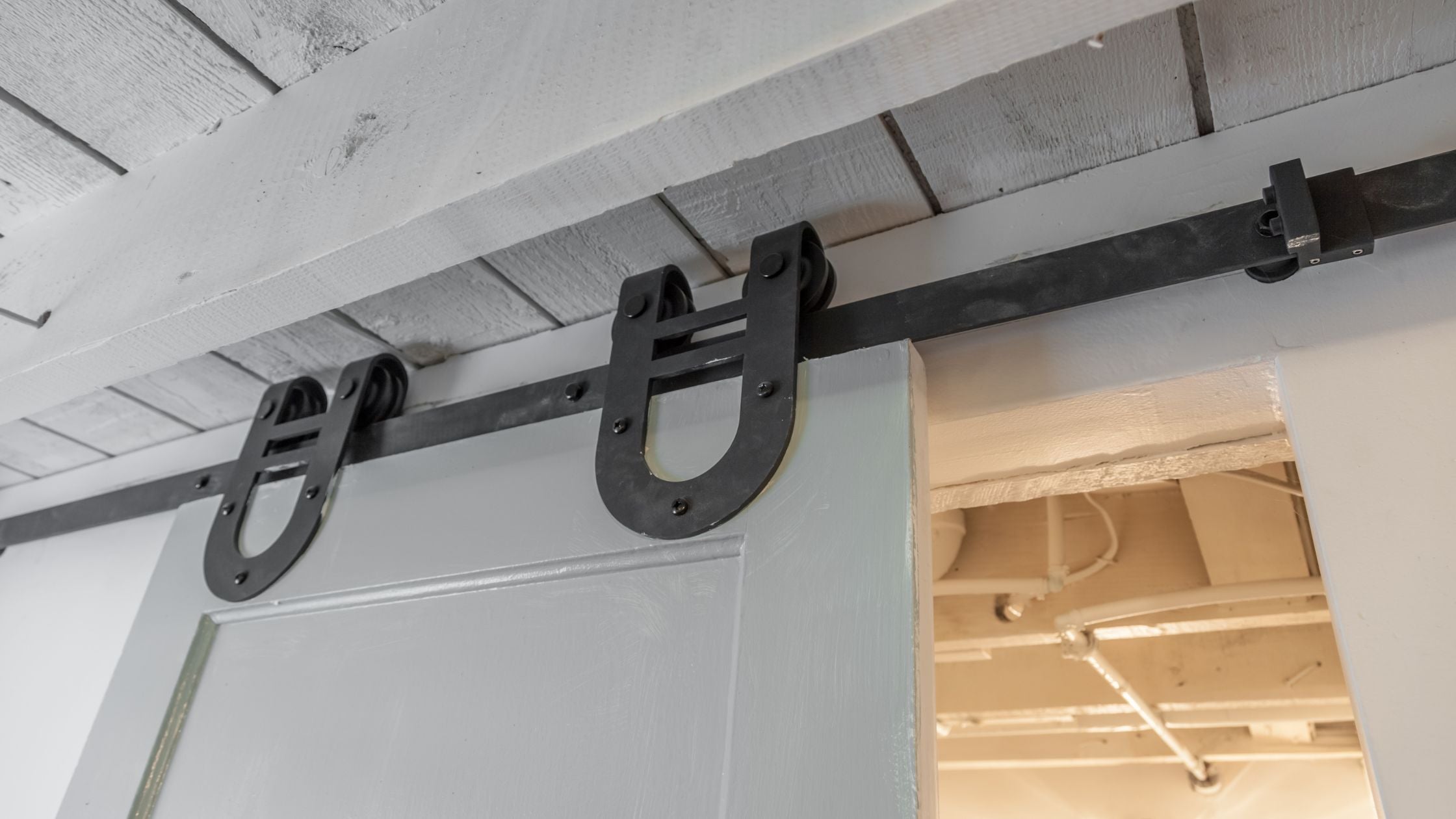
The track is a steel rail that mounts horizontally above the opening. Door rollers run inside a channel in the track face, carrying the full weight of the door panel as it slides. The track doesn't just guide the door — it supports it entirely from above. Everything else in a sliding door system (rollers, hangers, spacers, stops) depends on the track being level, properly mounted, and long enough for the door to fully clear the opening.
Track dimensions vary by hardware tier:
| Hardware lineup | Track width | Track thickness |
|---|---|---|
| House value line | 1-1/2 in | 1/4 in |
| Standard duty Goldberg Brothers | 1-1/2 in | 3/16 in |
| Heavy duty Goldberg Brothers | 2 in | 3/16 in |
| Stainless steel Goldberg Brothers | 2 in | 3/16 in |
A wider track is stiffer in bending — the increased cross-section resists deflection under load more effectively than a narrower track. This structural stiffness is one of the reasons heavier door weights are achievable in the heavy duty and stainless tiers.
Track length — the most common ordering mistake
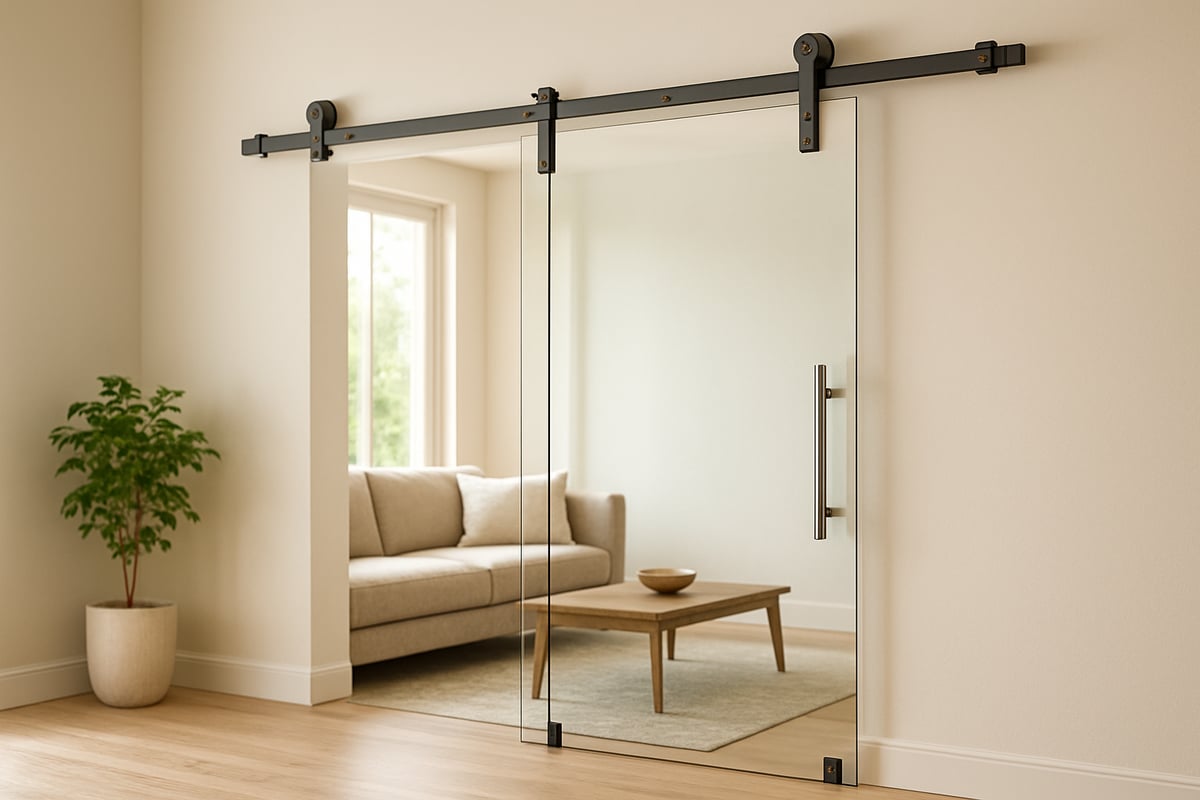
For a single sliding door, track length must be at least 2× the door width. Not 2× the opening width. Not the opening width plus a few inches. The door needs to travel its full width to clear the opening, and the track needs to accommodate the door in both the fully open and fully closed positions simultaneously.
Door width is determined first: opening width + 4 in minimum (2 in overlap per side). For bedroom and bathroom openings, opening + 6 in (3 in per side). Then double that door width for minimum track length.
Worked examples:
- 32 in opening → 36 in door (standard) → 72 in track minimum
- 36 in opening → 40 in door (standard) → 80 in track minimum
- 36 in opening → 42 in door (bedroom) → 84 in track minimum
- 48 in opening → 52 in door (standard) → 104 in track minimum
For bypass and bifold configurations, track length formulas are different — see our full sizing guide.
Extending the track with junction plates
Any track length can be achieved by joining two sections end-to-end with a junction plate. The plate bridges the joint between the two sections, keeping them aligned so rollers cross smoothly from one section to the next.
For kits that require a track over 7'6", the kit ships as multiple sections with junction plates already included — you don't need to source them separately. For custom lengths beyond what's listed on any product page, email us at info@thebarndoorhardwarestore.com before ordering and we'll configure the right combination of sections.
One important installation note: the header board must span continuously across both track sections. A header board that stops at the joint will not provide adequate support for the full track run. See our junction plate guide for full installation detail.

Mounting the track
Header board
The track must mount into solid structure — not drywall alone. In most installations this means a 1×6 hardwood header board (oak, maple, or poplar — not pine, which is too soft for sustained lag bolt load) spanning the full track length and secured into the wall studs behind it. The header board needs to extend to the next stud beyond each end of the track.
If blocking was installed inside the wall during construction, the track can mount directly into it without a separate header board. If you're not sure whether blocking exists, a stud finder and a few test holes will tell you quickly. See our header board guide for full detail.
Spacers
Every sliding door track mounts with spacers — small standoffs that hold the track a consistent distance from the wall. These are not optional. They create the clearance the door needs to slide freely without the hanger hardware catching on the wall surface. Standard hardware holds the door approximately 3/8 in from the wall; this gap exists by design and is required for the door to operate.
Level is everything
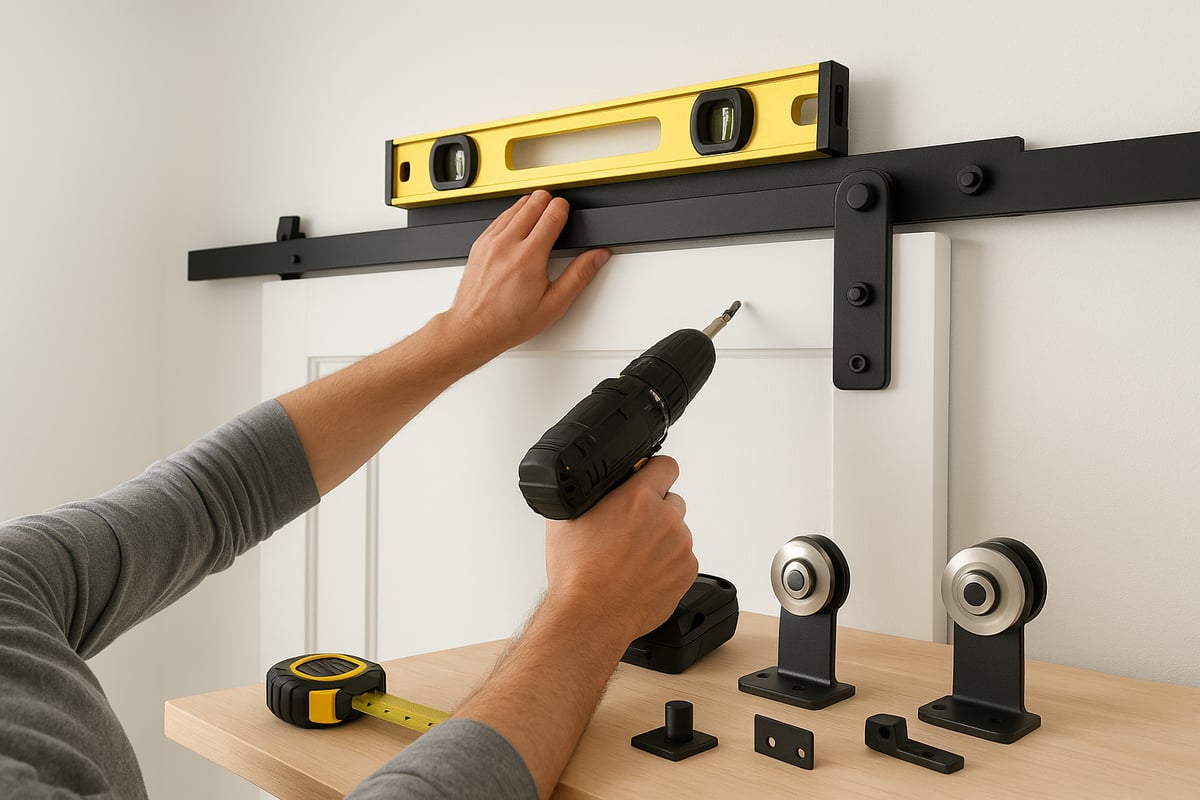
The track must be perfectly level. Even a fraction of a degree of grade causes the door to drift toward the low end — a door that slides open or closed on its own is almost always a leveling issue, not a hardware defect. Check level across the full track length before tightening any lag bolts, then recheck after tightening. See our door drifting guide if this becomes a problem after installation.
Ceiling clearance
The track and hangers require clearance above the rough opening. For Goldberg Brothers standard duty hardware: 4 in (straight strap, horseshoe) to 4-1/2 in (J-strap). For heavy duty hardware: 5-1/2 in for most styles, 9 in for wagon wheel styles. For stainless steel: 5-1/2 in for all styles. Measure before selecting a hanger style — if ceiling clearance is tight, straight strap requires the least at 4 in.

Track maintenance
Sliding door track requires minimal maintenance. The track itself is steel — it doesn't wear, stretch, or degrade under normal use. The main maintenance task is keeping the track channel clear of dust and debris, which can slow roller movement over time. Wipe with a dry cloth periodically; for anything more stubborn, a damp cloth followed by a dry wipe.
Do not lubricate the track. Goldberg Brothers hardware uses sealed bearings designed to run dry. Applying lubricant — silicone spray, WD-40, oil — attracts debris, builds up in the channel, and increases rolling resistance rather than reducing it. A clean, dry track is the correct operating condition for all hardware we carry.
For a full maintenance guide including roller and hardware checks, see our hardware maintenance guide.
Choosing the right track configuration
Track configuration is determined by wall clearance — the space available beside the opening for the door to slide into:
- Full wall clearance beside the opening: Single sliding track — one door, one track, the simplest setup. Browse our single track hardware.
- Limited wall clearance, wide opening: Single bypass (telescoping, one track) or double bypass (two parallel tracks, independent doors). Browse single bypass or double bypass.
- Minimal wall clearance on both sides: Bifold — panels fold compactly beside the opening. Browse bifold hardware.
- No solid wall above the opening: Ceiling mount — track mounts to ceiling joists instead. Browse ceiling mount hardware.
For a full configuration comparison with worked examples, see our configuration guide.
Not sure about track length or configuration for your opening?
Email us at info@thebarndoorhardwarestore.com with your opening width, door width if known, available wall clearance on each side, and ceiling clearance above the opening — we'll confirm the right track length and configuration before anything ships. Browse our full hardware collection or use our hardware finder. Available 7 days a week.
