
Solid pine barn door panels — finished or unfinished, standard sizes, hardware sold separately. For most projects you'll get a better door for less by sourcing one locally and skipping freight, and we'll say so when that's the smarter move. See our DIY vs. custom guide to compare.
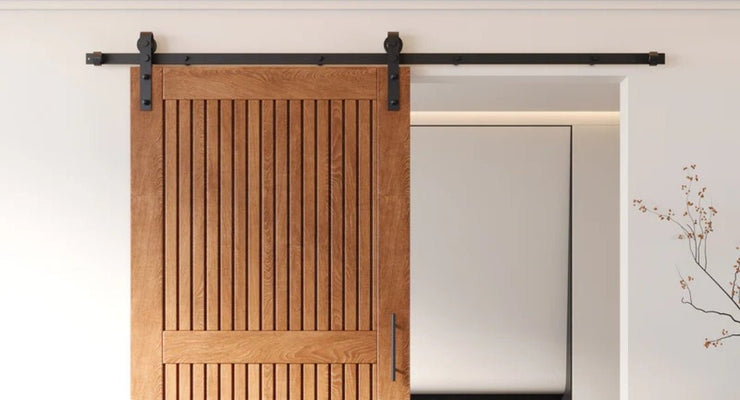


Traditional sliding panels vs. bifold panels
We carry two types of door panels — traditional sliding panels and bifold panels. The right one depends entirely on which hardware configuration you're using.
| Traditional sliding panel | Bifold panel | |
|---|---|---|
| Used with | Single track, bypass, biparting, hidden roller, ceiling mount hardware | Bifold hardware kits only |
| How it operates | Slides parallel to the wall along a track | Folds accordion-style on a pivot system |
| Wall clearance | Needs full door width of clear wall beside the opening | Minimal — panels fold compactly beside the opening |
| Door sizing | Opening + 4 in (standard) or + 6 in (bedroom/bathroom) | Bifold-specific formula — see sizing guide below |
If you're not certain which type you need, see our configuration guide for a full breakdown of how each operates and when to use each.
Sizing your door panel
The door must be wider than the rough opening — not equal to it. The door needs to overlap the wall on each side to cover the opening fully and provide privacy at the edges.
| Room type | Overlap per side | Door width formula |
|---|---|---|
| Standard rooms — hallway, pantry, living space | 2 in per side | Opening width + 4 in |
| Bedrooms and bathrooms | 3 in per side | Opening width + 6 in |
Door height should be opening height + 1 in, maintaining 1/2 to 1 in of floor clearance at the bottom for the door to slide freely.
We offer standard sizing only. If your project requires a non-standard door size, you'll need to source that locally or through a millwork supplier — we can't produce custom dimensions. For guidance on sourcing a custom door panel, see our DIY vs. custom guide.
For the full pre-order measurement checklist — including track length, wall clearance, and ceiling clearance — see our barn door measuring guide.
Finished vs. unfinished
Unfinished panels ship raw — you apply paint or stain before hanging. This gives you full control over the final color and sheen, and it's the right choice if you want to match an existing interior exactly. Lead time is shorter than finished panels.
Finished panels ship pre-stained in one of our available stain colors. If one of the available finishes matches what you need and you want to skip the finishing step, a finished panel ships ready to hang.
One practical note: if you're finishing a panel yourself, apply paint or stain before assembly — it's significantly easier to finish flat components than an assembled door. See our barn door kit guide for more on the finishing process.
Hardware — sold separately
Every door panel on this page requires separately purchased hardware. Hardware is not included. When selecting hardware, the two things that determine which kit you need are door weight and available wall clearance beside the opening.
- Door weight: Solid pine panels in standard sizes typically run 80–120 lbs. Hardware capacity must meet or exceed door weight — no safety factor multiplier needed.
- Wall clearance: A standard single sliding door needs clear wall space equal to the full door width on the slide side. If wall clearance is limited on both sides, bypass or bifold configurations solve it.
Browse our hardware kits collection or use our hardware finder to match your door to the right kit. For a full breakdown of what's in a kit and how to choose, see our sliding door hardware guide.
An alternative worth considering: barn door edge wrap
Before purchasing a pre-built pine panel here, consider whether a barn door edge wrap applied to a locally sourced door panel might be a better fit for your project. Wrapping a locally sourced panel — a standard hollow core or solid core door from a home center — typically costs less overall than buying and shipping a pre-built barn door panel, and the locally sourced door will already be acclimated to your home's humidity.
Edge wraps from Goldberg Brothers are available in all 16 powder coat colors for doors 3/4 in to 2-1/4 in thick. Browse our accessories collection for edge wrap options.
Questions about sizing or which panel is right for your project? Email us at info@thebarndoorhardwarestore.com with your opening dimensions — we'll confirm the right door size and help you find the matching hardware. Available 7 days a week.
